Summer Truffle
The summer truffle (Tuber aestivum) is the accessible truffle: the one that grows across most of Europe, costs a fraction of the famous Italian white, and can genuinely be cultivated in a garden or small orchard by anyone willing to wait a decade.
🗓️ Last reviewed: August 2026
Overview
The summer truffle (Tuber aestivum) is the accessible truffle: the one that grows across most of Europe, costs a fraction of the famous Italian white, and can genuinely be cultivated in a garden or small orchard by anyone willing to wait a decade. It is a black-skinned, marbled underground fungus with a mild hazelnut aroma, harvested from summer into autumn, and it is the species behind most affordable truffle products in Europe. Its close relative the Burgundy truffle, harvested later in the year with a stronger aroma, is now generally treated as the same species fruiting under different conditions. Anyone curious about growing truffles should start here rather than with the celebrity species.
Identification & Appearance
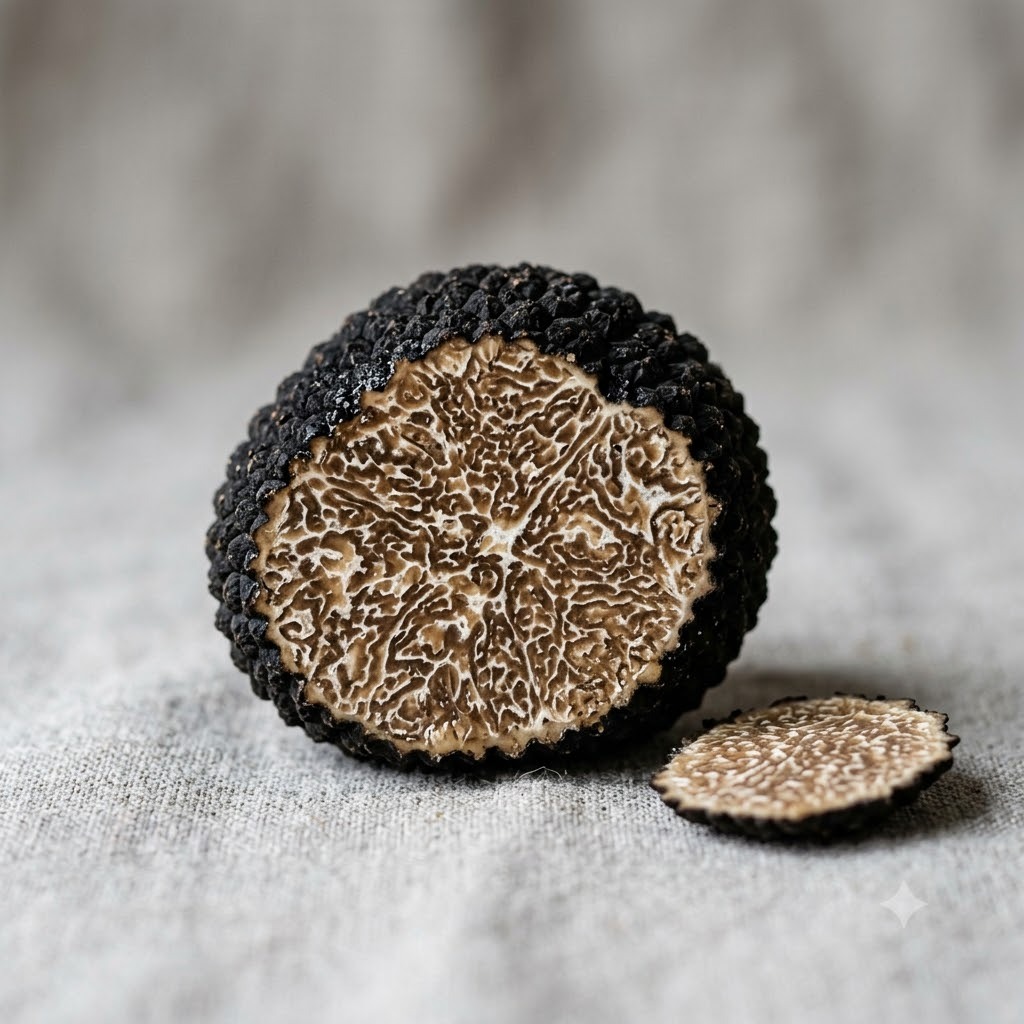
The fruit body is an irregular subterranean tuber, 2-10 cm across and occasionally larger, with a hard black outer skin covered in coarse pyramidal warts, each with visible facets. Cutting one open reveals the important feature: the interior, called the gleba, is pale beige to hazel brown and marbled with fine white branching veins, a pattern that is central to identifying any truffle species. The aroma is mild, nutty, and mushroomy, much less intense than the black Périgord or white Alba truffles. Truffles do not produce a spore print, since spores are held internally and dispersed by animals that dig them up and eat them. Identification of any truffle to species depends on the warted skin, the gleba colour and veining, and ultimately on microscopic spore ornamentation, so a wild find should always be confirmed by an expert.
Where It Grows
Summer truffles are ectomycorrhizal, forming partnerships with the roots of oak, hazel, beech, hornbeam, and lime, and they fruit underground, usually five to thirty centimetres down. They favour well-drained calcareous soils with a high pH, typically 7.5 to 8.5, and they are strongly associated with limestone and chalk country. The species is widespread across Europe, from Spain and Italy through France, Germany, and central Europe to Britain and Scandinavia, and it is harvested commercially in several countries. Trained dogs are the standard tool for finding them, since the truffle gives off aroma only when mature and the human nose cannot locate them underground. Pigs were traditionally used but are largely obsolete because they eat the harvest.
How to Grow at Home
This is the truffle species that genuinely can be cultivated, and truffle orchards are established commercially across Europe, Australia, and North America. The method is to plant seedlings, usually oak or hazel, whose roots have been inoculated with the fungus by a specialist nursery, in suitable ground. That ground must be alkaline, ideally pH 7.5 to 8.3, free-draining, and low in competing vegetation, and lime is often added to raise pH. Trees are planted several metres apart, kept weed-free, irrigated in dry summers, and left alone otherwise. The wait is the hard part: the first truffles typically appear five to ten years after planting, sometimes longer, and yields build slowly after that. A visible bare patch around the trunk, called the brûlé, where the fungus suppresses other plants, is the first sign that the partnership has taken.
Growing Conditions
Light
Full sun for the host trees, which need to grow well for the partnership to produce. Truffle orchards are planted in open ground rather than in existing woodland, and keeping competing vegetation down is standard practice.
Watering
Summer irrigation matters. Truffles form in spring and mature over summer, and a dry summer badly reduces the harvest. Commercial orchards typically irrigate to maintain even soil moisture from late spring through summer.
Temperature & Substrate
Fruit bodies mature from late spring through autumn, harvested from around May to November depending on region. The substrate is the decisive factor: free-draining calcareous soil, pH roughly 7.5-8.5, low in organic matter and competing plants, hosting inoculated oak or hazel roots.
Culinary Use
Summer truffles are mild, and that changes how they are used. Where an intense truffle is shaved raw over a finished dish, the summer truffle benefits from gentle warmth and fat to carry what aroma it has, so it is often infused into butter, cream, or eggs rather than used as a raw garnish. Shave it very thinly over hot pasta, risotto, or scrambled eggs at the last moment, or hold it in a sealed jar with eggs for a day so the shells absorb the aroma. Do not cook it hard; heat destroys the aromatic compounds. Use it quickly, within a week of harvest, since truffle aroma fades noticeably day by day. Be sceptical of cheap truffle oils, most of which are flavoured with synthetic 2,4-dithiapentane rather than any actual truffle.
Health & Nutrition
Truffles are eaten in tiny quantities, so nutrition is largely beside the point: a few grams provide negligible calories with some fibre and trace minerals. They are a good source of nothing in practical amounts. The genuine considerations are commercial rather than dietary. Truffle fraud is widespread, with cheaper species sold as expensive ones and synthetic aroma compounds substituting for the real thing, so buying from a reputable supplier matters more than for most foods. From a foraging perspective, truffles in several European countries are subject to harvesting regulations, licensing, and season limits, and digging on land without permission is both illegal and damaging to the mycelium. Learn the rules before searching.
Common Problems
- No truffles after ten years - the commonest outcome of amateur planting, usually caused by soil pH that was never right, poor drainage, or contaminated nursery stock.
- Losing the aroma - truffles fade fast. Use within days and store sealed with the food you want to perfume.
- Buying fakes - cheaper species and synthetic aromas are widespread. Buy whole truffles from a known supplier, not pre-sliced product.
- Damage from digging - careless excavation harms the mycelium. Trained dogs and careful hand tools protect the site.
- Ignoring the rules - many regions license truffle harvesting and set seasons.
Pros & Cons
Pros
- The truffle species that can genuinely be cultivated at small scale.
- Widespread across Europe and comparatively affordable.
- Long harvest season from late spring into autumn.
- A real crop for calcareous ground where little else pays.
Cons
- Five to ten years minimum before any harvest, with no guarantee.
- Mild aroma compared with the famous species.
- Requires alkaline, free-draining soil that many gardens do not have.
- Wild harvesting is regulated in many regions and needs a trained dog.
Best Suited For
- Landowners on chalk or limestone with patience measured in decades.
- Cooks who want the truffle experience at a realistic price.
- Anyone interested in mycorrhizal cultivation as a long-term project.
Not ideal for anyone on acidic soil, in a hurry, or expecting the intensity of an Alba white truffle.
FAQ
Can I really grow truffles in a garden? On the right soil, yes. You need inoculated oak or hazel seedlings from a specialist nursery, free-draining alkaline soil around pH 7.5-8.3, summer irrigation, and five to ten years of patience.
What is the brûlé? The bare, scorched-looking patch of ground around a productive truffle tree, where the fungus suppresses competing plants. It is the first visible sign that the partnership has established.
Is truffle oil made from truffles? Usually not. Most truffle oil is flavoured with a synthetic aroma compound. It is not a substitute for the real thing and it will not tell you what a truffle tastes like.
Never eat a wild truffle without 100% expert identification. Several underground fungi resemble truffles, including false truffles that are not edible. Confirm the warted black skin, marbled veined interior, and species identity with an expert before eating.
🪴 Foraging kit worth a look
Nothing here identifies a mushroom for you - identification stays with your field guides and local experts. These are simply the basics foragers carry.
Links go to Amazon or a partner store (such as Adagio Teas) and may earn us a commission at no extra cost to you. As an Amazon Associate we earn from qualifying purchases. We link gear types, not sponsors' picks: you choose the exact product.