Sheathed Woodtuft
The sheathed woodtuft (Kuehneromyces mutabilis) is a good edible mushroom with a genuinely dangerous problem: it grows in clusters on dead hardwood, is small and brown with a ring, and shares that description almost exactly with the funeral bell, a mushroom containing the same lethal amatoxins as the death cap.
🗓️ Last reviewed: August 2026
Overview
The sheathed woodtuft (Kuehneromyces mutabilis) is a good edible mushroom with a genuinely dangerous problem: it grows in clusters on dead hardwood, is small and brown with a ring, and shares that description almost exactly with the funeral bell, a mushroom containing the same lethal amatoxins as the death cap. In central and eastern Europe the woodtuft is a traditional food, cultivated on logs in some gardens and gathered in quantity, and it has a fine flavour. In Britain and much of the English-speaking world, guides increasingly advise leaving it alone, on the grounds that the consequence of getting it wrong is liver failure. Both positions are defensible, and anyone deciding between them should understand exactly what separates the two species.
Identification & Appearance
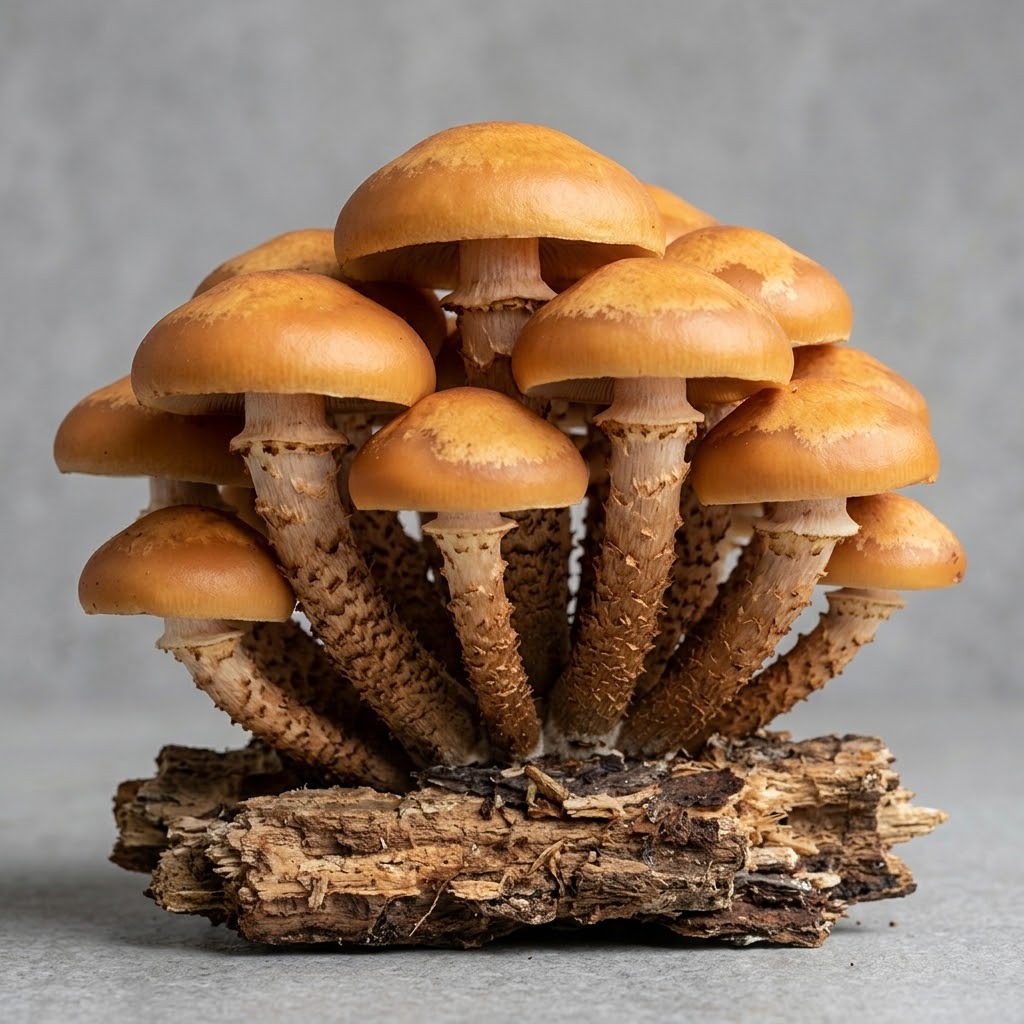
Caps are 2-6 cm across, tawny to date-brown, smooth, and hygrophanous, meaning they change colour dramatically as they dry, fading from the margin inwards and often leaving a two-tone cap with a darker outer band and a paler centre. Gills are pale then cinnamon brown, adnate to slightly decurrent. The stem is the key: below the ring it is covered in distinct dark brown recurved scales, giving a rough, shaggy, sheathed appearance, while above the ring it is smooth and pale. The ring itself is membranous and often darkened by fallen spores. The smell is pleasantly aromatic. Spore print is rust-brown. The funeral bell (Galerina marginata) has a smooth or silky stem below the ring with no scales, a similar rust-brown spore print, and a mealy rather than aromatic smell. The scaly stem is the primary separator, and it is not always obvious.
Where It Grows
Sheathed woodtufts fruit in dense clusters on dead hardwood: stumps, fallen logs, buried roots, and occasionally conifer wood. They appear from spring through autumn, with the main flush in autumn, and they can produce large crops from a single stump. The species is widespread across Europe, Asia, and North America. Critically, the funeral bell occupies the same habitat, fruits at the same time, and sometimes grows on the same log, occasionally within the same cluster. That overlap is the entire reason this species requires extreme care rather than ordinary care, and it is why a general rule of thumb, never gather small brown clustered mushrooms from wood, exists in most beginner foraging guidance.
How to Grow at Home
This is one of the few wild-gathered European mushrooms with a real cultivation tradition. In parts of central Europe it has been grown on hardwood logs and stumps using plug spawn, in the same way as shiitake and oyster mushrooms, and spawn is occasionally available from specialist suppliers. The method is standard: drill fresh hardwood logs, insert plugs, seal with wax, stack in shade, and wait a year or more for colonisation before fruiting begins in flushes after rain. Cultivated logs remove the identification risk entirely, which is the single strongest argument for growing rather than gathering this species. If you want to eat sheathed woodtufts and you are not an expert identifier, an inoculated log is by far the sensible route.
Growing Conditions
Light
Indirect light or shade. On logs outdoors, a shaded position that stays damp is ideal; direct sun dries logs and stops fruiting.
Watering
Fruiting follows rain. Cultivated logs benefit from soaking during dry spells, and keeping logs in contact with damp ground helps them hold moisture through summer.
Temperature & Substrate
Fruiting spans roughly 8-20°C from spring to autumn, peaking in autumn. The substrate is dead hardwood: birch, beech, alder, willow, poplar, and similar, as logs, stumps, or buried roots.
Culinary Use
It is a good mushroom, with a pleasant aromatic flavour and firm caps. Use the caps only; the scaly stems are tough and fibrous and should be discarded. Cook thoroughly, as with all wild mushrooms. They suit frying, mixed mushroom dishes, soups, and central European preparations with sour cream and paprika, and they hold their shape well. They also dry acceptably. The eating quality is not in question; the identification is. Anyone gathering rather than growing this species should collect a single specimen, take a spore print, examine the stem below the ring under good light for the recurved scales, and ideally have the collection checked by an experienced identifier before the first meal. Never mix clustered brown wood mushrooms from different logs in one bag.
Health & Nutrition
Nutritionally ordinary: low calorie, some protein and fibre, B vitamins, and trace minerals. The health section here is entirely about the look-alike. Galerina marginata contains amatoxins, the same class of toxin found in the death cap, and a modest quantity can cause fatal liver failure. Amatoxin poisoning follows a characteristic pattern: severe gastrointestinal symptoms starting six to twenty-four hours after eating, then an apparent recovery, then liver failure days later. Cooking, drying, and freezing do not destroy amatoxins. Anyone who suspects they have eaten a Galerina should go to hospital immediately and say what they ate; the delay before symptoms and the false recovery are precisely why these poisonings are so dangerous.
Common Problems
- Confusion with funeral bell - the critical risk. Check the stem below the ring for distinct dark recurved scales; a smooth or silky stem means do not eat it.
- Both species in the same cluster - documented and terrifying. Examine every single fruit body, not a sample.
- Hygrophanous colour change - the cap colour is unreliable because it changes as the mushroom dries. Use structural features, not colour.
- Tough stems - discard them.
- Overconfidence after one successful season - this is the species where complacency has the worst consequences.
Pros & Cons
Pros
- Good aromatic flavour and firm texture.
- Can be cultivated on logs, which removes the identification risk entirely.
- Fruits abundantly from a single stump.
- Long season from spring to autumn.
Cons
- Shares habitat, timing, and appearance with a deadly amatoxin mushroom.
- The separating feature, the scaly stem, is not always obvious.
- Cap colour changes with drying and cannot be relied on.
- Tough stems mean much of the mushroom is wasted.
Best Suited For
- Growers who inoculate hardwood logs and avoid the wild identification problem.
- Experienced foragers in central and eastern Europe with local mentoring.
- Cooks who want a firm mushroom for paprika and sour cream dishes.
Not ideal for beginners, anyone gathering alone without expert checking, or anyone unwilling to inspect every single fruit body.
FAQ
What exactly separates it from the funeral bell? The stem below the ring. Sheathed woodtuft has distinct dark brown recurved scales; the funeral bell is smooth or silky. Both have rust-brown spore prints, so the print alone does not settle it.
Is it safe if I cook it well? Cooking is irrelevant to the danger. Amatoxins in the look-alike are not destroyed by heat, drying, or freezing. Safety comes from identification only.
Should I just grow it instead? For most people, yes. Plug spawn on hardwood logs gives the same mushroom with no identification risk, and cultivated logs fruit for several years.
Never eat a sheathed woodtuft without 100% expert identification. This is the species where that sentence is most literally life-saving. Have every collection checked by an experienced identifier, examine each fruit body individually, and if there is any doubt at all, discard the lot.
🪴 Foraging kit worth a look
Nothing here identifies a mushroom for you - identification stays with your field guides and local experts. These are simply the basics foragers carry.
Links go to Amazon or a partner store (such as Adagio Teas) and may earn us a commission at no extra cost to you. As an Amazon Associate we earn from qualifying purchases. We link gear types, not sponsors' picks: you choose the exact product.