Snow Fungus
Snow fungus (Tremella fuciformis) is the translucent white, frilled jelly fungus that has been a fixture of Chinese kitchens and pharmacies for centuries and has more recently become a skincare-industry darling.
🗓️ Last reviewed: October 2026
Overview
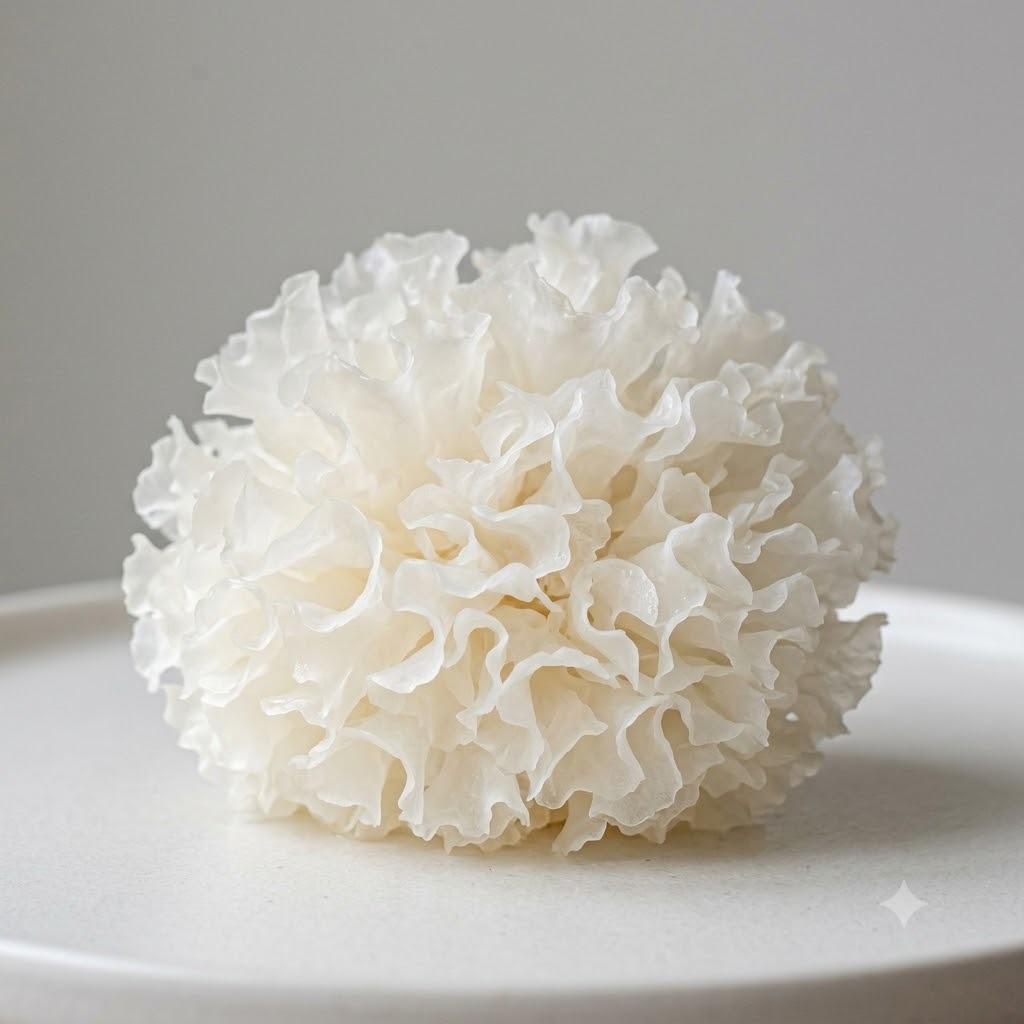
Snow fungus (Tremella fuciformis) is the translucent white, frilled jelly fungus that has been a fixture of Chinese kitchens and pharmacies for centuries and has more recently become a skincare-industry darling. It looks like a crumpled chiffon flower, has almost no flavour of its own, and behaves in cooking like a sponge with a pleasant crunch, which is exactly why it turns up in sweet soups rather than savoury dishes. The most interesting thing about it is biological rather than culinary: snow fungus cannot fruit on its own. It is a parasite of another fungus, and commercial cultivation only became possible once growers learned to raise both species together in the same bag. That dependency makes it one of the more unusual mushrooms a home grower can attempt.
Identification & Appearance
The fruit body is a gelatinous rosette of thin, wavy, translucent white lobes, typically 3-8 cm across, looking like a cluster of frilly petals or a sea anemone. It is soft and slippery when fresh and hydrated, shrinking to a hard, brittle, yellowish nugget when dried, then swelling to many times that size when soaked. There are no gills, no pores, and no conventional stem; spores are produced across the surface of the lobes. It grows attached to dead hardwood branches, usually in tropical and subtropical forests. The nearest confusables are other jelly fungi: the golden Tremella mesenterica, the brain-like Tremella aurantia, and the pale Ductifera and Exidia species. None of the white jelly fungi in the group are known to be dangerously toxic, but that is not a licence to eat unknown jelly fungi, since accurate identification still requires microscopy in several genera.
Where It Grows
Wild snow fungus grows on dead, fallen hardwood branches in humid subtropical and tropical forests across Asia, Australia, Africa, Central and South America, and the Pacific. Crucially, it does not decay that wood itself. Snow fungus has a limited ability to break down cellulose and lignin, so it lives as a parasite on the mycelium of a wood-decaying ascomycete of the genus Annulohypoxylon, which does the actual digestion. The host fungus opens up the wood, and the Tremella takes what it needs from it. In all environments, including cultivation, fruit body formation depends on the presence of that companion fungus. Commercial production is centred in China, where snow fungus is grown on sawdust substrate in huge volumes, and the crop is sold mainly dried.
How to Grow at Home
This is an advanced project rather than a beginner grow, and the reason is the dual culture. You need two organisms in the same bag: the snow fungus itself and a compatible Annulohypoxylon companion, usually A. stygium or A. archeri, which is sold alongside snow fungus cultures by specialist suppliers precisely because the crop fails without it. The substrate is supplemented hardwood sawdust, typically with wheat bran and a little sugar or gypsum, sterilised thoroughly because both organisms are slow relative to common contaminants. The companion fungus is usually established first or co-inoculated, and colonisation takes several weeks at 23-28°C. Fruiting then needs high humidity, moderate fresh air, and the same warmth. Fruit bodies form at the bag openings as small translucent knots that expand into the familiar frilled rosettes over roughly a week. Honest expectation setting: contamination rates are higher and yields less predictable than for oysters or shiitake, and a first attempt often produces companion-fungus growth with no Tremella at all.
Growing Conditions
Light
Low to moderate indirect light during fruiting, around eight to twelve hours a day. Snow fungus is less light-hungry than oyster mushrooms, but complete darkness gives poorly formed lobes. Direct sun is harmful and dries the gelatinous tissue quickly.
Watering
Humidity is the make-or-break factor. Fruiting wants 85-95 per cent relative humidity, and the jelly tissue collapses and hardens if it falls much below that for even a few hours. Mist the chamber rather than the fruit bodies, since standing water on the lobes encourages bacterial rot in tissue that is already almost entirely water.
Temperature & Substrate
Colonisation and fruiting both run warm, roughly 23-28°C. Below 20°C growth is slow and unreliable. The substrate is sterilised hardwood sawdust supplemented with bran, and it must be co-inoculated with a compatible Annulohypoxylon culture; without the companion fungus, the snow fungus will not fruit no matter how good the conditions are.
Culinary Use
Snow fungus has essentially no flavour, and that is the point. It is prized for texture, a delicate crunch that survives long simmering, and for the way it thickens a liquid slightly as its polysaccharides leach out. The classic use is a sweet Chinese dessert soup with rock sugar, dried longan, red dates, goji berries, and sometimes pear, simmered until the fungus is tender but still has bite. It also appears in savoury cold salads dressed with vinegar, chilli oil, and sesame. Dried snow fungus needs soaking for around thirty minutes until it swells and softens, after which the hard yellowish base is trimmed away and discarded. Cook it thoroughly. One genuine food-safety note applies to snow fungus itself as well as to its wood-ear relatives: rehydrated fungi left soaking at room temperature for many hours have caused serious bacterial food poisoning, so soak in the fridge and use promptly rather than leaving a bowl on the counter overnight.
Health & Nutrition
Snow fungus is almost pure polysaccharide and water, very low in calories, and a good source of soluble dietary fibre. Its polysaccharides hold many times their weight in water, which is the basis of both its texture in soup and its popularity as a cosmetic humectant marketed as a plant-based alternative to hyaluronic acid. In traditional Chinese medicine it has a long history of use for dryness, and modern laboratory work has looked at its polysaccharides for antioxidant and immune-modulating activity. That research is preliminary, mostly cell and animal work, and nothing about it justifies treating snow fungus as a treatment for any condition. As a food it is gentle, low in calories, and useful mainly as texture and fibre.
Common Problems
- No fruit bodies, only dark host growth - the companion fungus outpaced the Tremella, or the Tremella culture was weak. Both must be viable and compatible.
- Fruit bodies shrivelling and hardening - humidity dropped. Jelly fungi have no protective skin and dehydrate within hours.
- Slimy grey rot on the lobes - standing water plus poor airflow. Mist the air, not the mushroom.
- Green mould in the bag - inadequate sterilisation of supplemented sawdust.
- Bitter or off flavour after cooking - usually the hard base left on. Trim it after soaking.
Pros & Cons
Pros
- Unique crunchy-gelatinous texture that survives long cooking.
- Extremely long shelf life dried, expanding many times on soaking.
- Very low calorie, high soluble fibre.
- A genuinely interesting biology project for an experienced grower.
Cons
- Cannot be grown without a companion fungus, which complicates cultivation.
- Higher contamination and failure rates than mainstream gourmet species.
- No flavour of its own, so it depends entirely on the dish.
- Needs sustained warmth and very high humidity.
Best Suited For
- Experienced growers who want a technical challenge beyond oysters and shiitake.
- Cooks making Chinese sweet soups and cold texture salads.
- Anyone wanting a very low-calorie, high-fibre dried store-cupboard ingredient.
Not ideal for first-time growers, cool unheated growing spaces, or anyone looking for a mushroom with pronounced flavour.
FAQ
Why does snow fungus need a second fungus to grow? It has only a limited ability to digest wood. The companion ascomycete Annulohypoxylon breaks the wood down and creates the conditions the Tremella needs to switch from yeast-like growth to fruiting. Commercial dual culture exists for exactly this reason.
How much does dried snow fungus expand? Substantially. A small hard nugget swells into a large soft rosette after about thirty minutes of soaking, so a little dried weight goes a long way.
Does it really work like hyaluronic acid on skin? Its polysaccharides are strong water binders, which is why cosmetic formulators use them as humectants. That is a formulation property, not a claim that eating it changes your skin.
Never eat a wild jelly fungus without 100% expert identification. Several white and pale jelly fungi look alike and some genera can only be separated microscopically. Buy dried snow fungus or grow it, rather than gathering unknown jellies.
🪴 Foraging kit worth a look
Nothing here identifies a mushroom for you - identification stays with your field guides and local experts. These are simply the basics foragers carry.
Links go to Amazon or a partner store (such as Adagio Teas) and may earn us a commission at no extra cost to you. As an Amazon Associate we earn from qualifying purchases. We link gear types, not sponsors' picks: you choose the exact product.