Pavement Mushroom
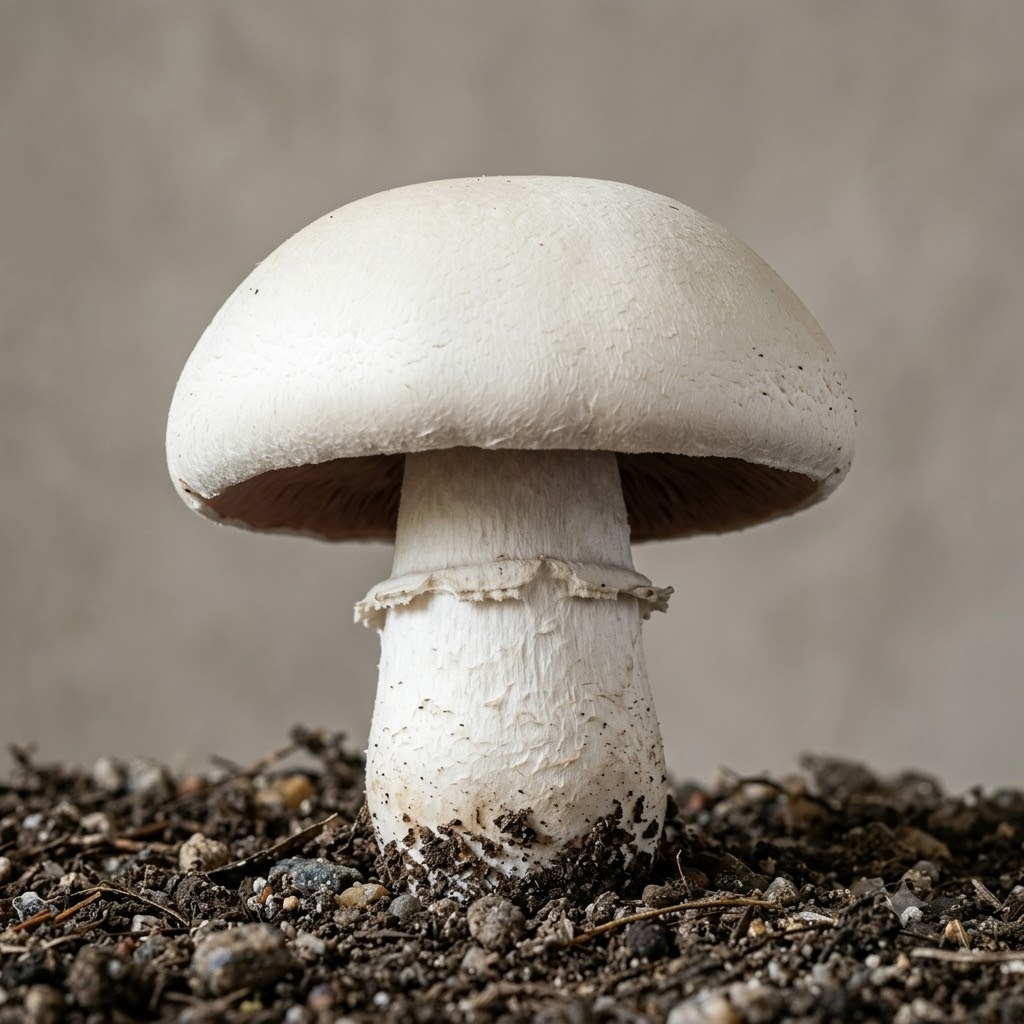
The pavement mushroom (Agaricus bitorquis) is the button mushroom's tougher urban cousin, the species famous for pushing up through tarmac, gravel car parks, and the compacted verge beside a bus stop.
🗓️ Last reviewed: August 2026
Overview
The pavement mushroom (Agaricus bitorquis) is the button mushroom's tougher urban cousin, the species famous for pushing up through tarmac, gravel car parks, and the compacted verge beside a bus stop. It belongs to the same genus as the shop-bought button mushroom and tastes broadly similar, but it is denser, firmer, and adapted to conditions that would kill a field mushroom: hard-packed soil, heat, drought, and disturbance. Commercially it has a niche as a warm-season alternative to Agaricus bisporus, since it fruits at temperatures the standard button mushroom cannot handle. For foragers it is a familiar and useful species, though its favourite habitats are exactly the ones where contamination from traffic and dogs makes gathering a bad idea.
Identification & Appearance
Caps are 5-15 cm across, white to dirty cream, thick-fleshed, and often dented, cracked, or gritty from forcing their way up through hard ground. The cap surface is dry and smooth to slightly scaly, and it frequently stays domed rather than opening flat. Gills start pale pink to greyish-pink and darken through chocolate to almost black as spores mature, which is the family signature of Agaricus. The stem is short, thick, and solid, and it carries the identifying feature: a double ring, formed from a sheathing lower ring and an upper ring, giving the species name bitorquis, meaning two collars. Flesh is white and may flush faintly pinkish when cut, never chrome yellow. The smell is mushroomy and pleasant. Spore print is dark brown. The pink-then-brown gills, double ring, solid stem, and lack of any yellow staining together separate it from its dangerous look-alikes, but no single feature does the job alone.
Where It Grows
This is the mushroom of hard ground. It fruits in compacted soil along paths, in gravel, on the edges of car parks, on roadside verges, in gardens with heavy traffic, and through cracks in asphalt, from late spring through autumn and often in warm spells when other Agaricus species have stopped. It is common across Europe, North America, and Asia, and is very much associated with human-modified ground rather than pasture or woodland. Unlike the field mushroom, which likes open grassland and dung-enriched pasture, the pavement mushroom prefers the mineral, compacted, disturbed soil that most fungi avoid. That toughness is impressive and is also the source of the main caution about eating it.
How to Grow at Home
Agaricus bitorquis is cultivated commercially in exactly the same way as the button mushroom, on composted substrate with a casing layer, and the same method scales down to a home setup. Prepare or buy mushroom compost, pasteurise it, spawn it at around one per cent of substrate weight, and colonise in the dark at 25-28°C, which is warmer than for the standard button mushroom. When the compost is fully run, apply a casing layer of pasteurised peat and lime or a soil-coir blend around three to four centimetres deep and keep it evenly damp. Pinning follows in two to three weeks. The species is slower to colonise and slower to pin than Agaricus bisporus, and that patience is the main barrier for home growers, but it repays it by cropping in summer heat when a button mushroom bed would simply stall. Composting is the real work: badly made compost gives green mould and no mushrooms.
Growing Conditions
Light
Light is not required. Agaricus species fruit perfectly well in darkness, and commercial button mushroom houses are dark. A dim room is fine, and direct sun on a casing bed is harmful because it dries the casing far faster than misting can fix.
Watering
Keep the casing layer evenly damp, misting lightly and often rather than soaking. Humidity of 80-90 per cent during pinning is the target, dropping slightly as the mushrooms grow. Water sitting on caps causes brown bacterial spotting, so aim at the casing.
Temperature & Substrate
This is the warm-tolerant Agaricus: colonisation at 25-28°C and fruiting at 18-25°C, several degrees above the button mushroom's preference. The substrate is composted straw and manure, pasteurised, topped with a pasteurised casing layer. It is the compost, not the casing, that determines whether the crop works.
Culinary Use
Pavement mushrooms cook like a firm button mushroom, with a denser bite and a slightly stronger flavour. The thick flesh browns well and holds up in a pan without collapsing, and the closed domed caps are excellent stuffed or grilled whole. Clean them carefully, since specimens that pushed up through grit carry it in the cap surface and gill edge; a brush and a damp cloth work better than soaking. Cook thoroughly. They take well to garlic, butter, cream, and long slow cooking in stews where softer mushrooms disappear. Older specimens with dark gills give a stronger, mustier flavour and colour a sauce grey, so pick or buy young. As with all Agaricus species, discard any specimen that smells of ink, phenol, or chemicals when the stem base is cut.
Health & Nutrition
Like other Agaricus mushrooms, this species is low in calories and provides protein, fibre, B vitamins including riboflavin, niacin and pantothenic acid, plus selenium, potassium, and copper. It generates vitamin D on exposure to ultraviolet light. The important health point for this particular species is environmental rather than nutritional: mushrooms take up heavy metals from their substrate, and a species that specialises in roadside verges, car parks, and urban paths is growing in ground that may contain lead, cadmium, vehicle residues, and dog fouling. Cultivated pavement mushrooms on clean compost are a different proposition from ones prised out of a supermarket car park. Foraged specimens should come from clean ground well away from traffic, and even then should not be eaten in large quantities habitually.
Common Problems
- Gritty caps and gills - inevitable in specimens that grew through compacted ground. Brush rather than wash, and trim heavily damaged surfaces.
- Confusion with the yellow stainer - a genuinely dangerous mix-up. Cut the stem base: chrome yellow staining and an ink or phenol smell mean discard.
- Slow colonisation - normal for this species; it is several days behind the button mushroom at every stage.
- Green mould in the compost - poorly prepared or under-pasteurised compost, the usual failure of home Agaricus growing.
- No pinning after casing - casing dried out, applied too early, or the room is too cold for this warm-loving species.
Pros & Cons
Pros
- Fruits in summer heat where standard button mushrooms stall.
- Firm, dense flesh that holds up to grilling and slow cooking.
- Easy to recognise thanks to the distinctive double ring.
- Common and widespread in towns and cities.
Cons
- Its favourite habitats are polluted, which makes foraging inadvisable.
- Slower to colonise and pin than the button mushroom.
- Needs proper mushroom compost and a casing layer, not a simple bag.
- Frequently gritty and damaged from pushing through hard ground.
Best Suited For
- Growers in warm climates wanting an Agaricus crop through summer.
- Cooks who want a firmer, more flavourful alternative to shop buttons.
- Urban naturalists learning to recognise the Agaricus genus safely.
Not ideal for foragers hoping to harvest from city pavements, or growers unwilling to handle compost and casing.
FAQ
Can it really break through asphalt? Yes. Mushroom tissue expands with considerable turgor pressure, and this species is well known for lifting paving slabs and cracking thin tarmac as it fruits.
How do I tell it from the poisonous yellow stainer? Cut the base of the stem. The yellow stainer flashes bright chrome yellow there and smells of ink or carbolic; the pavement mushroom does not. Never rely on cap appearance alone.
Is it safe to pick from a car park? It is safe to identify there and unwise to eat from there. Mushrooms accumulate heavy metals and traffic residues from the ground they grow in.
Never eat a wild Agaricus without 100% expert identification. The genus contains excellent edibles and species that will make you ill, and white gilled mushrooms in general include deadly species. Confirm the pink-to-brown gills, dark spore print, double ring, and absence of yellow staining with an experienced identifier.
🪴 Foraging kit worth a look
Nothing here identifies a mushroom for you - identification stays with your field guides and local experts. These are simply the basics foragers carry.
Links go to Amazon or a partner store (such as Adagio Teas) and may earn us a commission at no extra cost to you. As an Amazon Associate we earn from qualifying purchases. We link gear types, not sponsors' picks: you choose the exact product.