Parasol Mushroom
The parasol mushroom (Macrolepiota procera) is a tall gilled mushroom with a large, umbrella-shaped cap and a ring that moves on its stalk (International Journal of Food Science, 2022).
Last reviewed: November 2026
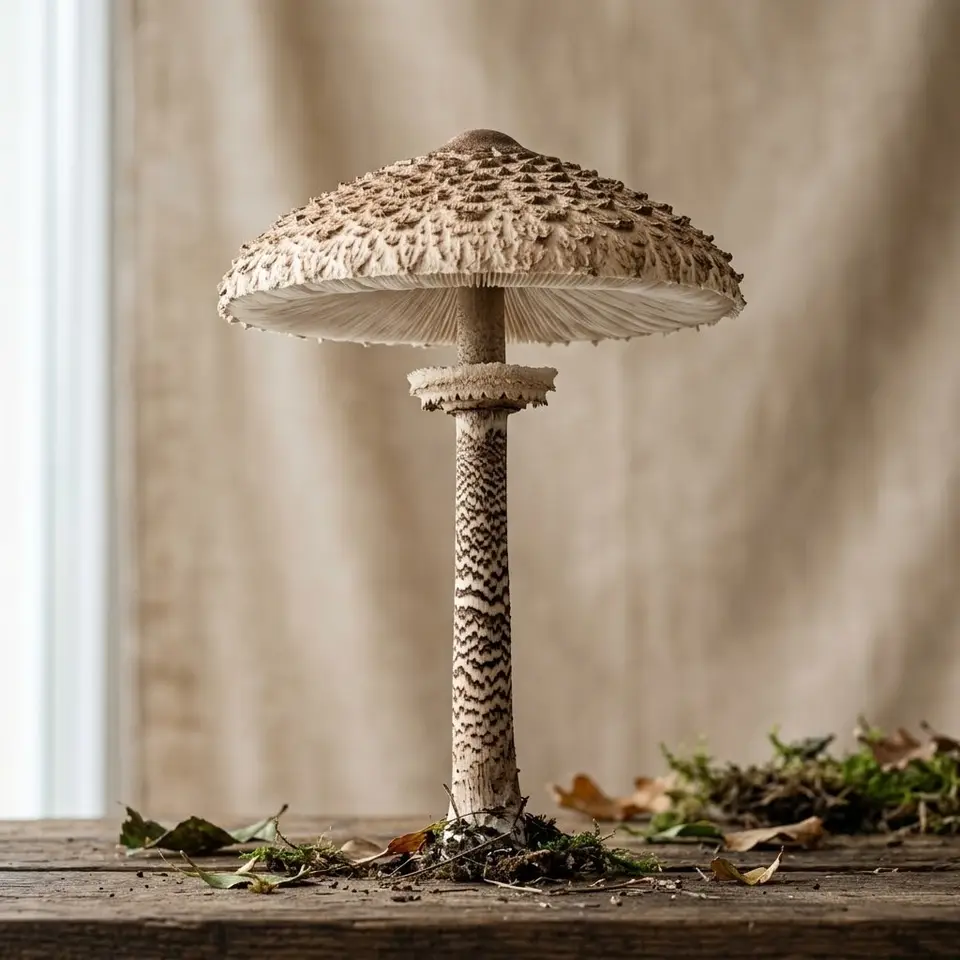 AI illustration
Not health advice: where this page mentions traditional or supplement uses, those are traditions, not treatments, and we do not advise on health. Ask a doctor or pharmacist before taking any mushroom as a supplement, particularly if you take medication or are pregnant or breastfeeding.
Overview
The parasol mushroom (Macrolepiota procera) is a tall gilled mushroom with a large, umbrella-shaped cap and a ring that moves on its stalk (International Journal of Food Science, 2022). It grows in grasslands, forest edges and open areas of Europe, North America and East Asia (Journal of Fungi, 2025). A 2022 review says parasols are considered edible, but that pickers without experience can easily confuse them with poisonous species (International Journal of Food Science, 2022). It is mostly a wild mushroom: in some regions it is not yet commercially cultivated and is collected from the wild during the harvest season (Journal of Fungi, 2025).
Identification & Appearance
The cap is large and umbrella-shaped in adult mushrooms, whitish with small brown patches, and 10-30 cm across (International Journal of Food Science, 2022). A 2025 study describes mature mushrooms by their tall, slender stalk, large umbrella-like cap with brown scales and gills on the underside (International Journal of Molecular Sciences, 2025). The stalk is whitish brown, hollow in the centre and 10-40 cm high, with a large ring that can be moved (International Journal of Food Science, 2022), and a 2025 review says its brown scales form a snakeskin pattern (Journal of Fungi, 2025). The gills under the cap are densely arranged (International Journal of Food Science, 2022).
We found no source we could check for the colour of the parasol's own spore print, so we leave it out.
Where It Grows
A 2025 review places it mainly in grasslands, forest edges and open areas of Germany, France, Italy and the United Kingdom, in moist grasslands and forest margins of the United States and Canada, and in parts of China, Japan and Korea (Journal of Fungi, 2025). A 2025 study says it is found in forests, meadows and clearings from late summer to autumn (International Journal of Molecular Sciences, 2025). A 2021 paper says it prefers light, warm places, especially well-drained calcareous and sandy soils in forests, meadows and gardens (Journal of Fungi, 2021).
Look-alikes
A 2022 review says parasols picked by people without experience can easily be confused with Amanita, Chlorophyllum and Lepiota species (International Journal of Food Science, 2022), and a 2024 medical report adds that some Lepiota mushrooms contain amatoxins, the toxins of the death cap (International Journal of Hepatology, 2024). This table is not a way to clear a wild mushroom for eating.
| Look-alike | How the source tells it apart | What the source says about the risk |
|---|---|---|
| Green-spored parasol (Chlorophyllum molybdites) | A 2018 taxonomy paper calls it the green-spored species and gives its group olive to greenish-white spores (MycoKeys, 2018) | That paper calls it a well-known toxic species (MycoKeys, 2018), and a 2021 paper from China says it is prone to being eaten by mistake and mainly causes serious gastrointestinal discomfort (Frontiers in Microbiology, 2021) |
| Death cap (Amanita phalloides) | We give no way to tell them apart | The 2022 review names it among the mushrooms parasols are confused with, says it is poisonous because of its amatoxins, and says these cause severe poisoning, often leading to death (International Journal of Food Science, 2022) |
| Lepiota species such as L. brunneoincarnata | We give no way to tell them apart | Lepiota is among the genera that contain amatoxins, and its species are a rare cause of fatal mushroom poisoning (International Journal of Hepatology, 2024) |
Checked: 21 November 2026.
See also our mushroom identifier.
Safety
- Spore print: a 2018 taxonomy paper calls the poisonous Chlorophyllum molybdites the green-spored species (MycoKeys, 2018). We found no source we could check for the parasol's own spore-print colour, so we do not offer a spore print as a way to clear this mushroom for eating.
- Wild mushrooms: we do not advise eating any wild mushroom on the strength of a web page, including this one. If someone may have eaten a poisonous mushroom, contact a poison control center or emergency services straight away.
- Metals: a 2025 review says this species can, under certain conditions, build up potentially harmful levels of lead, cadmium and mercury (Journal of Fungi, 2025). It adds that cadmium in the cap can be up to five times higher than in the stem (Journal of Fungi, 2025).
- Raw mushrooms: Germany's Federal Institute for Risk Assessment says raw edible mushrooms in salads often cause intolerance reactions and that any mushroom dish should be cooked for at least 15 minutes (BfR).
- Your doctor decides: this page is not medical advice.
Culinary Use
A 2022 review says the fruiting bodies are considered edible and are eagerly picked in many regions of the world, and warns that they are sometimes confused with poisonous species (International Journal of Food Science, 2022). We give no recipes for it, because it is picked wild and the risks above apply. For general ways to prepare mushrooms you have bought or grown, see our guide to cooking home-grown mushrooms. A 2025 review says improper storage can lead to contamination by bacteria and moulds, and that good ventilation during storage helps to prevent this (Journal of Fungi, 2025).
Health & Nutrition
A 2025 review reports a moisture content generally between 88 and 92%, carbohydrate at 40.90-60.30% of dry weight and about 0.70-4.23% lipids (Journal of Fungi, 2025). It also lists vitamins B2, B3 and B5 and minerals such as potassium, phosphorus, magnesium and iron (Journal of Fungi, 2025). These are food-composition findings, not evidence of a medical effect, and this mushroom does not replace medical care.
How to Grow at Home
Sources differ. A 2022 review says the mycelium can be bought and inoculated in the garden, with shredded wood waste such as branches, leaves and chips as the recommended substrate, and that mushrooms usually appear only in the second year after inoculation (International Journal of Food Science, 2022). A 2025 review says that in some regions it is not yet commercially cultivated and is collected from the wild during the harvest season (Journal of Fungi, 2025). In one study, its mycelium grew on wheat straw, peat, oak leaves and mixtures of them, but no mushrooms formed (Journal of Fungi, 2025).
Common Problems
- Mistaking a poisonous look-alike for it: a 2022 review says parasols can easily be confused with Amanita, Chlorophyllum and Lepiota species (International Journal of Food Science, 2022).
- Metals in the mushroom: under certain conditions it can build up potentially harmful levels of lead, cadmium and mercury (Journal of Fungi, 2025).
- Trying to grow it: a 2022 review says mushrooms usually appear only in the second year (International Journal of Food Science, 2022), and in one study the mycelium grew on several substrates, but no mushrooms formed (Journal of Fungi, 2025).
- Spoilage in storage: improper storage can lead to contamination by bacteria and moulds (Journal of Fungi, 2025).
Best Suited For
Good fit if:
- you are studying the mushrooms of grasslands and forest edges, where a 2025 review places it (Journal of Fungi, 2025);
- you want to learn its field marks: a large umbrella-like cap with brown scales (International Journal of Molecular Sciences, 2025) and a ring that can be moved (International Journal of Food Science, 2022).
Think twice if:
- you want a quick crop at home, since a 2022 review says mushrooms usually appear only in the second year (International Journal of Food Science, 2022), and in one study none formed (Journal of Fungi, 2025);
- you are not sure of your identification, since a 2022 review says parasols can easily be confused with poisonous species (International Journal of Food Science, 2022).
FAQ
Can I grow parasol mushrooms at home?
Sources differ. A 2022 review says the mycelium can be bought and inoculated in the garden on shredded wood waste, and that mushrooms usually appear only in the second year (International Journal of Food Science, 2022). In one study the mycelium grew on several substrates, but no mushrooms formed (Journal of Fungi, 2025).
How is it different from the green-spored parasol?
A 2022 review names the green-spored parasol among the species parasols are easily confused with (International Journal of Food Science, 2022), and a 2018 taxonomy paper calls it the green-spored species and a well-known toxic one (MycoKeys, 2018). We found no source we could check for the parasol's own spore-print colour. We do not offer this as a way to clear a mushroom for eating.
When does it appear?
A 2025 study says it is found in forests, meadows and clearings from late summer to autumn (International Journal of Molecular Sciences, 2025).
Should parasol mushrooms be cooked?
Yes. Germany's Federal Institute for Risk Assessment says raw edible mushrooms in salads often cause intolerance reactions and that any mushroom dish should be cooked for at least 15 minutes (BfR).
What should I know before picking wild parasols?
We give no edibility verdict on wild mushrooms. A 2022 review says parasols are considered edible but are easily confused with poisonous species, and that young specimens should not be picked because their identifying features are not yet developed (International Journal of Food Science, 2022). A 2024 medical report notes that some Lepiota mushrooms contain amatoxins (International Journal of Hepatology, 2024).
Sources
The facts on this page link to these sources:
- International Journal of Food Science, 2022 (doi.org)
- Journal of Fungi, 2025 (doi.org)
- International Journal of Molecular Sciences, 2025 (doi.org)
- Journal of Fungi, 2021 (doi.org)
- International Journal of Hepatology, 2024 (doi.org)
- MycoKeys, 2018 (doi.org)
- Frontiers in Microbiology, 2021 (doi.org)
- BfR (bfr.bund.de)
General information only. If you suspect poisoning, call a poison control center, a doctor or a vet straight away.
Foraging kit worth a look
Nothing here identifies a mushroom for you - identification stays with your field guides and local experts. These are the basics foragers carry.
Links go to Amazon or a partner store (such as Adagio Teas) and may earn us a commission at no extra cost to you. As an Amazon Associate we earn from qualifying purchases. We link gear types, not sponsors' picks: you choose the exact product.