Oyster Mushroom
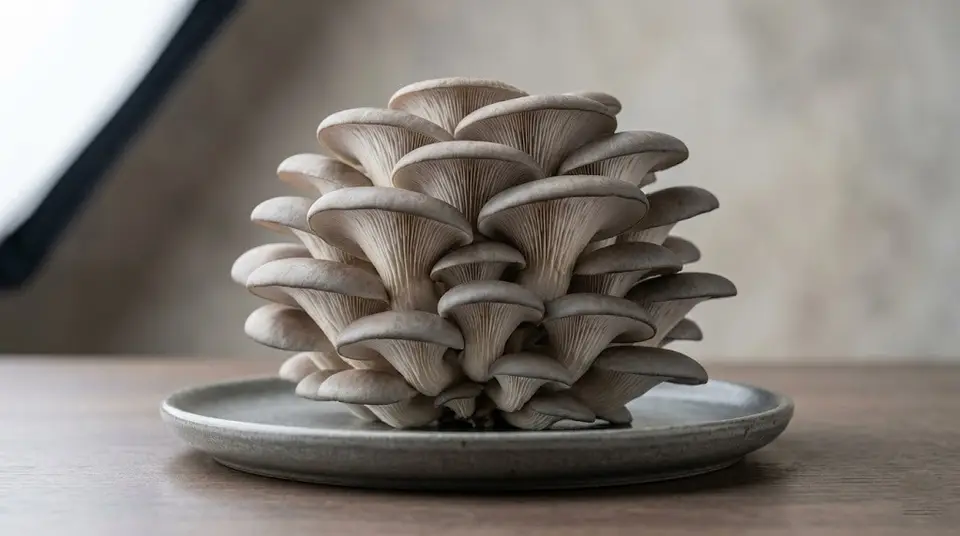
The oyster mushroom (Pleurotus ostreatus) is a gilled mushroom that grows in dense, overlapping clusters on the trunks and larger fallen branches of broadleaved trees (Wellcome Open Research, 2023).
Last reviewed: November 2026
 AI illustration
Not health advice: where this page mentions traditional or supplement uses, those are traditions, not treatments, and we do not advise on health. Ask a doctor or pharmacist before taking any mushroom as a supplement, particularly if you take medication or are pregnant or breastfeeding.
Overview
The oyster mushroom (Pleurotus ostreatus) is a gilled mushroom that grows in dense, overlapping clusters on the trunks and larger fallen branches of broadleaved trees (Wellcome Open Research, 2023). It is a common commercial crop (Cornell Small Farms Program), and Cornell's guide to growing mushrooms calls oysters the best species to grow on straw (Cornell Small Farms Program). Anyone growing it indoors should know about one health risk: a 2026 medical review lists Pleurotus among the mushrooms linked to hypersensitivity pneumonitis, an immune-mediated lung disease (Respiratory Research & Clinical Practice, 2026).
Identification & Appearance
Oyster mushrooms grow in dense, overlapping clusters of thin, fleshy, fan-shaped caps attached at the side (Wellcome Open Research, 2023). The National Park Service describes broad, wavy caps in off-white to brown clusters (Muir Woods National Monument). A 2023 species description gives the cap colour as dark grey, grey brown, bluish grey or yellow brown (Wellcome Open Research, 2023). The gills are white and run strongly down a stem that sits off-centre (Wellcome Open Research, 2023), and UC IPM describes shelf-like mushrooms, smooth on top, with gills that extend down the stalk (UC IPM). The spore print is white to pale lilac grey (Wellcome Open Research, 2023). The 2023 description gives caps of 50-150 mm, and occasionally up to 350 mm (Wellcome Open Research, 2023), and UC IPM gives 2-8 inches per mushroom (UC IPM). In centimetres that is about 5-15 cm, up to 35 cm, and 5-20 cm, computed from the millimetres and inches.
Where It Grows
In the wild it grows on wood: a 2023 species description says that throughout Europe it causes a white rot in a broad range of broadleaved trees, particularly beech and oak, on standing trunks or larger fallen branches (Wellcome Open Research, 2023). UC IPM lists a long range of host trees, from alder and ash to oak and willow, and says infections start through open wounds (UC IPM). At Muir Woods in California it is found from late autumn through winter on hardwoods such as oaks (Muir Woods National Monument). In low-nitrogen conditions its hyphae can release toxins that paralyse nematodes before digesting them (Wellcome Open Research, 2023).
Look-alikes
A 2026 paper on Omphalotus poisoning in China says the main cause is mistaking these fungi for edible mushrooms such as Pleurotus, because they look superficially alike (Toxins, 2026). This table is not a way to clear a wild mushroom for eating.
| Look-alike | How the source tells it apart | What the source says |
|---|---|---|
| Phoenix oyster (Pleurotus pulmonarius) | Cornell's guide has growers use it in summer and P. ostreatus in fall, winter and spring (Cornell Small Farms Program) | Cornell's guide treats both as crops (Cornell Small Farms Program) |
| Ghost fungus (Omphalotus nidiformis) | Its genus is mistaken for Pleurotus because of superficial similarities (Toxins, 2026) | SA Health lists it among poisonous mushrooms (SA Health), and Omphalotus poisoning largely involves acute gastroenteritis with nausea, vomiting, cramps and diarrhoea (Toxins, 2026) |
| Angel's wing (Pleurocybella porrigens) | Causes white rot in conifers (National Park Service). UC IPM's host list for the oyster mushroom is mostly broadleaved trees but includes fir and spruce (UC IPM), so the host alone does not settle it | In 2004, 55 cases of food poisoning were reported from eating it, and 17 of them ended in death from acute encephalopathy (BMC Research Notes, 2014) |
| King oyster (Pleurotus eryngii) | Grows on the roots of plants in the carrot family (Frontiers in Microbiology, 2019), while the oyster mushroom grows on trunks and fallen branches of trees (Wellcome Open Research, 2023) | A commercially grown mushroom (Molecules, 2023) |
Facts from SA Health are adapted from material by the Government of South Australia, licensed under CC BY 4.0 (creativecommons.org/licenses/by/4.0). We reworded them.
Checked: 21 November 2026.
See also our mushroom identifier.
Safety
- Lung disease: a 2026 medical review lists Pleurotus among the mushrooms linked to hypersensitivity pneumonitis, an immune-mediated lung disease caused by breathing in antigens repeatedly, and names mushroom farms and repeated culinary handling among the settings (Respiratory Research & Clinical Practice, 2026). If you grow mushrooms indoors and develop a fever or breathing problems, tell your doctor that you work with mushrooms.
- Raw mushrooms: Germany's Federal Institute for Risk Assessment says raw edible mushrooms in salads often cause intolerance reactions and that any mushroom dish should be cooked for at least 15 minutes (BfR).
- Wild mushrooms: we do not advise eating any wild mushroom on the strength of a web page, including this one. If someone may have eaten a poisonous mushroom, contact a poison control center or emergency services straight away.
- Your doctor decides: this page is not medical advice.
Culinary Use
A 2023 genome paper names its fast growth, culinary characteristics and good keeping qualities as the reasons it is one of the three most extensively cultivated fungi in the world (Wellcome Open Research, 2023). For ways to prepare them, see our guide to cooking home-grown mushrooms. Cornell's guide is more cautious about storage: it says harvested mushrooms keep for about 7 days at 34-37 °F if picked at the right stage, that oysters are especially fragile after harvest, and that shiitake tend to keep better (Cornell Small Farms Program). That is about 1-3 °C, computed from the Fahrenheit figures. Food researchers have also added oyster mushroom powder to a pumpkin and carrot soup (Food Science and Nutrition, 2019).
Health & Nutrition
Per 100 g, raw oyster mushrooms hold 89.2 g water, 33 kcal, 3.31 g protein, 0.41 g fat, 6.09 g carbohydrate and 2.3 g fibre (USDA FoodData Central). The same USDA record lists 4.96 mg niacin, 0.349 mg riboflavin and 420 mg potassium per 100 g (USDA FoodData Central). In a 2019 study, beta-glucans were the main form of glucan in both Pleurotus strains tested (Food Science and Nutrition, 2019). These are food-composition findings, not evidence of a medical effect, and this mushroom does not replace medical care.
How to Grow at Home
If you start from a home grow kit, follow the instructions that come with it. On straw, Cornell's guide describes a crop cycle of five weeks from inoculation to harvest (Cornell Small Farms Program). It advises fruiting straw logs indoors because insects lay larvae in them outside (Cornell Small Farms Program). The figures below come from this guide for commercial growers, so treat them as a rough guide for a home setup.
Temperature
For most species, the guide calls 62-65 °F ideal, says many lose productivity below 50-55 °F, and says that above 75 °F many produce less and at lower quality (Cornell Small Farms Program). That is about 17-18 °C, 10-13 °C and 24 °C, computed from the Fahrenheit figures. Some growers use P. ostreatus in fall, winter and spring and switch to P. pulmonarius in summer (Cornell Small Farms Program).
Humidity
Keep humidity above 85% for the first 4 days after fruiting starts, while the young pins are tender (Cornell Small Farms Program). After about 3 days of pinning it can drop as low as 60%, although the guide calls the 80% range ideal (Cornell Small Farms Program).
Light
If you can read a book comfortably in the room, the light is enough (Cornell Small Farms Program). Low light produces skinny mushrooms with long stems (Cornell Small Farms Program).
Fresh Air
The guide advises keeping carbon dioxide below 800 ppm for oysters, and says high levels produce long stems and little caps (Cornell Small Farms Program).
Propagation Steps: Growing Oyster Mushrooms on Straw
Cornell's guide describes this method for growers (Cornell Small Farms Program):
- Shred the straw: this exposes more surface for the mycelium, and yields can rise substantially (Cornell Small Farms Program).
- Pasteurize it: keep the straw at 140-160 °F for at least two hours (Cornell Small Farms Program). The guide also describes cold fermentation and a lime soak (Cornell Small Farms Program).
- Drain and cool: spread it on a clean surface until you can handle it or it drops below 100 °F (Cornell Small Farms Program).
- Pack it with spawn: pack the straw tightly into a bag or bucket, mixing the spawn in evenly or adding a handful every 3-4 inches (Cornell Small Farms Program).
- Incubate: oysters take 14-28 days to colonize straw, and the block is ready once the mycelium has grown through all of it (Cornell Small Farms Program).
- Start fruiting: cut the bag corner to corner on its broad side, and later flushes will come from the same cut (Cornell Small Farms Program).
- Harvest: pick when the gills are exposed but the cap edge is still curled under, and remove all the mushroom material (Cornell Small Farms Program).
Checked: 21 November 2026.
The temperatures above are about 60-71 °C for pasteurizing and 38 °C for cooling, computed from the Fahrenheit figures.
Common Problems
- Long stems, tiny caps: too much carbon dioxide (Cornell Small Farms Program). Low light also makes mushrooms skinny and long-stemmed (Cornell Small Farms Program).
- Green mould on the straw: two Trichoderma species cause it, and severe outbreaks have led to crop losses on oyster mushroom farms (Folia Microbiologica, 2013).
- Larvae in the mushrooms: insects lay larvae in straw logs fruited outside, which is why Cornell's guide fruits them indoors (Cornell Small Farms Program).
- Thin mushrooms that pass their best quickly: a sign of warmth, since mushrooms become thinner and mature faster as temperatures rise (Cornell Small Farms Program).
- No mushrooms forming: fruiting starts once the substrate is fully colonized, and lower temperatures with more oxygen generally encourage it (Cornell Small Farms Program).
Best Suited For
Good fit if:
- you want a crop that Cornell's guide puts at about five weeks from inoculation to harvest on straw (Cornell Small Farms Program);
- you can fruit it indoors, as the guide advises for straw logs (Cornell Small Farms Program).
Think twice if:
- you would spend a lot of time around fruiting mushrooms in a closed room, since a 2026 medical review lists Pleurotus among the mushrooms linked to an immune-mediated lung disease (Respiratory Research & Clinical Practice, 2026);
- you want a mushroom that stores for a long time, since Cornell's guide says shiitake tend to keep better than oysters (Cornell Small Farms Program).
FAQ
How long does it take to grow oyster mushrooms?
On straw, Cornell's guide describes a crop cycle of five weeks from inoculation to harvest (Cornell Small Farms Program). Colonizing the straw takes 14-28 days of that (Cornell Small Farms Program).
Can I grow oysters on coffee grounds?
Yes, Cornell's guide covers it: use the grounds the same day they were brewed or freeze them, and mix them with 50% sawdust when you inoculate (Cornell Small Farms Program).
Why are my mushrooms all stem?
High carbon dioxide produces long stems and little caps, so oysters need fresh air, and Cornell's guide advises keeping carbon dioxide below 800 ppm (Cornell Small Farms Program).
How long do fresh oyster mushrooms keep?
About 7 days at 34-37 °F if they were picked at the right stage, according to Cornell's guide (Cornell Small Farms Program).
Should oyster mushrooms be cooked?
Yes. Germany's Federal Institute for Risk Assessment says raw edible mushrooms in salads often cause intolerance reactions and that any mushroom dish should be cooked for at least 15 minutes (BfR).
What should I know before picking wild oyster mushrooms?
We give no edibility verdict on wild mushrooms. A 2026 paper on Omphalotus poisoning in China says these fungi are mistaken for edible Pleurotus (Toxins, 2026), and Germany's Federal Institute for Risk Assessment says to collect and prepare only mushrooms you can reliably identify as edible (BfR).
Sources
The facts on this page link to these sources:
- Wellcome Open Research, 2023 (doi.org)
- Cornell Small Farms Program (smallfarms.cornell.edu)
- Cornell Small Farms Program (smallfarms.cornell.edu)
- Respiratory Research & Clinical Practice, 2026 (doi.org)
- Muir Woods National Monument (nps.gov)
- UC IPM (ipm.ucanr.edu)
- Toxins, 2026 (doi.org)
- SA Health (sahealth.sa.gov.au)
- National Park Service (nps.gov)
- BMC Research Notes, 2014 (doi.org)
- Frontiers in Microbiology, 2019 (doi.org)
- Molecules, 2023 (doi.org)
- BfR (bfr.bund.de)
- Food Science and Nutrition, 2019 (doi.org)
- USDA FoodData Central (fdc.nal.usda.gov)
- Folia Microbiologica, 2013 (doi.org)
General information only. If you suspect poisoning, call a poison control center, a doctor or a vet straight away.
Foraging kit worth a look
Nothing here identifies a mushroom for you - identification stays with your field guides and local experts. These are the basics foragers carry.
Links go to Amazon or a partner store (such as Adagio Teas) and may earn us a commission at no extra cost to you. As an Amazon Associate we earn from qualifying purchases. We link gear types, not sponsors' picks: you choose the exact product.