Tillandsia Ionantha
Tillandsia Ionantha is one of the most popular air plants in the world, a tiny soil-free bromeliad that grips onto trees and rocks rather than roots into ground (Tillandsia ionantha).
Last reviewed: October 2026
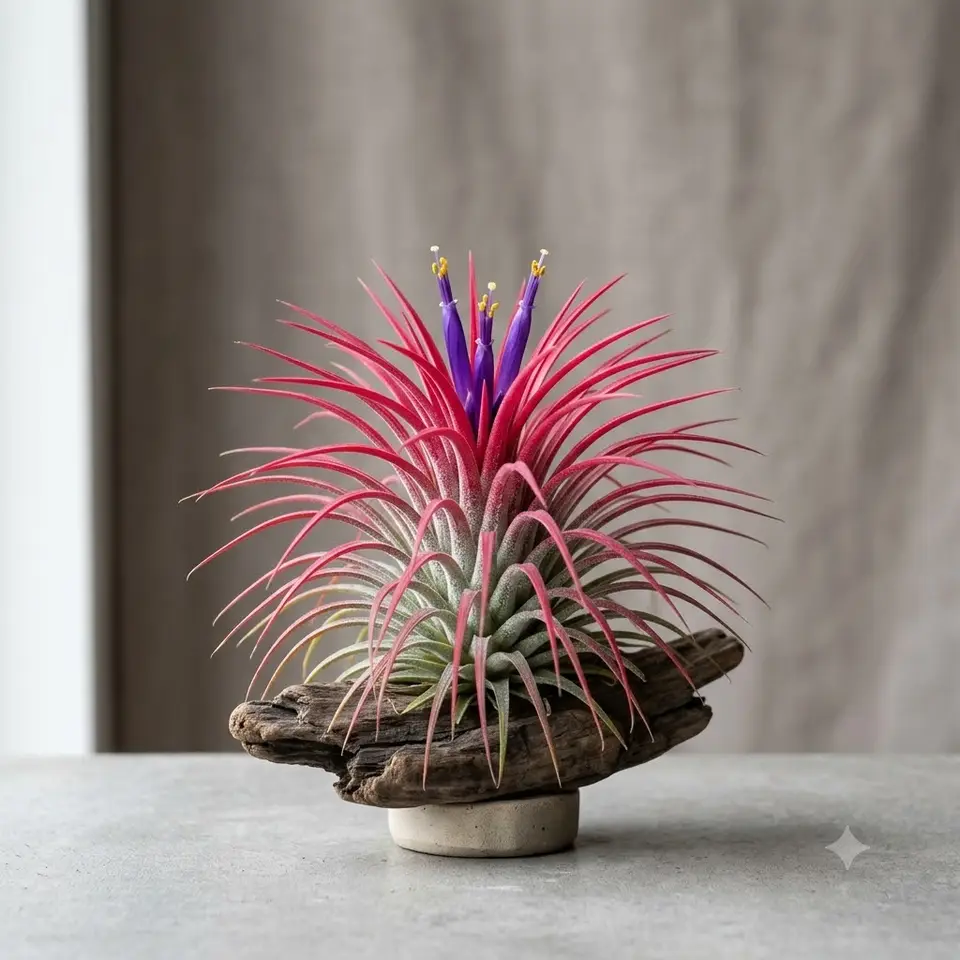 AI illustration
 Overview
Tillandsia Ionantha is one of the most popular air plants in the world, a tiny soil-free bromeliad that grips onto trees and rocks rather than roots into ground (Tillandsia ionantha). Its silvery-green leaves flush bright red or pink as it prepares to bloom, and the whole plant rarely grows larger than a golf ball. Because it needs no pot and no dirt, it is a favourite for mounted displays, terrariums, and open bowls.
Origin & Natural Habitat
Tillandsia ionantha is native to Mexico and Central America, ranging through Guatemala, Nicaragua, and Costa Rica. In the wild it is an epiphyte, clinging to tree bark, cliff faces, and rock outcrops in warm, humid forests and scrub. It draws moisture and nutrients from the air, rain, and dew through specialised scales on its leaves, which is why it survives without any soil at all.
Appearance
This is a small rosette plant, about 6 to 8 cm tall with leaves 3 to 6 cm long (Wikipedia; the Botany Brisbane species account allows up to 12 cm), made of narrow, tapering leaves that curve gently outward. The leaves are covered in fine silvery trichomes that give the plant a frosted, fuzzy look and help it capture water. As blooming approaches, the inner leaves blush vivid red, pink, or orange, and a tubular violet-purple flower with bright yellow stamens emerges from the centre. Mature size stays compact, and clustered plants form tight cushions over time.
Why People Grow It - Qualities & Benefits
- Needs no soil or pot, so it can be displayed almost anywhere
- Dramatic colour change to red and purple at flowering time
- Compact and lightweight, ideal for small spaces and terrariums
- Forgiving and beginner-friendly once the soaking routine is learned
Care
Light: Bright indirect light is ideal. A spot near an east or south-facing window with filtered sun keeps the colour strong without scorching the leaves. Avoid harsh direct midday sun through glass.
Water: Soak the whole plant in room-temperature water for 20 to 30 minutes about once a week, and mist lightly between soaks in dry rooms. Air plants take water through their leaves, not their roots, so misting alone is not enough. After each soak, shake off the excess and set the plant upside-down in a bright, airy spot until it is completely dry. Water trapped in the base is the number one cause of rot.
Mounting: Never plant it in dirt. Display it mounted on driftwood, cork bark, rock, or a shell, tucked into a wire frame, or resting loose in an open bowl. Whatever you choose, air must be able to circulate all the way around it.
Temperature & Humidity: Warm conditions of roughly 18 to 30°C suit it best, with good airflow at all times. It tolerates average household humidity but appreciates a little more; just make sure moisture never sits stagnant around the base.
Feeding: Feed monthly by adding a dilute bromeliad or air-plant fertiliser to the soak water. Use a quarter to half the label strength, as too much will burn the delicate leaves.
Extra: The make-or-break habit is drying, not watering. Always dry the plant fully upside-down within a few hours of soaking, because a rosette that stays wet at its core will rot from the inside out. Non-toxic to cats and dogs - a pet-safe plant.
Propagation
Tillandsia ionantha propagates through offsets, called pups, that form around the base after the plant flowers. Each parent typically produces two to several pups, which you can leave attached to form a clump or gently twist away once they reach about a third of the parent's size. The original plant slowly declines after blooming, which is normal, while the pups carry on and eventually bloom themselves.
Common Problems & Pests
- Rot and a soft, mushy or falling-apart base, almost always from water left sitting in the centre after soaking
- Dry, curled, or crispy leaf tips from too little water or very dry air
- Occasional mealybugs or scale, which can be rinsed off during a longer soak
Toxicity & Safety
Tillandsia ionantha is non-toxic to cats and dogs, making it one of the safest houseplants to keep around pets. There is no soil to spill or chew, which removes a common pet hazard entirely. The plant itself poses no poisoning risk, though as with anything, fertiliser-treated soak water should not be drunk by pets or people.
Pros & Cons
Pros
- No soil, no pot, and endless display options
- Genuinely pet-safe and non-toxic
Cons
- Rots easily if not dried properly after soaking
- Misting alone will slowly starve it of water
Best Suited For
- Beginners and small-space dwellers who want a low-mess plant
- Pet households looking for a guaranteed non-toxic option
FAQ
Do I really need to soak it, or is misting enough?
Soaking is essential. A weekly 20 to 30 minute soak rehydrates the whole plant, while misting only wets the surface and cannot keep it alive on its own over the long term.
Why did my air plant turn red?
That colour shift is a good sign. Tillandsia ionantha blushes red, pink, or orange as it prepares to flower, so the change means your plant is healthy and about to bloom.
Gear for growing tillandsia ionantha
Links go to Amazon or a partner store (such as Adagio Teas) and may earn us a commission at no extra cost to you. As an Amazon Associate we earn from qualifying purchases. We link gear types, not sponsors' picks: you choose the exact product.