Tillandsia Xerographica
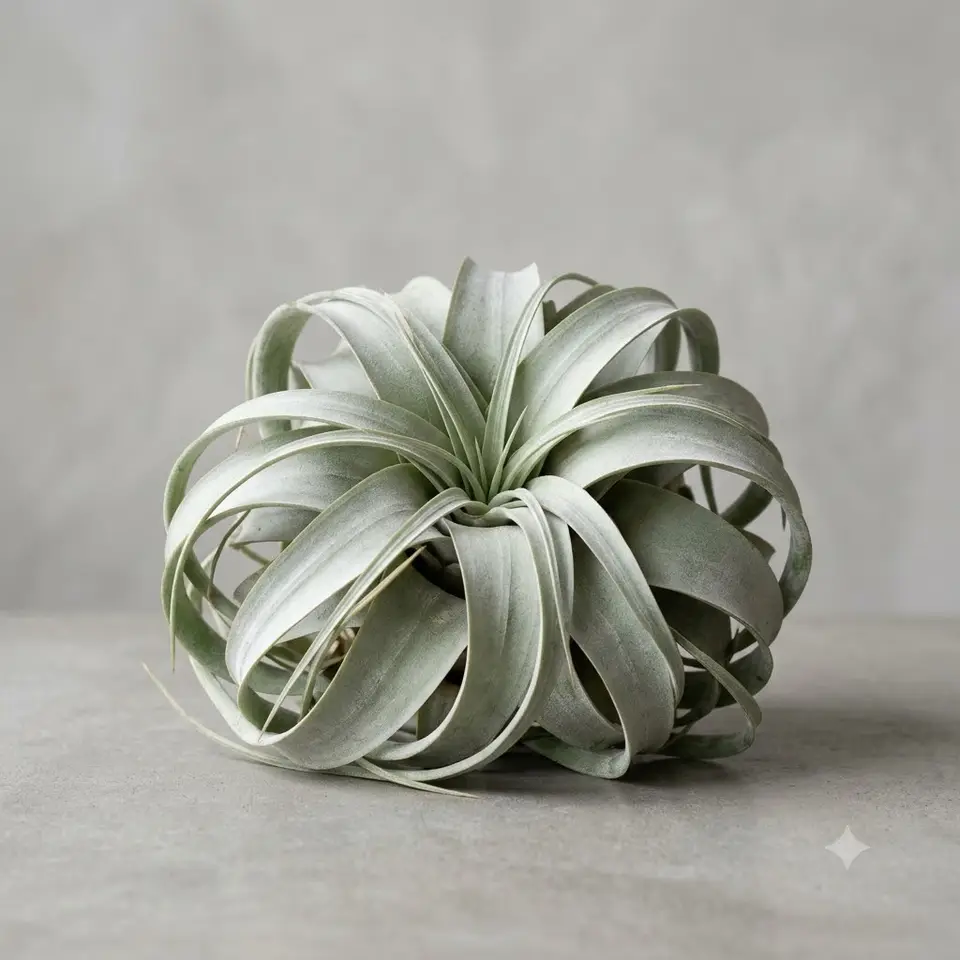
Tillandsia Xerographica, sometimes called the "king of air plants", is a large, silvery rosette of broad leaves that curl and twist like ribbon (Tillandsia xerographica).
Last reviewed: October 2026
 AI illustration
 Overview
Tillandsia Xerographica, sometimes called the "king of air plants", is a large, silvery rosette of broad leaves that curl and twist like ribbon (Tillandsia xerographica). It is an epiphyte, meaning it grows without soil and draws moisture and nutrients through its leaves rather than its roots. Slow-growing and long-lived, it is prized as much as a living ornament as a plant.
Origin & Natural Habitat
Xerographica is native to the dry regions of southern Mexico, Guatemala, El Salvador, and Honduras. It grows as an epiphyte in seasonally dry deciduous forest, anchoring itself to tree branches and rocks rather than rooting in ground. This is a xeric (drought-adapted) species: it survives long dry spells on high light, warm air, and the humidity it captures from the atmosphere, which is exactly why it resents sitting wet.
Appearance
The plant forms a symmetrical rosette of wide, tapering leaves that arch outward and curl at the tips, often spiralling into loose ringlets. Leaves are covered in fine silvery scales called trichomes, giving the whole plant a soft grey-green, almost frosted look. A mature specimen typically spans 30 to 60 cm across, with large collector plants reaching closer to 90 cm over many years. When it eventually blooms, it sends up a branched flower spike with tubular blooms in red, yellow, and purple tones.
Why People Grow It - Qualities & Benefits
- Striking, sculptural form that works as living decor with no pot or soil needed
- One of the more forgiving air plants thanks to its drought tolerance
- Extremely versatile display - it can sit in a bowl, on wood, or be mounted on a wall
- Long-lived and slow-growing, so a single specimen stays a centrepiece for years
Care
Light: Bright indirect light is ideal, and it tolerates a few hours of gentle direct sun. In a dim room it grows weak, loses its silvery bloom, and colours fade, so give it the brightest spot you can short of harsh midday glare.
Water: Soak the whole plant in room-temperature water for 20 to 30 minutes, then mist lightly between soakings. Air plants take up water through their leaves, not their roots, so misting alone never gives them enough - the soak is the real drink. Because xerographica is a dry-forest species, once every 1 to 2 weeks is usually plenty; in cool or humid conditions, less. Crucially, after every soak shake off the excess and dry the plant fully upside-down for several hours so no water pools in the centre.
Mounting: No soil, ever. Display it resting in a shallow bowl, nestled on driftwood, rock, or shell, or wired to a mount. Never plant it in dirt or potting mix - buried in soil the base holds moisture and rots.
Temperature & Humidity: Warm rooms of roughly 16 to 32°C suit it best, and it is not frost hardy. Good airflow matters more than high humidity - moving air lets the leaves dry quickly after watering and is the single biggest defence against rot.
Feeding: Feed roughly once a month by adding a dilute bromeliad or air-plant fertiliser to the soak water. Use it at quarter strength; too much fertiliser burns the trichomes.
Extra: The make-or-break rule is drying, not watering - a xerographica dies far more often from staying wet in still air than from thirst, so always dry it upside-down and give it airflow. Non-toxic to cats and dogs - a pet-safe plant.
Propagation
Xerographica reproduces by offsets, called pups, which form around the base after the plant flowers. Let each pup grow to about a third to half the size of the parent before gently twisting or cutting it away, then care for it exactly like an adult. Because the plant blooms only once in its life and grows slowly, patience is essential - pups can take many months to appear and years to reach full size.
Common Problems & Pests
- Rot - a soft, browning, or mushy centre, almost always from water pooling in the rosette or poor airflow after soaking
- Dehydration - leaves that curl tightly inward, roll, or feel crisp, a sign it needs a proper soak rather than just misting
- Scale or mealybugs - occasional sap-sucking pests that can be wiped off or treated; inspect the leaf bases where they hide
Toxicity & Safety
Tillandsia Xerographica is non-toxic to cats and dogs, making it one of the safest houseplants to keep around pets. There is no soil to spill or dig, which removes a common hazard. As basic good practice with any plant, do not let animals drink or eat the fertiliser solution, but the plant itself poses no poisoning risk.
Pros & Cons
Pros
- Pet-safe and completely non-toxic to cats and dogs
- Forgiving of drought and low-maintenance for an air plant
Cons
- Fatally intolerant of staying wet - rot is the number one killer
- Needs real soaking plus good airflow, not the quick misting many people assume is enough
Best Suited For
- Design-minded growers who want a sculptural, soil-free statement piece
- Pet households looking for a genuinely safe, striking houseplant
FAQ
Can I just mist it instead of soaking?
No. Misting only wets the surface and leaves the plant slowly dehydrating. Xerographica needs a full 20 to 30 minute soak to actually rehydrate, with misting used only as a light top-up between soaks.
Why did the centre of my plant turn brown and soft?
That is rot, and it almost always means water sat trapped in the rosette. Always dry the plant upside-down after soaking and keep it somewhere with moving air so the leaves dry within a few hours.
Gear for growing tillandsia xerographica
Links go to Amazon or a partner store (such as Adagio Teas) and may earn us a commission at no extra cost to you. As an Amazon Associate we earn from qualifying purchases. We link gear types, not sponsors' picks: you choose the exact product.