Tuberous Begonia
The Tuberous Begonia is a flowering tuberous perennial prized for its large, rose-like or camellia-like blooms in saturated shades of red, orange, yellow, pink and white.
Last reviewed: September 2026
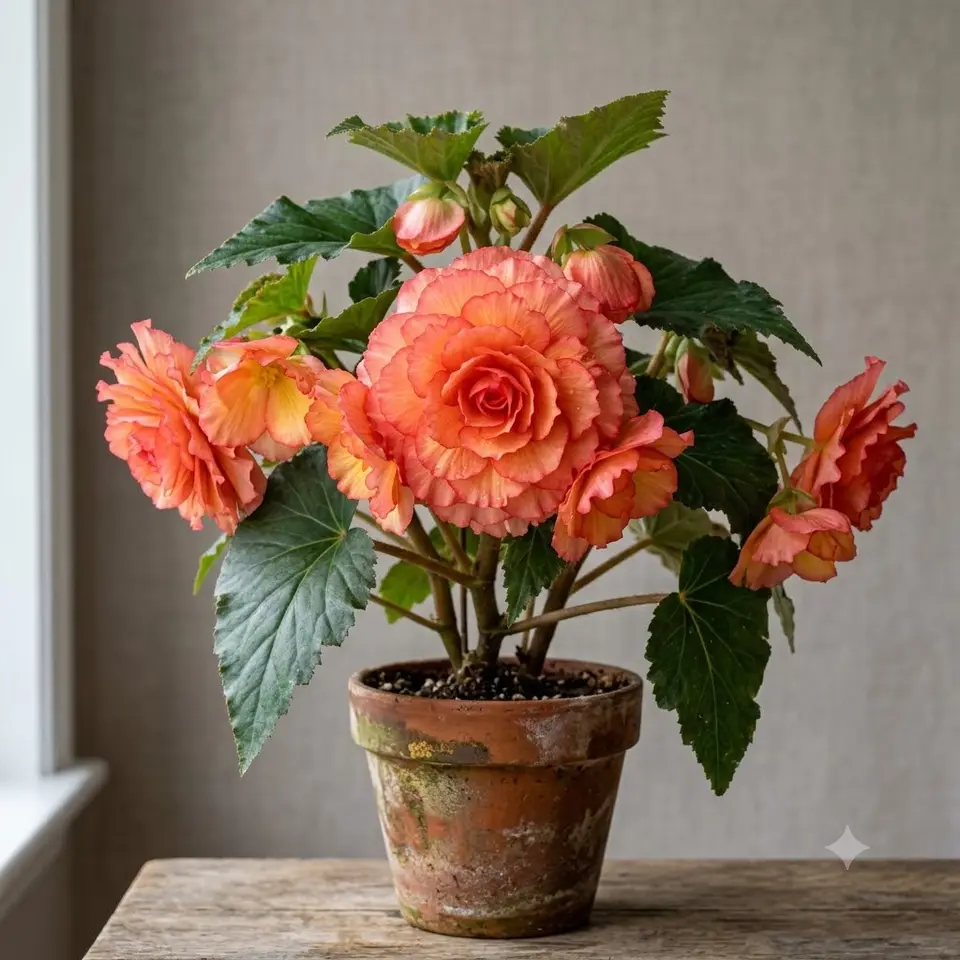 AI illustration
 Overview
The Tuberous Begonia is a flowering tuberous perennial prized for its large, rose-like or camellia-like blooms in saturated shades of red, orange, yellow, pink and white. Collectors grow it as much for the showy, often ruffled or double flowers as for its neat, asymmetric foliage, and both upright and cascading (pendula) forms exist. It is a complex garden hybrid group (Begonia × tuberhybrida).
Origin & Natural Habitat
The parent species were collected from the cool, humid cloud forests and high slopes of the Andes in South America, across Bolivia, Peru and Ecuador. Those ancestors evolved in bright but filtered light with steady moisture and mild temperatures, which is why the hybrids resent both harsh sun and stagnant heat.
Appearance
The leaves are typically asymmetric and ovate to heart-shaped, mid to deep green, sometimes flushed red on the undersides or along the veins, with a slightly fleshy, brittle texture. Flowers are the main event: they can reach 8 to 15 cm across, single or fully double, borne on succulent, somewhat weak stems. Grown from a flattened tuber, plants usually reach about 20 to 45 cm tall, with pendulous types trailing well over the pot edge.
Why People Grow It - Qualities & Benefits
- Some of the largest and most flamboyant blooms available in a compact houseplant
- A wide colour range plus single, double, ruffled and picotee flower forms to collect
- Trailing pendula types are excellent for hanging baskets and shelf edges
- Long flowering season through the warm months before a natural rest period
Care
Light: Bright, indirect light. Morning sun or filtered light is fine, but hot direct afternoon sun scorches the leaves and bleaches the flowers.
Water: Keep the mix evenly moist but never waterlogged. Water when the top 2-3 cm feel dry, and always let excess drain away - the tuber rots quickly in soggy soil. Avoid wetting the foliage.
Soil: A light, fast-draining, peat or coir based mix with added perlite or bark. Good aeration around the tuber is essential.
Temperature & Humidity: Warmth of roughly 16 to 24°C suits it best; it dislikes heat above 27°C and cold below 13°C. It wants higher humidity (50% or more), but be honest - pairing high humidity with poor airflow invites mildew, so give it moving air too.
Feeding: Feed every two weeks during active growth with a balanced or slightly high-potassium liquid fertilizer at half strength. Stop feeding as the plant begins to slow in autumn.
Extra: This plant goes dormant. In autumn the foliage yellows and dies back; reduce watering, let the tuber rest cool and nearly dry through winter, then restart it in spring. Do not throw out a plant that simply looks dead in winter. Toxic to cats and dogs (soluble calcium oxalates, most concentrated in the tubers) - keep out of reach of pets and children.
Propagation
Most reliably propagated by dividing a dormant or just-sprouting tuber, making sure each piece carries a growth bud (eye), then dusting cut surfaces with fungicide and letting them callus before potting. Basal or stem cuttings taken in spring also root in a moist, airy medium, and named strains can be grown from seed, though seedlings are slow and variable.
Common Problems & Pests
- Powdery mildew and botrytis (grey mould) in still, humid air - space plants and improve ventilation
- Stem and tuber rot from overwatering or water sitting on the crown
- Spider mites, thrips and mealybugs, especially in dry indoor heat; bud drop from sudden temperature or moisture swings
Toxicity & Safety
Begonia is toxic to cats and dogs. The plant contains soluble calcium oxalates, which are most concentrated in the tubers and underground parts. If chewed, they can cause intense oral irritation, drooling, pawing at the mouth and vomiting, and larger ingestions of the tuber carry more serious risk. The sap may also irritate sensitive skin, so wash your hands after handling or dividing tubers.
Pros & Cons
Pros
- Spectacular, large flowers in a huge colour and form range
- Compact size and trailing options fit shelves, baskets and small spaces
Cons
- Fussy about watering, humidity and airflow, and rot-prone if overwatered
- Goes fully dormant, so it is bare for part of the year and needs winter storage
Best Suited For
- Growers who enjoy a seasonal rhythm and don't mind a dormant rest period
- Collectors wanting bold blooms in a bright, humid, well-ventilated spot
FAQ
Why did my Tuberous Begonia suddenly die back?
Most likely it is entering natural dormancy, which is normal in autumn. Ease off water, keep the tuber cool and barely moist through winter, and it should resprout in spring.
Why are the flower buds dropping before they open?
Bud drop usually follows a stress or a swing in conditions - inconsistent watering, low humidity, a draft or a sudden temperature change. Aim for steady moisture, gentle airflow and stable warmth.
Sources
Pet toxicity: checked against the ASPCA Animal Poison Control Center lists of toxic and non-toxic plants for cats and dogs, genus-wide entry "Begonia" (Begonia spp.): toxic to cats and dogs. Lists read on 10 October 2026.
Gear for growing tuberous begonia
Links go to Amazon or a partner store (such as Adagio Teas) and may earn us a commission at no extra cost to you. As an Amazon Associate we earn from qualifying purchases. We link gear types, not sponsors' picks: you choose the exact product.