Vanilla Orchid
Vanilla is a vining orchid whose cured seed pods are the world's vanilla; it can be grown at home as a handsome climbing vine with succulent leaves.
Last reviewed: October 2026
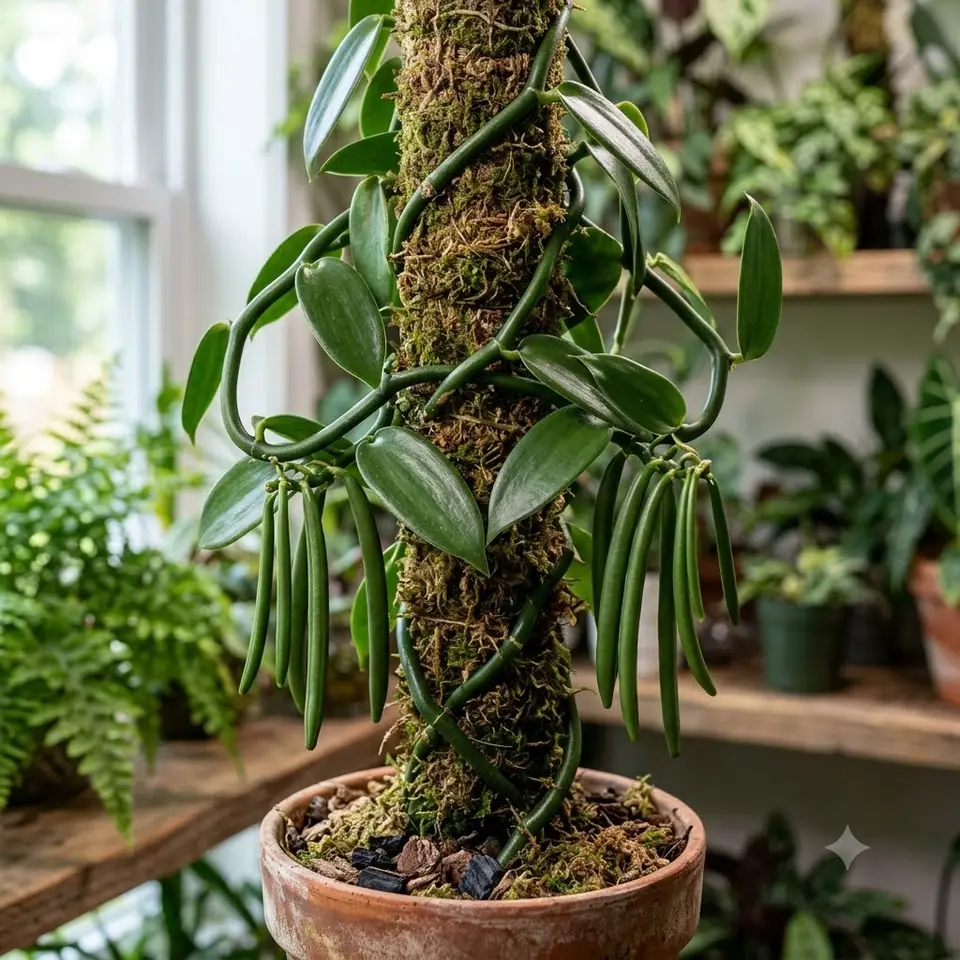 AI illustration
 Overview
Vanilla is a vining orchid whose cured seed pods are the world's vanilla; it can be grown at home as a handsome climbing vine with succulent leaves. Flowers (and thus pods) demand years, meters and greenhouse warmth, but even leafy, it's the most storied plant on the shelf. (Vanilla planifolia.)
Origin & Natural Habitat
Mexico and Central America - climbing tree trunks in warm humid forest; the Aztec spice-orchid, now farmed in Madagascar and beyond.
Appearance
A true VINE: thick zigzag stems with fleshy leaves and aerial roots, climbing meters given support; mature vines (3 m+) may produce greenish blooms lasting ONE DAY each - hand-pollinated the same morning to set pods.
Why People Grow It - Qualities & Benefits
- Grow actual vanilla: the world's favorite flavor
- Handsome fast climbing foliage regardless
- Variegated forms are striking
- The best plant STORY in the collection
Care
Light: Bright indirect with gentle sun; a warm bright wall or pole to climb decides its happiness.
Water: Moist-but-drained; mist aerial roots; the fleshy vine forgives brief lapses.
Potting medium: A chunky rooted base plus a climbing medium (moss pole, slab, trellis) - the aerial roots do half the living.
Temperature & Humidity: Warm always: 18-32°C, no cold below ~13°C; humidity 60%+ for real vigor.
Feeding: Dilute, every two weeks in warmth.
Rest & rebloom: None; growth follows warmth. FLOWERING asks maturity (3+ m of vine, a few years), a bright warm run and slight spring stress - the home-pod project is a real one.
Propagation
Stem cuttings of several nodes root readily - the commercial method too; a cutting from a friend is the traditional start.
Common Problems & Pests
- No flowers for years (normal: vines must reach size)
- One-day blooms missed = no pods (pollinate by 10 am with a toothpick)
- Rot at cold-wet roots
- Scale on stems
Toxicity & Safety
Orchids are generally considered non-toxic to cats and dogs - one of the safest flowering houseplant families. The cured pods are the familiar spice; raw plant sap contains calcium oxalate crystals and can cause moderate to severe skin irritation: handle prunings with care.
Pros & Cons
Pros
- Edible-history glamour
- Fast attractive vine
- Easy from cuttings
Cons
- Pods = greenhouse-level patience
- Day-length bloom logistics
- Needs warmth and meters
Best Suited For
- Warm sunrooms and greenhouses
- Story-driven growers
- Vine trainers
- Ambitious kitchen gardeners
FAQ
Will I actually get vanilla beans?
With a 3 m+ vine, greenhouse warmth, and YOU as the morning pollinator (each bloom lives a day) - yes, hobbyists genuinely do. As a leafy vine alone it's still worth the pot.
Why hand-pollinate?
Its natural pollinators, native bees of its home forests, don't live in your sunroom - and outside that range even commercial farms pollinate every bloom by hand, one by one, before noon.
Gear for growing vanilla orchid
Links go to Amazon or a partner store (such as Adagio Teas) and may earn us a commission at no extra cost to you. As an Amazon Associate we earn from qualifying purchases. We link gear types, not sponsors' picks: you choose the exact product.