Vanda Orchid
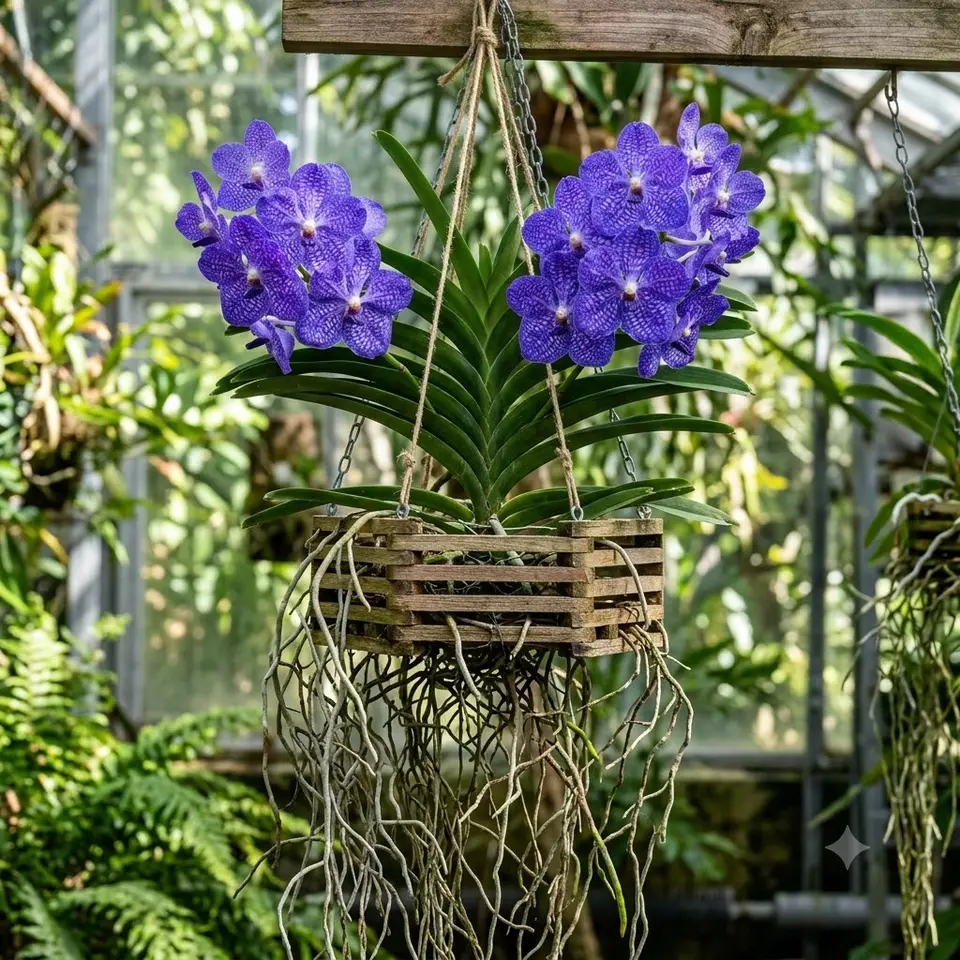
Vandas are orchids grown in empty baskets with roots dangling meters in the air, crowned with flat, saturated blooms in blues and purples no other orchid attempts.
Last reviewed: October 2026
 AI illustration
 Overview
Vandas are orchids grown in empty baskets with roots dangling meters in the air, crowned with flat, saturated blooms in blues and purples no other orchid attempts. They are tropical sun-and-humidity divas: spectacular where misted daily, doomed on a dim dry shelf. (Vanda.)
Origin & Natural Habitat
Monsoon Asia (India to the Philippines) high in bright tree crowns - full tropical light, daily rain, constant warm humidity.
Appearance
Strap-leaved ladders 30-120 cm with thick aerial roots cascading below; flat round blooms 5-12 cm in electric blues, purples, oranges and tessellated patterns.
Why People Grow It - Qualities & Benefits
- The blues: the closest thing to truly blue orchids
- Dramatic bare-root basket culture
- Huge flat long-lasting blooms
- A statement of successful tropical growing
Care
Light: Strong - the brightest of common orchids: near-full sun (acclimated) in humid climates, brightest possible windows elsewhere.
Water: The commitment: bare roots need DAILY drenching or misting (twice in heat) until green, then air-dry by night. In dry homes, soak-dunks and humidity do the work.
Potting medium: None - that's the point: empty slat baskets, roots in air. (Some growers use very coarse chunks in dry climates.)
Temperature & Humidity: Warm always: 18-32°C, never below ~13°C; humidity 60%+ is the real requirement.
Feeding: Weakly with nearly every watering in growth - constant light feeding suits constant bare-root rinsing.
Rest & rebloom: No true rest; bloom flushes several times yearly under good light. Shrivelled roots = under-humidity, the classic decline.
Propagation
Top-cutting a tall plant with aerial roots (the base often re-sprouts 'keikis'); side keikis potted when rooted.
Common Problems & Pests
- Desiccation in normal room air: the killer of shelf vandas
- No bloom = insufficient light
- Root loss from cold or drought
- They fail SLOWLY: by the time it looks bad, act fast
Toxicity & Safety
Orchids are non-toxic to cats and dogs - one of the safest flowering houseplant families.
Pros & Cons
Pros
- Unreal colors, incl. true blue-violet
- Sculptural root curtains
- Multiple flushes yearly when happy
Cons
- Daily-care regime
- Needs light + humidity most homes lack
- Not a beginner orchid, honestly
Best Suited For
- Bathrooms with bright windows
- Greenhouses, conservatories, humid climates
- Dedicated daily-ritual growers
- Tropical patios (frost-free)
FAQ
Can a vanda really live with no pot at all?
In nature they're bare-rooted on branches - the basket is just a handle. The trade: YOU become the rain, daily.
How do I keep one in a dry apartment?
Morning dunk-soaks (15 min in tepid water) + a bright bathroom + humidifier gets many through; if roots stay silver and shrivel, the home is telling you Phalaenopsis instead.
Gear for growing vanda orchid
Links go to Amazon or a partner store (such as Adagio Teas) and may earn us a commission at no extra cost to you. As an Amazon Associate we earn from qualifying purchases. We link gear types, not sponsors' picks: you choose the exact product.