Tillandsia Juncea
Tillandsia juncea is a grass-like air plant that grows a dense fountain of thin, quill-shaped leaves, giving it a soft, reed-like silhouette (Tillandsia juncea).
Last reviewed: September 2026
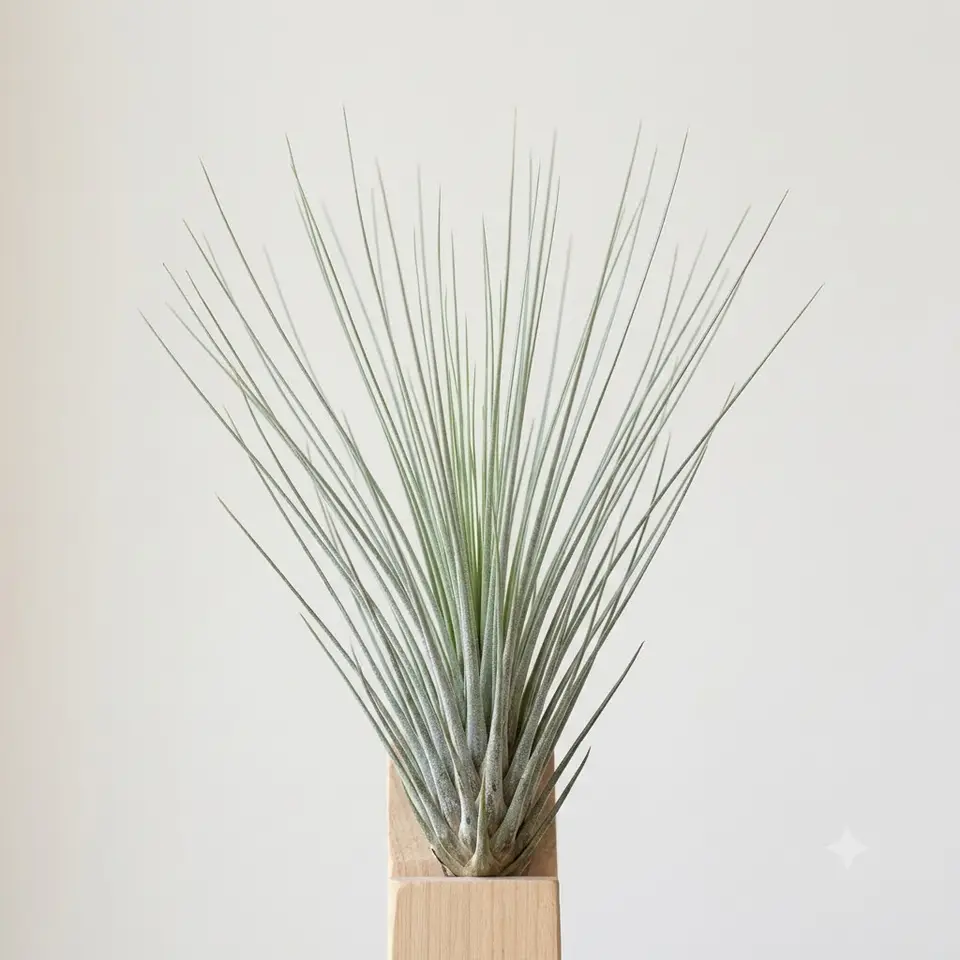 AI illustration
 Overview
Tillandsia juncea is a grass-like air plant that grows a dense fountain of thin, quill-shaped leaves, giving it a soft, reed-like silhouette (Tillandsia juncea). Like all true air plants, it lives without soil and takes in water and nutrients through tiny scales on its foliage rather than through roots. Its name comes from the Latin for "rush," a nod to its slender, upright, grassy form.
Origin & Natural Habitat
Tillandsia juncea is native to a wide band of the Americas, from Mexico through Central America and into northern South America, and it also grows in parts of the Caribbean. In the wild it is an epiphyte, anchoring itself to tree branches and rocky outcrops rather than rooting in the ground. It favours warm, humid forests and scrublands where it catches rain, dew, and airborne moisture on its leaves while enjoying bright, filtered light through the canopy.
Appearance
This species forms a tuft of many narrow, tapering leaves that arch outward like a spray of fine grass or rushes. Individual leaves are stiff yet slender, often 20 to 40 cm long but only a few millimetres wide, in a silvery green to grey-green colour thanks to the fine trichomes that coat them. A mature clump typically reaches around 25 to 40 cm tall. When it blooms, the centre can flush red or coral and push up a small spike with violet-toned flowers, a striking contrast against the muted foliage.
Why People Grow It - Qualities & Benefits
- Soil-free and easy to display in creative ways, from mounted driftwood to open bowls
- A soft, grassy texture that adds a natural, sculptural look to shelves and terrariums
- Compact and lightweight, so it fits small spaces and hanging arrangements
- Pet-safe, making it a comfortable choice for homes with cats and dogs
Care
Light: Bright indirect light is ideal. A spot near an east or shaded south window works well; strong, direct midday sun can scorch and dehydrate the leaves.
Water: Soak the whole plant in room-temperature water for 20 to 30 minutes about once a week, and mist lightly between soakings in dry rooms. Air plants drink through their leaves, not roots, so misting alone is not enough - a real soak is what keeps them hydrated. After soaking, shake off excess water and set the plant upside-down to dry fully within a few hours; trapped water sitting in the dense centre is the main cause of rot.
Mounting: Never plant it in dirt. Display it mounted on wood, cork, rock, or a shell, or simply resting in a dry bowl or wire holder. Avoid moss or any material that stays soggy against the base.
Temperature & Humidity: Warm conditions between about 15 and 30°C suit it best, along with good airflow. Moderate humidity helps, but airflow matters even more so the plant can dry quickly after watering.
Feeding: Add a dilute bromeliad or air-plant fertiliser to the soak water about once a month during the growing season to support healthy growth and blooming.
Extra: The make-or-break step is drying. This plant holds water in its tight cluster of leaves, so always dry it thoroughly upside-down and give it steady airflow - never leave it damp in a closed container. Non-toxic to cats and dogs - a pet-safe plant.
Propagation
Tillandsia juncea reproduces through offsets, often called pups, that emerge from the base after the parent plant flowers. Let each pup grow to roughly a third to half the size of the parent, then gently separate it or leave it to form a clustered clump. The parent slowly declines after blooming, which is normal, while the pups carry on the plant.
Common Problems & Pests
- Rot from water trapped in the centre after soaking, shown by a soft, browning, or mushy base
- Dehydration from misting only or too little water, seen as curling, wrinkled, or crispy leaf tips
- Occasional mealybugs or scale, which can be removed by hand or with a gentle rinse and inspection
Toxicity & Safety
Tillandsia juncea is non-toxic to cats and dogs and is considered a pet-safe plant. It poses no poisoning risk if a curious pet nibbles it. It is grown purely as an ornamental, and while the plant itself is safe, any fertiliser added to its soak water should be kept out of reach of pets and children.
Pros & Cons
Pros
- No soil needed and very flexible to display
- Pet-safe and low mess
Cons
- Prone to rot if not dried properly after soaking
- Needs regular soaking, not just quick misting
Best Suited For
- Plant lovers who enjoy soil-free, hands-on displays like mounts and terrariums
- Pet owners wanting a safe, sculptural accent plant
FAQ
Can I just mist Tillandsia juncea instead of soaking it?
Misting alone rarely gives it enough water. Its dense, grassy leaves need a full weekly soak of 20 to 30 minutes to stay hydrated, with misting used only as a light top-up between soaks.
Why is the base turning brown and soft?
That is usually rot from water sitting in the centre after watering. Always shake the plant out and dry it upside-down with good airflow, and avoid resting it on damp moss or leaving it in a closed, humid container.
Gear for growing tillandsia juncea
Links go to Amazon or a partner store (such as Adagio Teas) and may earn us a commission at no extra cost to you. As an Amazon Associate we earn from qualifying purchases. We link gear types, not sponsors' picks: you choose the exact product.