Tillandsia Stricta
Tillandsia Stricta (Tillandsia stricta) is one of the most popular and forgiving air plants, a soilless epiphyte that clings to branches in the wild and lives entirely on water and nutrients drawn through its leaves.
Last reviewed: September 2026
 AI illustration
 Overview
Tillandsia Stricta (Tillandsia stricta) is one of the most popular and forgiving air plants, a soilless epiphyte that clings to branches in the wild and lives entirely on water and nutrients drawn through its leaves. It forms a tidy rosette of fine, arching leaves and rewards good care with a short-lived but vivid blush of pink bracts and blue-purple flowers. Its toughness and quick pupping make it a common starting point for collectors of the genus.
Origin & Natural Habitat
Native to eastern and southern South America, Tillandsia stricta grows across Brazil, Paraguay, Uruguay, Argentina, Venezuela and Trinidad. It is an epiphyte, anchoring to tree bark, shrubs and sometimes rock and dune scrub rather than rooting in soil. In these habitats it sits in bright, filtered light with plenty of moving air, catching moisture from rain, mist and humidity rather than from the ground.
Appearance
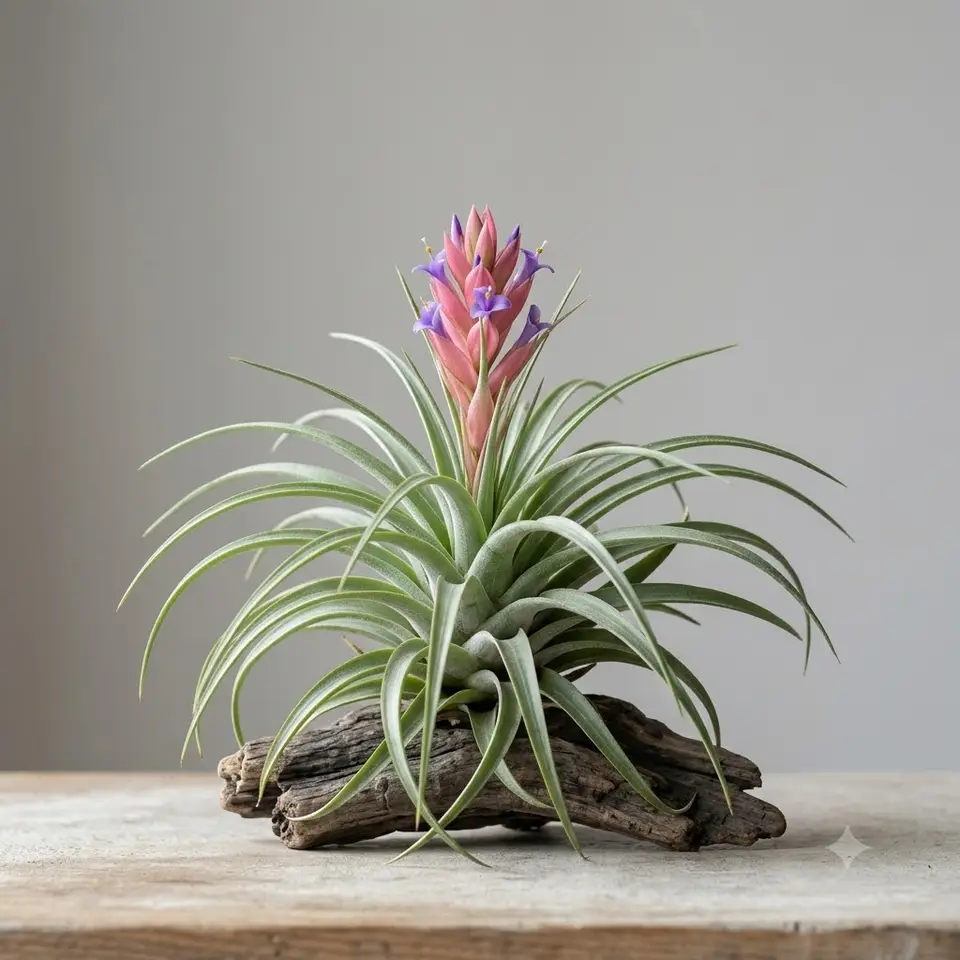
The plant builds a dense rosette of narrow, tapering leaves that arch outward and curl slightly at the tips. Leaves are typically 5 to 12 cm long and range from soft silvery-green to a greyer, more fuzzy-scaled look depending on the form, with soft-leaf and hard-leaf types both in cultivation. Mature plants stay compact, usually around 8 to 15 cm across. At flowering it pushes out a bright rose-pink bract holding small tubular blue to violet flowers, a display that lasts only a few days but is a highlight of growing it.
Why People Grow It - Qualities & Benefits
- Needs no pot or soil, so it can be displayed almost anywhere with good light and air
- Very forgiving and fast to produce offsets, making it one of the easiest air plants to keep and multiply
- Delivers a striking pink-and-violet bloom that signals a healthy, mature plant
- Compact and lightweight, ideal for small spaces, shelves and mounted arrangements
Care
Light: Bright indirect light. A spot near an east or lightly shaded south window is ideal. Avoid harsh midday sun through glass, which can scorch and dry the leaves too fast.
Water: Soak the whole plant in room-temperature water for 20 to 30 minutes about once a week, and mist lightly between soakings in dry rooms. Air plants take water in through their leaves, not roots, so misting alone is not enough. Crucially, shake off excess and dry the plant fully upside-down for a few hours after soaking so water does not sit in the crown - trapped moisture is the number one cause of rot.
Mounting: No soil, ever. Display it mounted on driftwood, cork, rock or a shell, or resting loose in an open bowl or frame. Never plant it in dirt, and never glue over the base or bury the leaf crown.
Temperature & Humidity: Warm conditions of roughly 15 to 30°C suit it, with moderate humidity and, most importantly, good airflow. Steady air movement helps it dry out between waterings and keeps rot at bay.
Feeding: Add a dilute bromeliad or air-plant fertiliser to the soak water about once a month during active growth. Use a quarter to half the label strength - too much will burn the leaf scales.
Extra: The make-or-break rule is drying, not watering. Get the plant fully dry within about four hours of every soak and it will thrive; leave water pooled in the base and it will slowly rot from the centre out. Non-toxic to cats and dogs - a pet-safe plant.
Propagation
Propagation is easy through offsets, called pups. After the plant flowers, it produces one or more pups around its base. Leave them attached until each pup reaches about a third to half the size of the parent, then gently twist it free or simply let the cluster grow on together into a fuller clump. The original rosette slowly declines after blooming, which is normal, while the pups carry on.
Common Problems & Pests
- Rot from trapped water, shown by a browning, mushy base and leaves that pull out easily - almost always caused by poor drying or a crown left wet
- Dehydration, shown by exaggerated leaf curl, browning tips and a papery feel, from too-infrequent soaking or very dry air
- Mealybugs or scale occasionally, appearing as white cottony spots or small brown bumps that can be picked off or treated with a gentle rinse
Toxicity & Safety
Tillandsia stricta is non-toxic to cats and dogs, making it one of the safer houseplants for pet households. Because it grows without soil there is no potting mix to cause stomach upset. As with any plant, pets should not be encouraged to chew it, and water that has been dosed with fertiliser should not be left where animals might drink it.
Pros & Cons
Pros
- Soilless and low-mess, with no pot or repotting needed
- Beginner-friendly, pet-safe and quick to produce offsets
Cons
- Rots quickly if not dried properly after soaking
- Needs genuine weekly soaking, not just misting, so it is not truly hands-off
Best Suited For
- Beginners and small-space growers who want a plant with no soil and minimal fuss
- Pet owners looking for a safe, decorative species to mount or display in the open
FAQ
Can I just mist my Tillandsia Stricta instead of soaking it?
Misting alone will not keep it hydrated. It helps between waterings, but the plant needs a full 20 to 30 minute soak roughly weekly to take up enough water through its leaves.
Why did my plant turn mushy at the base?
That is rot from water sitting in the crown. Always shake off excess and dry the plant upside-down within a few hours of soaking, and keep it somewhere with good airflow to prevent it happening again.
Gear for growing tillandsia stricta
Links go to Amazon or a partner store (such as Adagio Teas) and may earn us a commission at no extra cost to you. As an Amazon Associate we earn from qualifying purchases. We link gear types, not sponsors' picks: you choose the exact product.