Tillandsia Tectorum
Tillandsia Tectorum is the fuzziest, most snow-white of the air plants, prized by collectors for the dense silvery fuzz that coats every leaf (Tillandsia tectorum).
Last reviewed: September 2026
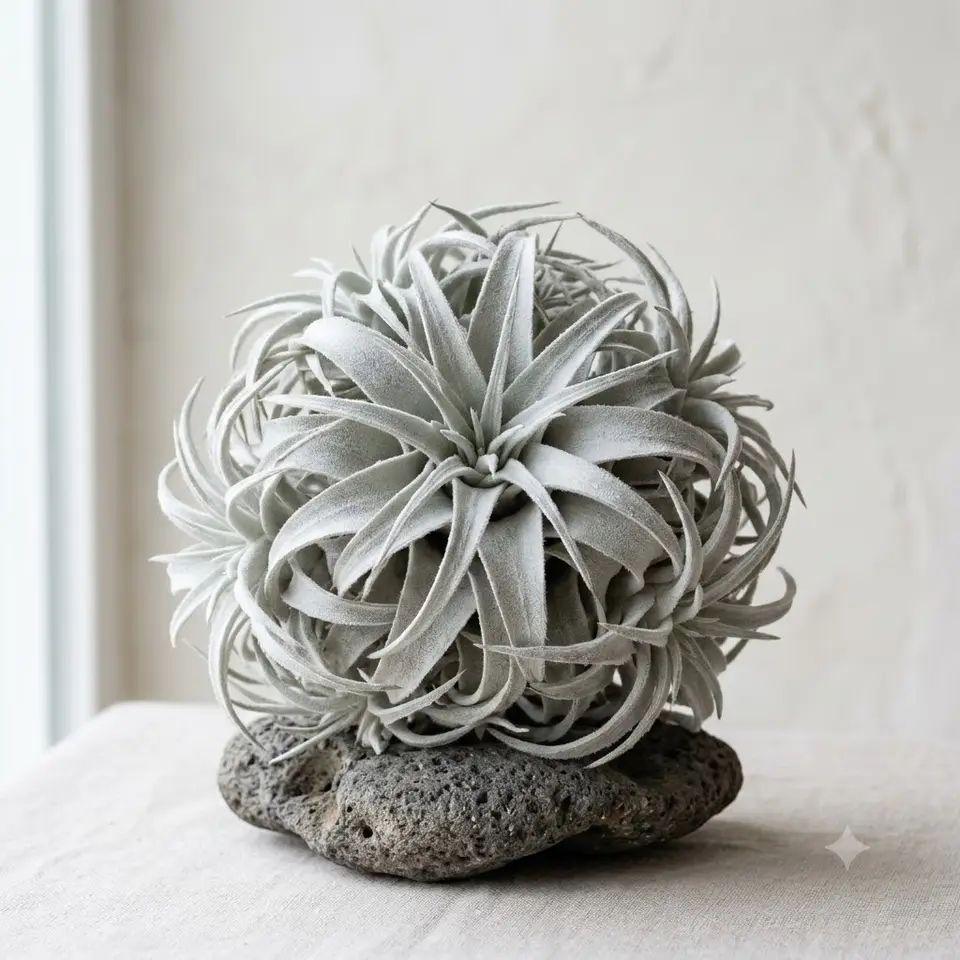 AI illustration
 Overview
Tillandsia Tectorum is the fuzziest, most snow-white of the air plants, prized by collectors for the dense silvery fuzz that coats every leaf (Tillandsia tectorum). Those hairs are not decoration for their own sake - they are living trichomes that scoop moisture from mist and fog. It is a soil-free epiphyte that grows entirely on air, light and the water it catches through its leaves.
Origin & Natural Habitat
Tillandsia tectorum is native to the high Andes of Ecuador and Peru, where it clings to sun-baked rock faces, cliffs and even rooftops at elevations that can top 3,000 metres. This is an arid, high-UV, high-airflow habitat with intense daytime sun and cool nights, and moisture arriving mostly as fog and dew rather than rain. The heavy coat of trichomes is a direct adaptation to that punishing, dry environment - it reflects fierce sunlight and harvests water from the air.
Appearance
Expect a rosette of narrow, tapering leaves that recurve and twist, giving the plant a soft, cloud-like or almost feathery silhouette. The whole plant reads as frosty silver-white because the trichomes are so dense they almost hide the green tissue beneath; a drier plant looks whiter, while a freshly watered one darkens slightly and shows more of its base colour. Forms range from tight, compact clumps to a looser "large form" with elongated stems, and a mature plant typically sits somewhere around 8 to 15 cm across. When it blooms it pushes out a spike with soft lavender-purple flowers that contrast beautifully against the white foliage.
Why People Grow It - Qualities & Benefits
- Genuinely striking - the dense white fuzz makes it one of the most ornamental air plants you can own.
- Needs no pot and no soil, so it fits shells, driftwood, wire frames or a simple bowl.
- More drought-tolerant than most Tillandsias, which suits forgetful or travel-prone owners.
- Compact and lightweight, easy to display in tight or unconventional spaces.
Care
Light: Bright indirect light, and it will happily take a few hours of gentle direct sun - it is a high-altitude sun lover. The brighter and drier the light, the whiter and fuzzier it stays. Deep shade dulls the colour and invites rot.
Water: Air plants take up water through their leaves, not roots. That said, tectorum is the exception among air plants: its dense trichomes hold moisture, and it comes from an arid habitat, so it prefers frequent light misting over heavy soaking. Mist it 2 to 3 times a week until the leaves darken, and give it a short 20 to 30 minute soak only occasionally - roughly every 2 to 3 weeks - rather than the weekly soak other Tillandsias want. After any soak or heavy misting, shake it out and dry it fully upside-down in good airflow so no water sits trapped in the crown. Standing wet is the number one killer here.
Mounting: No soil, ever. Display it mounted on wood, cork, rock or a shell, or resting loose in an open bowl. Never plant it in dirt and never glue or bury the base in a way that traps moisture - it needs to dry out completely between waterings.
Temperature & Humidity: Warm, roughly 15 to 30°C, with excellent airflow. Unlike jungle air plants it does not crave high humidity, and stagnant, humid air is a rot risk. Keep it out of hard frost.
Feeding: Feed lightly with a dilute bromeliad or air-plant fertiliser about once a month, added to the water you mist or soak with. Go weak - too much fertiliser can burn the trichomes.
Extra: The make-or-break rule for tectorum is simple: when in doubt, keep it drier. It forgives underwatering far better than overwatering, so treat the misting bottle as your main tool and reserve soaks for occasional deep drinks. Non-toxic to cats and dogs - a pet-safe plant.
Propagation
Like other Tillandsias, tectorum reproduces by offsets, known as pups, which emerge from the base after the plant flowers. Once a pup reaches roughly a third to a half the size of the parent, you can gently twist it free, or simply leave it attached to form a natural clump over time. Growth is slow, so patience is essential - this is a plant measured in seasons, not weeks.
Common Problems & Pests
- Rot from staying wet - a brown, mushy or collapsing centre almost always means water sat trapped in the crown.
- Dehydration - tightly curling, brittle leaves and a papery feel mean it needs more misting.
- Scale or mealybugs occasionally appear; check the leaf bases and remove pests by hand or with a diluted mild treatment.
Toxicity & Safety
Tillandsia tectorum is non-toxic to cats and dogs, and it is safe around children too. Air plants are genuinely pet-safe, so it is a worry-free choice for households with curious animals. As a common-sense note, the plant is not food and any fertiliser solution should never be eaten, but the plant itself poses no poisoning hazard.
Pros & Cons
Pros
- One of the most beautiful, distinctly white air plants available.
- Drought-tolerant and forgiving of missed waterings compared with other Tillandsias.
Cons
- Counterintuitive watering - easy to kill by overwatering if you treat it like a typical air plant.
- Slow-growing, so clumps and displays take a long time to build.
Best Suited For
- Collectors who want a standout, sculptural air plant and understand it needs less water, not more.
- Busy or travel-prone owners who would rather underwater than fuss daily.
FAQ
Should I soak Tillandsia tectorum like other air plants?
Not on the same schedule. Because of its dense trichomes and dry native habitat, tectorum prefers regular light misting and only occasional short soaks every couple of weeks. Frequent weekly soaking, which suits greener air plants, tends to rot this one.
Why does my tectorum look greener after watering?
That is normal. When the trichomes are wet they lie flat and let the green tissue show through, so the plant looks darker. As it dries it fluffs back up and returns to its signature frosty white - a handy visual cue that it has dried out.
Gear for growing tillandsia tectorum
Links go to Amazon or a partner store (such as Adagio Teas) and may earn us a commission at no extra cost to you. As an Amazon Associate we earn from qualifying purchases. We link gear types, not sponsors' picks: you choose the exact product.