Tillandsia Harrisii
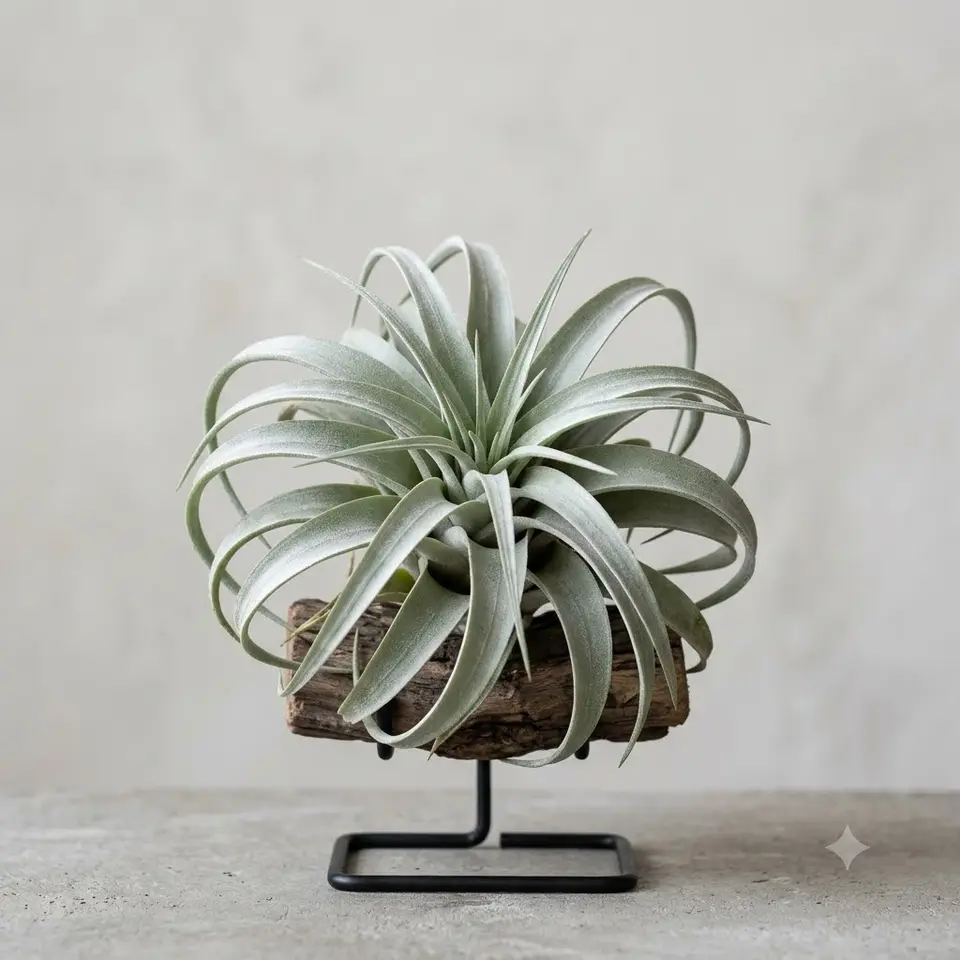
Tillandsia Harrisii is a soft, silvery air plant prized for its velvety fuzz and graceful curving rosette (Tillandsia harrisii).
Last reviewed: September 2026
 AI illustration
 Overview
Tillandsia Harrisii is a soft, silvery air plant prized for its velvety fuzz and graceful curving rosette (Tillandsia harrisii). It is an epiphyte, which means it grows anchored to surfaces rather than in soil, drawing moisture and nutrients straight through its leaves. That habit makes it one of the most sculptural, low-footprint plants you can keep on a shelf.
Origin & Natural Habitat
The species is endemic to Guatemala, native to the hot, dry Motagua River valley in the country's interior. There it grows in thorn scrub and semi-desert, clinging to rocks and tree bark in bright sun and low humidity. It survives on dew, brief rains, and steady air movement rather than rich ground, which is why it copes with drought but resents standing water. Wild populations are limited, and the species is CITES-listed, so cultivated stock is the responsible source.
Appearance
Harrisii forms an open rosette of narrow, tapering leaves that arch outward in a soft curve, typically reaching about 15 to 20 cm across and tall. The whole plant is coated in dense silvery-white trichomes, giving it a suede-like, powdery grey-green colour and a plush texture. When mature it sends up a striking flower spike: a flattened coral-red bract holds a row of tubular violet-purple flowers, a dramatic contrast against the pale foliage.
Why People Grow It - Qualities & Benefits
- No pot or soil needed, so it fits shelves, driftwood, and tight display spaces
- The silvery velvet texture and sculptural curve read as living decor
- Striking red-and-purple bloom on an otherwise pale, muted plant
- Forgiving of neglect and low humidity once you learn the soak rhythm
Care
Light: Bright indirect light is ideal; it tolerates some gentle direct sun but keep it out of harsh, baking midday rays behind glass.
Water: Soak the whole plant in room-temperature water for 20 to 30 minutes about once a week, and mist lightly between soaks in dry rooms. Air plants take water through their leaves, not roots, so a quick misting alone is not enough. After every soak, shake it out and set it upside-down to dry fully within a few hours; trapped water in the base is the number one killer.
Mounting: No soil, ever. Display it resting in a bowl or mounted on wood, cork, rock, or a shell using wire or a dab of non-toxic adhesive. Never bury the base in dirt, which suffocates it and causes rot.
Temperature & Humidity: Warm and airy suits it best, roughly 15 to 30°C, with good airflow around the leaves. It handles average household humidity; the priority is that it dries out quickly after watering.
Feeding: Add a dilute bromeliad or air-plant fertiliser to the soak water about once a month during the growing season; a quarter strength is plenty.
Extra: The make-or-break tip is airflow and drying, not watering more. A plant that never fully dries will rot from the centre no matter how healthy it looks. Non-toxic to cats and dogs - a pet-safe plant.
Propagation
Like most Tillandsia, Harrisii is monocarpic, meaning the rosette flowers once and then slowly declines while producing offsets called pups. After blooming, small pups emerge from the base; leave them attached until each reaches roughly a third to half the size of the parent, then gently twist them free to grow on their own. Over time a single plant becomes a clustering colony.
Common Problems & Pests
- Rot from staying wet: a mushy, browning base or leaves that pull out easily means water sat too long
- Dehydration: exaggerated leaf curl, wrinkling, or crisp brown tips signal it needs a longer soak
- Mealybugs or scale occasionally hide between leaves; rinse them off and treat spot infestations
Toxicity & Safety
Tillandsia Harrisii is non-toxic to cats and dogs, and is considered a pet-safe houseplant. There are no known poisonous compounds in the foliage. As with any plant, discourage pets from chewing it, and keep fertiliser solution out of reach since the concentrate is not meant to be ingested, but the plant itself poses no poisoning risk.
Pros & Cons
Pros
- Needs no soil or pot, so it is endlessly flexible to display
- Drought-tolerant and pet-safe, forgiving of the occasional missed watering
Cons
- Rots quickly if it cannot dry out, so drainage and airflow are non-negotiable
- Flowers only once per rosette before slowly giving way to pups
Best Suited For
- Small-space growers and renters who want greenery without pots or soil
- People with curious cats or dogs who need a genuinely non-toxic plant
FAQ
Can I just mist it instead of soaking?
No. Misting raises surface humidity but does not rehydrate the plant enough on its own. A weekly 20 to 30 minute soak is what actually keeps it alive; misting is only a between-soak supplement in dry air.
Why did my air plant turn mushy and fall apart?
That is almost always rot from water trapped in the base. Always dry it upside-down after soaking, give it strong airflow, and never let it sit in a puddle or in soil.
Gear for growing tillandsia harrisii
Links go to Amazon or a partner store (such as Adagio Teas) and may earn us a commission at no extra cost to you. As an Amazon Associate we earn from qualifying purchases. We link gear types, not sponsors' picks: you choose the exact product.