Tillandsia Fuchsii
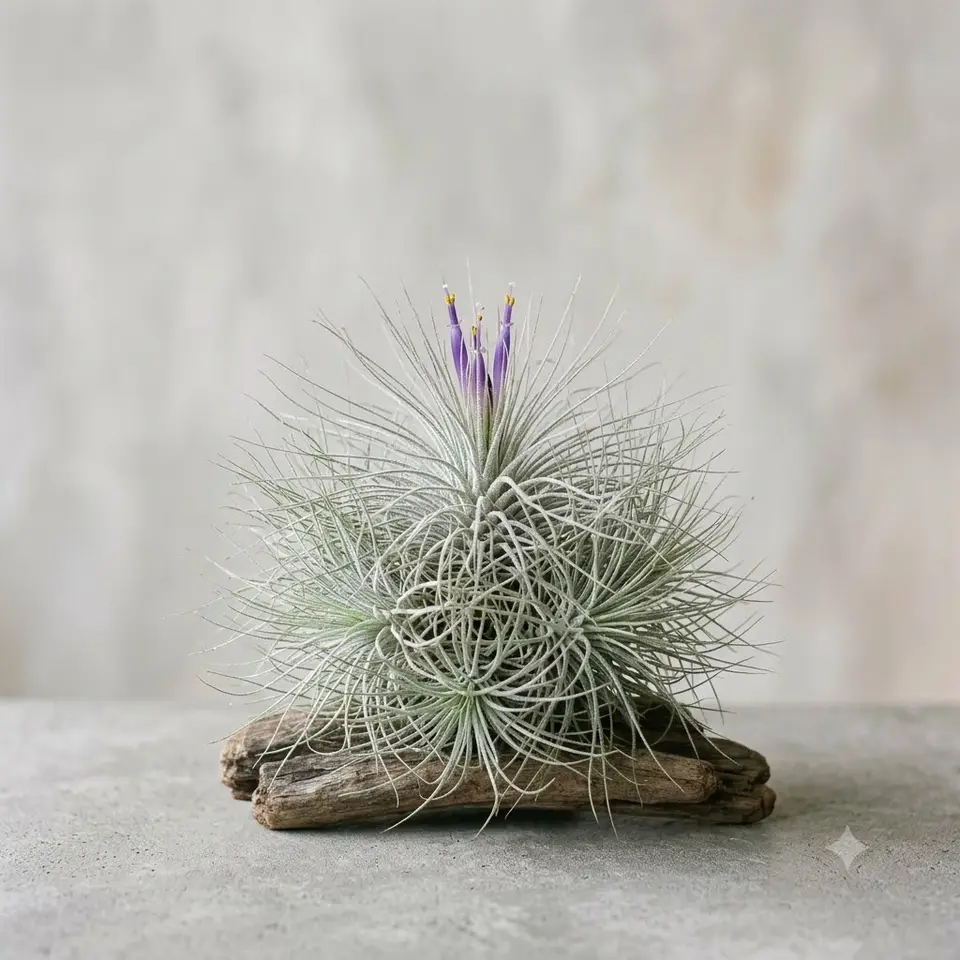
Tillandsia fuchsii is a tiny, sculptural air plant prized by collectors for its round bulbous base and halo of hair-thin, silvery leaves that look like a soft green firework (Tillandsia fuchsii).
Last reviewed: September 2026
 AI illustration
 Overview
Tillandsia fuchsii is a tiny, sculptural air plant prized by collectors for its round bulbous base and halo of hair-thin, silvery leaves that look like a soft green firework (Tillandsia fuchsii). It is an epiphyte, meaning it grows on other surfaces rather than in soil, drawing moisture and nutrients through its leaves. Small enough to sit in the palm of your hand, it is one of the more delicate members of the genus and rewards attentive watering.
Origin & Natural Habitat
Tillandsia fuchsii is native to Mexico and Guatemala. In the wild it grows as an epiphyte, anchoring itself to tree branches and rough bark in semi-arid highland forests and scrub. There it lives entirely above the ground, exposed to bright filtered light, warm days, cooler nights and regular airflow that dries it out between rains and dews.
Appearance
This is a small species, typically reaching only 5 to 10 cm across including its leaves. It forms a rounded, slightly bulbous base from which dozens of extremely fine, needle-like leaves radiate in all directions, creating a soft, fuzzy, spherical silhouette. The leaves are coated in tiny silvery scales called trichomes, giving the whole plant a frosted grey-green colour. When mature and happy, it sends up a slender spike bearing a narrow red-and-green bract and small tubular violet flowers that stand well above the leaf ball. A finer-leaved form, sometimes sold as var. gracilis, has even more delicate, thread-like foliage.
Why People Grow It - Qualities & Benefits
- Its dandelion-like, spherical shape is unlike almost any other houseplant and makes an instant conversation piece.
- It needs no pot and no soil, so it can be displayed in creative ways on wood, stone or in a small dish.
- Its compact size suits tiny spaces, shelves, desks and terrarium-style displays.
- It is completely non-toxic, making it a safe choice in homes with cats and dogs.
Care
Light: Bright, indirect light. A spot near an east or west window, or a metre back from a bright south window, is ideal. Protect it from harsh, direct midday sun, which can scorch the fine leaves.
Water: Soak the whole plant in room-temperature water for 20 to 30 minutes about once a week, and give it a light mist once or twice between soaks in dry rooms. Air plants take in water through their leaves, not roots, so a quick misting alone is not enough to keep this species hydrated. Crucially, after every soak, shake off the excess and set the plant upside-down to dry fully within a few hours - trapped water sitting in the bulbous base is the most common cause of rot.
Mounting: No soil, ever. Display it mounted on driftwood, cork bark, a rock or a shell, tucked into a wire holder, or resting loose in a shallow open bowl. Never plant it in dirt or pack the base in moss, as this traps moisture and rots the plant.
Temperature & Humidity: Warm, comfortable room temperatures of roughly 15 to 28°C suit it well. It enjoys moderate humidity but, above all, good airflow so it can dry quickly after watering. Avoid stuffy, stagnant corners.
Feeding: Feed roughly once a month by adding a dilute bromeliad or air-plant fertiliser to the soak water at about a quarter of the label strength. Do not over-feed, as the fine leaves are sensitive.
Extra: The make-or-break rule is drying, not watering - always turn the plant upside-down and let it dry completely after each soak, because water pooling in the fuzzy base will silently rot it from the centre out. Non-toxic to cats and dogs - a pet-safe plant.
Propagation
Like other Tillandsia, it propagates by producing offsets, known as pups, usually after it has flowered. Once a pup has grown to roughly one-third to one-half the size of the parent, you can gently twist or cut it away and grow it on as an independent plant, or leave it attached to form a clustered clump over time. The parent slowly declines after flowering and fruiting, which is normal for the genus.
Common Problems & Pests
- Rot from trapped water: a mushy, darkening or collapsing base almost always means water sat in the crown; improve drying and airflow.
- Dehydration: leaves that curl tightly, crisp at the tips or feel brittle signal it needs longer, more frequent soaks rather than just misting.
- Pests are uncommon, but mealybugs or scale can occasionally appear as small white or brown bumps; remove them and rinse the plant thoroughly.
Toxicity & Safety
Tillandsia fuchsii is non-toxic to both cats and dogs, and air plants in general are considered pet-safe. There is no soil to worry about, though as with any plant it is sensible to keep fertiliser bottles and treated soak water out of reach and to discourage pets from chewing on the foliage.
Pros & Cons
Pros
- Striking, unusual spherical form that needs no pot or soil.
- Small, pet-safe and easy to display almost anywhere with bright light.
Cons
- Fine leaves and a bulbous base make it more rot-prone than sturdier air plants.
- Needs genuine weekly soaking and careful drying, not just occasional misting.
Best Suited For
- Collectors who enjoy small, sculptural specimens and hands-on watering routines.
- Homes with pets, bright indirect light and good airflow.
FAQ
Can I keep Tillandsia fuchsii alive by misting alone?
No. Misting raises humidity but does not fully hydrate it. This species needs a proper 20 to 30 minute soak about weekly, with misting only as a supplement between soaks.
Why did my plant turn mushy in the middle?
That is rot caused by water trapped in the bulbous base. After every soak, shake it out and dry it upside-down within a few hours, and make sure it sits somewhere with good air movement.
Gear for growing tillandsia fuchsii
Links go to Amazon or a partner store (such as Adagio Teas) and may earn us a commission at no extra cost to you. As an Amazon Associate we earn from qualifying purchases. We link gear types, not sponsors' picks: you choose the exact product.