Tillandsia Caput-Medusae
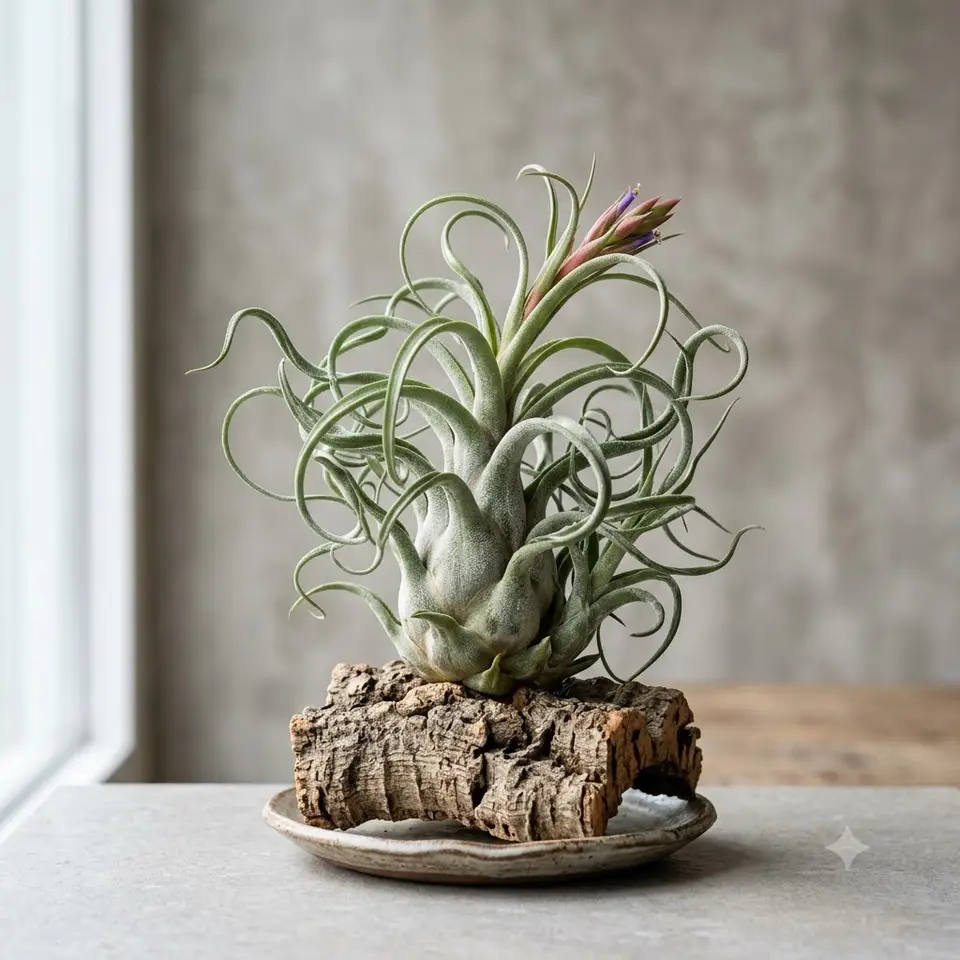
Tillandsia Caput-Medusae is one of the most recognisable air plants, named after the mythological Medusa for its thick, snaking leaves that writhe outward from a swollen base (Tillandsia caput-medusae).
Last reviewed: September 2026
 AI illustration
 Overview
Tillandsia Caput-Medusae is one of the most recognisable air plants, named after the mythological Medusa for its thick, snaking leaves that writhe outward from a swollen base (Tillandsia caput-medusae). It grows without soil, drawing water and nutrients through silvery scales on its foliage, which makes it a favourite for mounted displays and terrariums. It is forgiving of neglect but unforgiving of staying wet, so drainage and airflow matter more than watering frequency.
Origin & Natural Habitat
This species is native to southern Mexico and Central America, ranging through Guatemala, Honduras, El Salvador and Nicaragua. In the wild it is an epiphyte, clinging to tree branches and rock faces in dry to seasonally humid forests and scrub. It endures bright sun, warm air and long dry spells, absorbing moisture from rain, mist and dew rather than from any root system in soil.
Appearance
The plant forms a hollow, bulbous base, often greenish to purple-tinged, from which several thick, tapering leaves curl and twist like tentacles. Leaves are covered in fine grey trichomes that give the whole plant a soft silvery-green cast, turning greener when hydrated and more silver when dry. A mature specimen typically reaches around 15 to 25 cm across. When blooming, it pushes up a bright red or pink branched spike carrying tubular violet-blue flowers, a striking contrast against the muted foliage.
Why People Grow It - Qualities & Benefits
- Needs no pot or soil, so it can be displayed almost anywhere with good light
- Sculptural, snake-like form that works as living decor on wood, shell or in a bowl
- Compact and lightweight, ideal for small spaces, shelves and terrariums
- Rewarding bloom of vivid red bract and purple flowers on a mature plant
Care
Light: Bright indirect light is ideal; a few hours of gentle morning sun is fine, but harsh midday sun through glass can scorch and dehydrate it.
Water: Soak the whole plant in room-temperature water for 20 to 30 minutes about once a week, and mist lightly between soaks in dry rooms. Air plants take in water through their leaves, not roots, so misting alone is rarely enough. After every soak, shake off excess and set the plant upside-down to dry fully within 3 to 4 hours; water trapped in the bulbous base is the main cause of rot.
Mounting: Never plant it in soil. Display it mounted on driftwood, cork, rock or a shell, nestled in a bowl, or wired to a frame. It must sit where air can circulate all around it and where it can drain and dry after watering.
Temperature & Humidity: Warm conditions of roughly 15 to 30°C suit it best, with moderate humidity and, above all, good airflow. Avoid cold draughts and freezing temperatures.
Feeding: Add a dilute bromeliad or air-plant fertiliser to the soak water about once a month during the growing season; use a weak dose, as trichomes are easily overwhelmed by strong feed.
Extra: The make-or-break habit is drying, not watering: always invert the plant after a soak so no water lingers in the base, and give it steady air movement. Non-toxic to cats and dogs - a pet-safe plant.
Propagation
After the plant flowers, it produces offsets known as pups around the base. Let each pup grow to roughly one third to one half of the parent's size, then gently twist or cut it away. Pups can be displayed on their own and will mature over the following year or two. The original plant flowers only once, then slowly declines as its pups take over, which is normal for the genus.
Common Problems & Pests
- Rot at the base, shown by browning, mushy or collapsing leaves, usually from water left sitting inside the bulb
- Dehydration, seen as tightly curling, wrinkled or crispy leaf tips, a sign it needs longer soaks
- Mealybugs or scale occasionally hiding between the leaves; remove by hand or with a diluted insecticidal treatment
Toxicity & Safety
Tillandsia Caput-Medusae is non-toxic to cats and dogs, making it one of the safer choices for pet households. The plant itself poses no known poisoning risk if a curious pet nibbles it. As a general rule, any fertiliser residue should not be eaten, and since the plant is grown without soil there is no potting mix to worry about, but the foliage is considered pet-safe.
Pros & Cons
Pros
- No soil or pot required, with a bold sculptural shape
- Genuinely pet-safe and non-toxic to cats and dogs
Cons
- Rots quickly if water stays in the base or airflow is poor
- Needs proper weekly soaking, not just occasional misting
Best Suited For
- Collectors and beginners who want a low-mess plant without pots or soil
- Pet owners looking for a safe, decorative accent for shelves or terrariums
FAQ
Can I keep it alive with misting alone?
Usually not. Misting raises surface humidity but rarely rehydrates the plant fully. A weekly 20 to 30 minute soak is what keeps it plump, with misting as a supplement between soaks.
Why is my air plant turning brown and soft at the base?
That is almost always rot from trapped water. Water pooling in the hollow bulb after soaking causes it. Always dry the plant upside-down within a few hours and keep it somewhere with steady airflow.
Gear for growing tillandsia caput-medusae
Links go to Amazon or a partner store (such as Adagio Teas) and may earn us a commission at no extra cost to you. As an Amazon Associate we earn from qualifying purchases. We link gear types, not sponsors' picks: you choose the exact product.