Tillandsia Brachycaulos
Tillandsia Brachycaulos is a soft-leaved epiphytic air plant that grows without soil, drawing its water and nutrients straight through its foliage (Tillandsia brachycaulos).
Last reviewed: October 2026
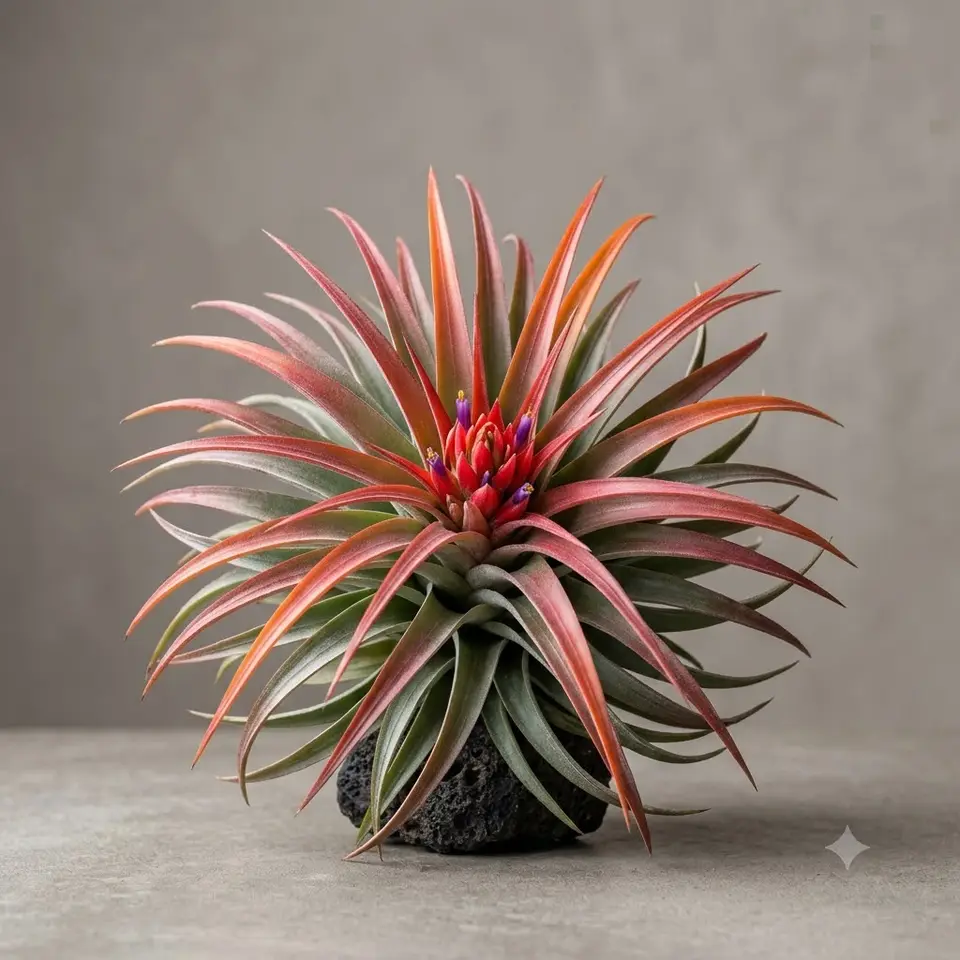 AI illustration
 Overview
Tillandsia Brachycaulos is a soft-leaved epiphytic air plant that grows without soil, drawing its water and nutrients straight through its foliage (Tillandsia brachycaulos). It forms a lush green rosette that flushes deep red or copper as it prepares to bloom, making it one of the more colourful and rewarding air plants to keep. It is small, forgiving, and ideal for anyone wanting a low-footprint collector plant that displays beautifully on wood, rock, or in an open bowl.
Origin & Natural Habitat
Tillandsia brachycaulos is native to Mexico and Central America, ranging through Guatemala, Belize, Honduras, El Salvador, Nicaragua, and Costa Rica. In the wild it grows as an epiphyte, anchoring itself to tree branches and trunks in humid tropical and subtropical forests rather than rooting in the ground. There it lives on filtered light, warm air, and moisture from rain and humidity, using its small wiry roots only to grip its host, not to feed.
Appearance
This species forms a compact, symmetrical rosette of narrow, arching leaves that taper to fine points, usually reaching about 12 to 20 cm across. The foliage is soft and slightly fleshy, coloured a fresh grassy green when well hydrated. As flowering approaches, the whole rosette can blush from the centre outward in vivid red, pink, or copper tones, and it then pushes out tubular violet-purple flowers. Mature size stays modest, which is part of its appeal for shelf and terrarium displays.
Why People Grow It - Qualities & Benefits
- Dramatic colour change - the rosette flushes brilliant red or copper before blooming
- No soil, no pot, no mess - it can be mounted or simply set on a surface
- Compact and space-friendly, perfect for small homes and grouped displays
- Pet-safe and low-commitment, a genuinely beginner-friendly collector plant
Care
Light: Bright indirect light is ideal - a spot near an east or south-facing window with a sheer curtain. Avoid harsh direct midday sun, which can scorch the soft leaves, and avoid deep shade, which dulls the colour and weakens growth.
Water: Soak the whole plant in room-temperature water for 20 to 30 minutes about once a week, and mist lightly between soakings in dry rooms. Air plants take up water through their leaves, not their roots, so misting alone falls short: it needs a real soak. Critically, after soaking, shake off the excess and set the plant upside-down to dry fully within a few hours; water trapped in the central rosette is the number-one cause of rot.
Mounting: Never plant it in soil - soil will suffocate and rot it. Display it mounted on driftwood, cork bark, rock, or shell, tucked into a wire holder, or resting loose in an open dish. If you attach it, use a non-copper wire or a plant-safe glue at the base only, keeping the centre free.
Temperature & Humidity: It likes warm conditions, roughly 15 to 30°C, and moderate to high humidity with good airflow. Airflow matters as much as moisture - stagnant, damp air invites rot, so give it a breezy, well-ventilated spot rather than a sealed container.
Feeding: Feed lightly by adding a dilute bromeliad or air-plant fertiliser to the soak water about once a month during active growth. Use a weak concentration - air plants are easily over-fed.
Extra: The make-or-break habit is drying it out completely after every soak, upside-down, so no water lingers in the crown - get that right and this plant is nearly foolproof. Non-toxic to cats and dogs - a pet-safe plant.
Propagation
After flowering, the mother plant produces offsets known as pups from around its base. Let each pup grow to roughly one third to one half the size of the parent, then gently twist or separate it away and care for it exactly like an adult. The original rosette slowly declines after blooming, which is normal, but the pups carry the plant on and can form clustered colonies over time.
Common Problems & Pests
- Rot from staying wet - a browning, mushy, or collapsing centre means water sat in the crown; dry more thoroughly after soaking
- Dehydration - curling, wrinkled, or crispy leaf tips signal it needs longer or more frequent soaks
- Mealybugs or scale can occasionally appear; rinse them off and treat the plant, checking hidden leaf bases
Toxicity & Safety
Tillandsia brachycaulos is non-toxic to cats and dogs, making it a safe choice for pet households. The plant itself poses no poisoning risk if a curious pet nibbles a leaf. The only common-sense caution is that any fertiliser added to its soak water is not intended to be eaten, so keep feeding solutions out of reach - the plant on its own is harmless.
Pros & Cons
Pros
- Pet-safe and non-toxic to cats and dogs
- Soil-free and compact, easy to display anywhere
Cons
- Rots easily if left wet in the centre
- Needs real weekly soaking, not just occasional misting
Best Suited For
- Beginners and pet owners wanting a safe, forgiving plant
- Small-space growers who like mounted or shelf displays
FAQ
Can I just mist it instead of soaking?
No - misting alone rarely delivers enough water. It needs a full 20 to 30 minute soak roughly weekly, with misting only as a top-up between soaks in dry conditions.
Why is my air plant turning red?
That is usually a good sign. The rosette naturally blushes red or copper as it approaches flowering, though very intense bright light can also deepen the colour.
Gear for growing tillandsia brachycaulos
Links go to Amazon or a partner store (such as Adagio Teas) and may earn us a commission at no extra cost to you. As an Amazon Associate we earn from qualifying purchases. We link gear types, not sponsors' picks: you choose the exact product.