Tillandsia Aeranthos
Tillandsia aeranthos is a hardy, clump-forming air plant that lives entirely without soil, drawing water and nutrients through silvery scales on its leaves (Tillandsia aeranthos).
Last reviewed: September 2026
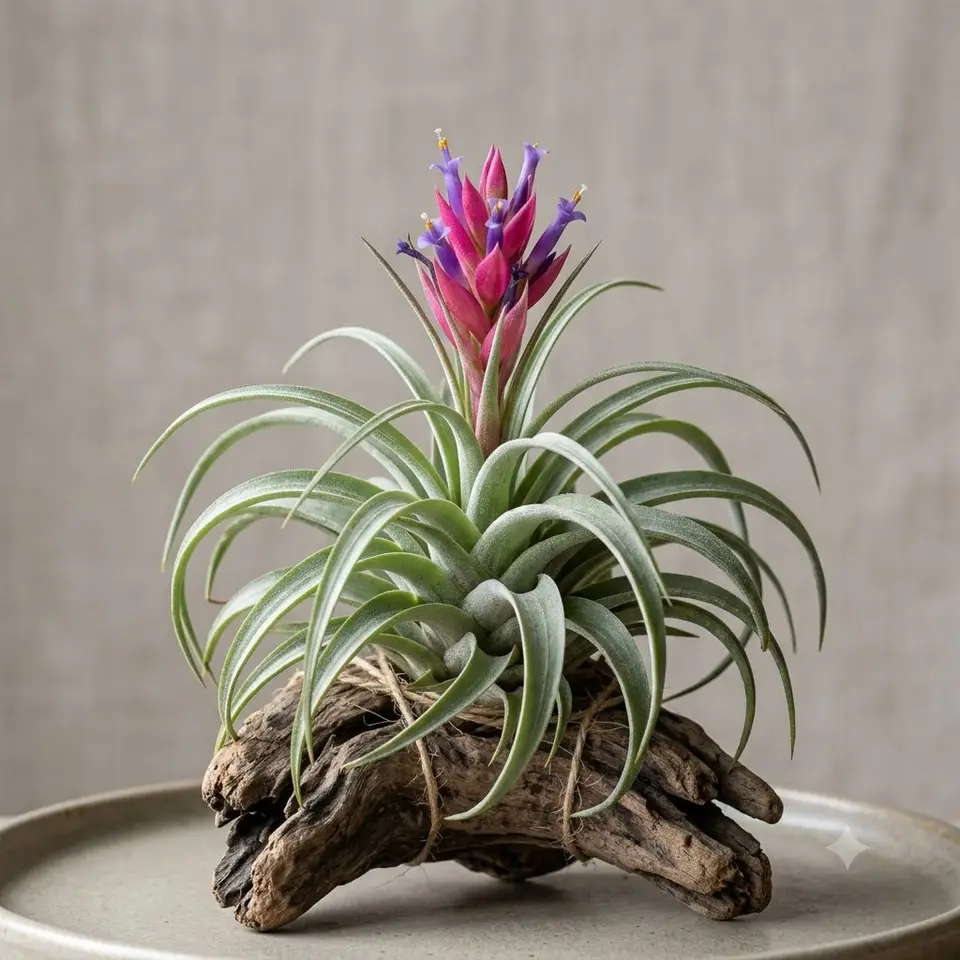 AI illustration
 Overview
Tillandsia aeranthos is a hardy, clump-forming air plant that lives entirely without soil, drawing water and nutrients through silvery scales on its leaves (Tillandsia aeranthos). It is one of the toughest and most forgiving species in the genus, prized for its stiff rosette of recurved leaves and a striking pink-and-blue flower spike. Because it needs no pot or dirt, it can be mounted on almost any surface, which makes it a favourite starter collector plant.
Origin & Natural Habitat
The species is native to southern South America, ranging across southern Brazil, Uruguay, Paraguay and north-eastern Argentina. In the wild it grows as an epiphyte, anchoring itself to tree branches, and sometimes as a lithophyte on rocks and cliffs. These are open, breezy, subtropical habitats with strong light, regular humidity from dew and rain, and fast-drying airflow - conditions that explain why the plant hates sitting wet.
Appearance
It forms a dense rosette of narrow, stiff, triangular leaves that arch and curve outward, each roughly 5 to 8 cm long. The foliage is a greyish silver-green, the colour coming from a coating of tiny water-absorbing scales called trichomes. Individual rosettes stay compact at around 10 to 15 cm across, but the plant readily offsets into tight clusters over time. When it blooms it sends up a short stem carrying a rose-pink bract and deep violet-blue, three-petalled flowers - a high-contrast display that is the main reason collectors seek it out.
Why People Grow It - Qualities & Benefits
- No soil, no pot, no repotting - it can be displayed almost anywhere with light and air
- One of the most cold-tolerant and beginner-friendly Tillandsia species
- Vivid pink-and-blue flowering that stands out against the silvery foliage
- Clumps up over the years into a fuller, more sculptural specimen
Care
Light: Bright, indirect light is ideal. A spot near an east or south-facing window with filtered sun keeps the silvery leaves healthy and encourages blooming. It can take some gentle direct morning sun but harsh midday glare will scorch and dry it out.
Water: Soak the whole plant in room-temperature water for 20 to 30 minutes about once a week, and lightly mist between soaks in dry rooms. Air plants take up water through their leaves, not their roots, so misting alone is never enough. After every soak, shake off the excess and set the plant upside-down to dry fully within a few hours - trapped water in the centre of the rosette is the number one cause of rot.
Mounting: Never plant it in soil. Display it mounted on driftwood, cork bark, a rock or a shell, tucked into a wire frame, or resting loose in an open bowl. Any roots it grows are used only to grip a surface, not to feed, so they should stay dry and exposed to air.
Temperature & Humidity: Warm, average room temperatures of about 15 to 27°C suit it, and it tolerates brief cooler dips better than most air plants. Moderate humidity is fine, but good airflow matters more than high humidity - stagnant, damp air invites rot.
Feeding: Feed roughly once a month by adding a dilute bromeliad or air-plant fertiliser to the soak water, at about a quarter of the usual strength. Skip feeding in the coldest, darkest months when growth slows.
Extra: The make-or-break habit is drying: always let it dry completely and upside-down after soaking, and give it moving air so water never pools in the centre. Get that right and it is nearly indestructible. Non-toxic to cats and dogs - a pet-safe plant.
Propagation
Tillandsia aeranthos propagates through offsets, commonly called pups. After the plant flowers, the mother rosette produces one or more pups at its base. Leave them attached until each pup is at least a third to half the size of the parent, then gently twist or cut it away and mount it separately. The original rosette flowers only once but can keep pushing out pups for a while before it slowly declines.
Common Problems & Pests
- Rot from staying wet: a mushy base, leaves that pull out easily, or a foul smell means water sat too long - almost always fatal once it starts
- Dehydration: leaves curling harder, browning at the tips, and a dull look signal too little soaking, not too little misting
- Scale or mealybugs occasionally appear as small bumps or cottony spots; rinse them off during soaking or dab with a cotton swab dipped in diluted alcohol
Toxicity & Safety
Tillandsia aeranthos is non-toxic to cats and dogs, making it one of the safest houseplants to keep around curious pets. There is no soil to dig in and no known toxic compounds in the foliage. As a general rule, neither the plant, any mounting media, nor fertiliser is meant to be eaten, but the plant itself poses no poisoning risk to animals or people.
Pros & Cons
Pros
- Soil-free and flexible - display it almost anywhere with light and airflow
- Genuinely tough and cold-tolerant, forgiving of beginner mistakes
Cons
- Dies quickly if left wet or under-soaked - the drying routine is non-negotiable
- Small size and slow clumping mean it takes years to become a showpiece
Best Suited For
- Beginners who want a low-mess, pot-free plant and will commit to a weekly soak
- Collectors and small-space growers who enjoy mounted or displayed epiphytes
FAQ
Can I just mist it instead of soaking?
No. Misting raises surface humidity but does not rehydrate the plant enough on its own. It needs a full 20 to 30 minute soak about weekly, with misting only as a top-up between soaks.
Why did my air plant fall apart from the centre?
That is rot, caused by water trapped in the rosette after watering. Always dry the plant upside-down with good airflow after soaking, and never let it sit damp in a closed container.
Gear for growing tillandsia aeranthos
Links go to Amazon or a partner store (such as Adagio Teas) and may earn us a commission at no extra cost to you. As an Amazon Associate we earn from qualifying purchases. We link gear types, not sponsors' picks: you choose the exact product.