Philodendron Prince of Orange
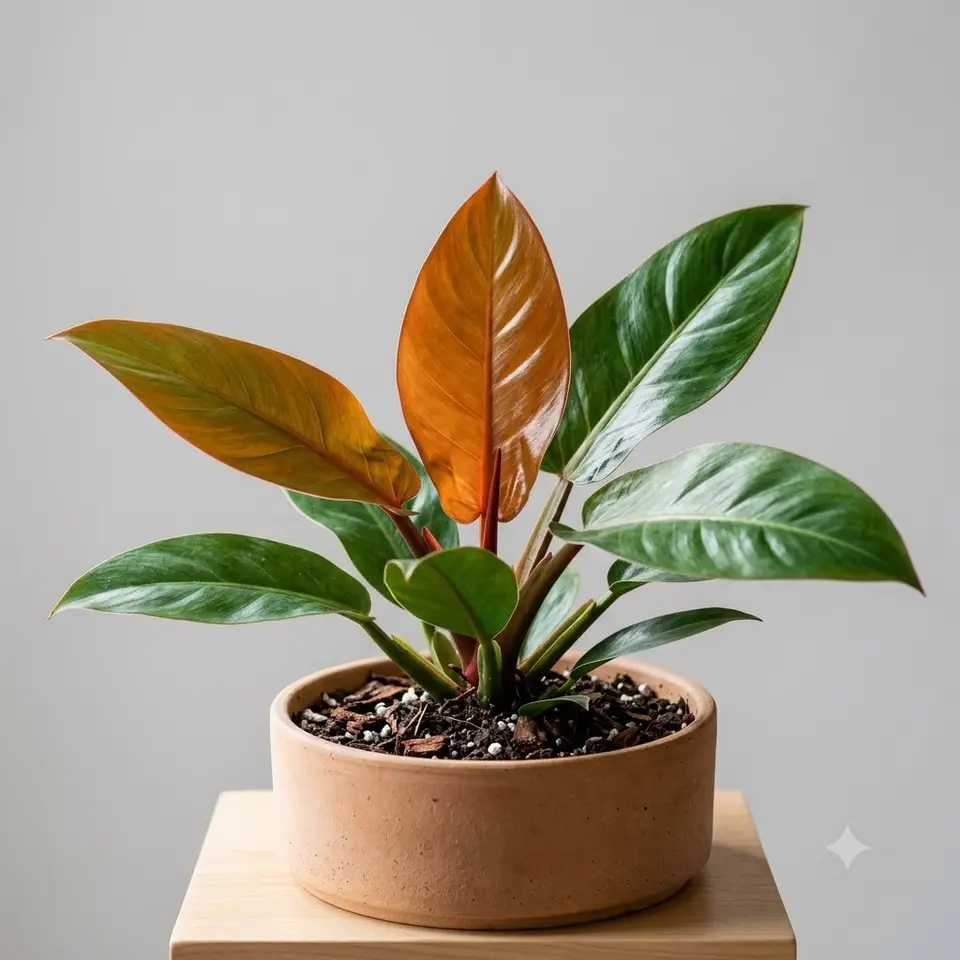
Philodendron Prince of Orange is a self-heading hybrid prized for new leaves that unfurl a glowing coppery orange before ageing through amber and chartreuse to deep green (Philodendron 'Prince of Orange').
Last reviewed: September 2026
 AI illustration
 Overview
Philodendron Prince of Orange is a self-heading hybrid prized for new leaves that unfurl a glowing coppery orange before ageing through amber and chartreuse to deep green (Philodendron 'Prince of Orange'). Unlike its climbing cousins, it grows as a compact rosette from a central crown, making it a tidy, colourful tabletop plant. It is a man-made cultivar, so every leaf flush gives a living gradient of colour on one plant.
Origin & Natural Habitat
This plant is a cultivated hybrid and does not occur in the wild, so it has no true native range of its own. Its parent stock traces back to the genus Philodendron, whose species are native to the warm, humid rainforests of tropical Central and South America. In those forests wild philodendrons grow on the shaded forest floor and lower trunks, which is why this hybrid favours bright indirect light, steady warmth and consistent moisture indoors.
Appearance
The leaves are broad, elongated and gently spear-shaped with a lightly rippled surface, typically reaching around 20 to 30 cm long on an established plant. New growth emerges bright orange, then shifts to salmon, yellow-green and finally a settled deep green, so a healthy plant shows several colours at once. Growth is self-heading rather than vining, with leaves radiating from a short central crown. Indoors it usually forms a mounded clump about 45 to 60 cm tall and roughly as wide at maturity.
Why People Grow It - Qualities & Benefits
- Every new leaf arrives fiery orange, giving a colour show without needing flowers.
- Its self-heading, clumping habit stays compact and does not need a moss pole or trellis.
- It is forgiving and fast to establish, tolerating average indoor conditions well.
- The multi-tone foliage suits shelves, desks and plant groupings as a warm accent.
Care
Light: Bright, indirect light. A few hours of gentle morning sun deepens the orange tones, but harsh midday sun scorches the leaves and washes out colour. Too little light dulls the new growth to plain green. Water: Water when the top 3 to 5 cm of mix feels dry, then water thoroughly and let excess drain. Keep it evenly moist but never soggy, as constantly wet roots invite rot. Soil: A loose, airy aroid mix that drains fast, for example peat or coir with plenty of orchid bark and perlite, in a pot with drainage holes. Temperature & Humidity: Comfortable at 18 to 27°C; protect it from cold draughts and anything below about 13°C. It tolerates average room humidity but is happiest above 50%, showing crisper leaves in drier air. Feeding: Feed monthly during spring and summer with a balanced diluted houseplant fertiliser, and pause in autumn and winter when growth slows. Extra: The orange colour is a young-leaf trait, not a permanent state, so do not expect old leaves to stay orange; short aerial roots and a thickening crown are normal with age. Toxic to cats and dogs (insoluble calcium oxalate crystals) - chewing causes oral irritation, drooling and vomiting.
Propagation
Because it is self-heading rather than vining, propagate by division or by basal cuttings that include a node. When the plant matures it may produce offsets or a stem section with roots at the crown; separate a healthy piece with at least one node and some roots, pot it into damp aroid mix, and keep it warm and humid until new growth appears. Rooting is slower and less reliable than with climbing philodendrons, so patience helps.
Common Problems & Pests
- Overwatering and heavy soil lead to yellowing lower leaves and root rot.
- Sap-sucking pests such as spider mites, mealybugs and thrips can settle on the undersides and in the crown.
- Faded, all-green new leaves and leggy growth usually signal too little light.
Toxicity & Safety
This plant is toxic to cats and dogs. Like all philodendrons it contains insoluble calcium oxalate crystals in its tissues; when a pet chews or bites the leaves, these needle-like crystals release and irritate the mouth and throat. Typical signs include intense oral pain, pawing at the mouth, excessive drooling, difficulty swallowing and vomiting. It is also irritating to people, so keep it out of reach of pets and small children and wash hands after handling cut stems or sap.
Pros & Cons
Pros
- Striking orange new growth gives ongoing colour without flowers.
- Compact self-heading form needs no support and stays tidy.
Cons
- Toxic to cats, dogs and children, so placement must be careful.
- The orange is temporary and fades to green, which can disappoint buyers expecting a permanently orange plant.
Best Suited For
- Beginner and intermediate growers wanting easy colour on a shelf or desk.
- Pet-free or carefully arranged homes with bright indirect light.
FAQ
Why did my new leaves come in green instead of orange?
The vivid orange is strongest in bright indirect light. In a dim spot the plant still grows, but the fresh leaves emerge a plainer green and the colour transition is muted. Moving it closer to a bright window usually restores the orange flush on the next round of growth.
Do the leaves stay orange forever?
No. The orange is a feature of young leaves only. Each new leaf ages through amber and chartreuse to a settled deep green over several weeks, so a healthy plant always shows a mix of ages and colours rather than staying fully orange.
Gear for growing philodendron prince of orange
Links go to Amazon or a partner store (such as Adagio Teas) and may earn us a commission at no extra cost to you. As an Amazon Associate we earn from qualifying purchases. We link gear types, not sponsors' picks: you choose the exact product.