Philodendron White Knight
Philodendron White Knight is a prized variegated climbing aroid grown for its dark, near-black stems streaked with pink and its deep green leaves splashed with bold white variegation.
Last reviewed: September 2026
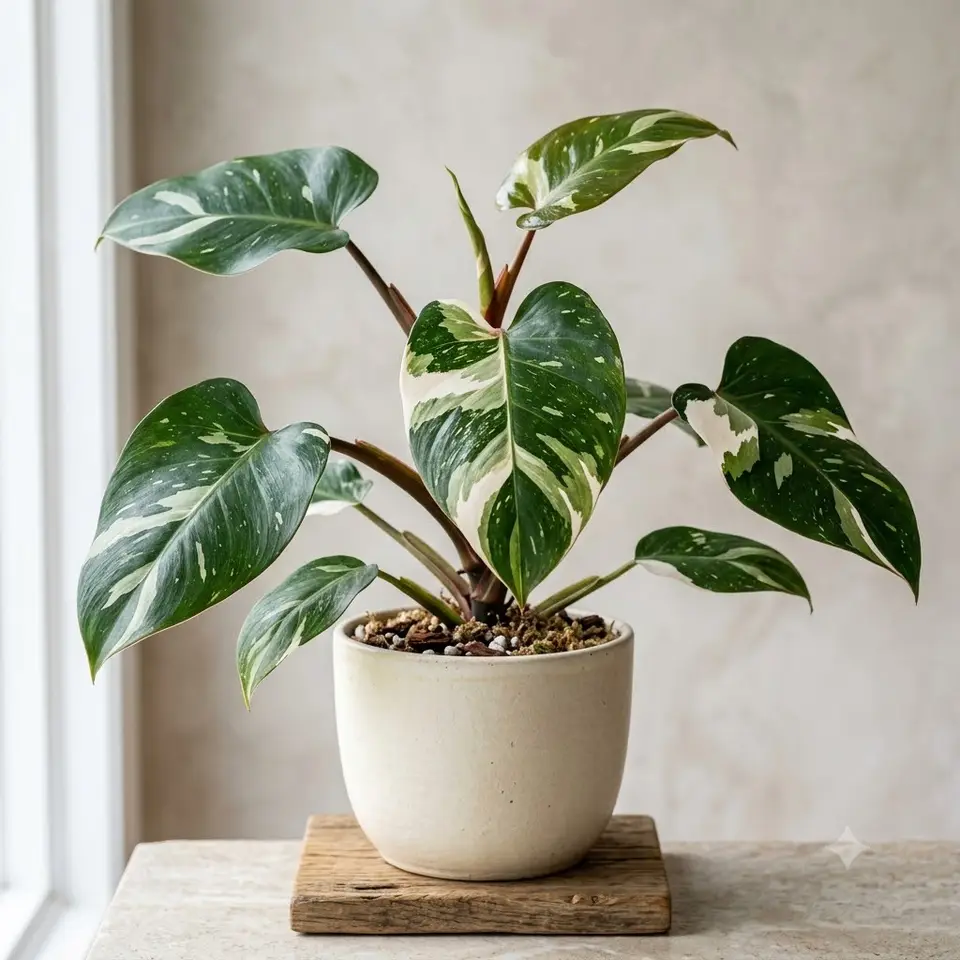 AI illustration
 Overview
Philodendron White Knight is a prized variegated climbing aroid grown for its dark, near-black stems streaked with pink and its deep green leaves splashed with bold white variegation. It is usually listed as a cultivar of Philodendron erubescens ('White Knight'), though its exact parentage is uncertain. Its slow growth, striking colour contrast, and unstable variegation have made it a sought-after collector plant rather than a beginner pick.
Origin & Natural Habitat
White Knight is a nursery-raised cultivar and does not exist as a wild population. Its accepted parent species, Philodendron erubescens, is native to the tropical rainforests of Colombia and surrounding parts of South America, where it grows as a hemi-epiphytic climber. In habitat these philodendrons scramble up tree trunks toward filtered canopy light, rooting into bark and leaf litter in warm, humid, consistently moist conditions - the environment the cultivar still prefers indoors.
Appearance
The leaves are heart-shaped to elongated and roughly 15 to 25 cm long, held on dark burgundy to blackish-purple petioles. Each leaf is deep glossy green marked with irregular white sectors, streaks, or half-and-half splits, and no two leaves are patterned alike. New growth often emerges from pink or wine-red stems, giving the plant a distinctive tricolour look of black, pink, and white against green. As a climber it develops aerial roots and, given a moss pole, can reach around 1.5 to 2 m or more indoors, with larger leaves as it matures.
Why People Grow It - Qualities & Benefits
- Dramatic, high-contrast variegation that makes it a standout display and collector's piece
- Dark pink-to-black stems that add colour interest beyond the leaves
- A manageable climbing habit that trains neatly up a moss pole for a compact footprint
- Every leaf is uniquely patterned, so the plant stays visually interesting as it grows
Care
Light: Bright, indirect light is essential - the white sectors carry no chlorophyll, so strong indirect light helps the plant power itself while keeping variegation stable. Avoid harsh direct midday sun, which scorches the pale tissue, and avoid deep shade, which encourages reversion to plain green. Water: Keep the mix lightly moist but never soggy; water when the top 3 to 5 cm feels dry. The white areas are prone to rot, so err toward slightly drier rather than waterlogged, and always let excess drain away. Soil: A chunky, fast-draining aroid mix - for example bark, perlite, and coco coir with a little compost - that holds moisture yet stays airy around the roots. Temperature & Humidity: Warm conditions of about 18 to 27°C suit it best; protect it from drafts and anything below roughly 13°C. It prefers humidity above 60%, so a pebble tray, grouping, or humidifier helps, especially for the delicate white growth. Feeding: Feed with a balanced, diluted liquid fertiliser roughly every 4 to 6 weeks during spring and summer, and pause in winter. Over-feeding can burn the sensitive variegated tissue. Extra: Give it a moss pole to climb - support and higher humidity around the aerial roots encourage bigger, better-variegated leaves. Note: Philodendron White Knight is toxic to cats and dogs, so keep it out of reach of pets.
Propagation
Propagate from stem cuttings that include at least one node, since the node is where new roots and growth emerge. For the best odds of keeping the pattern, choose a cutting with both green and white tissue - an all-white cutting has no chlorophyll and will usually fail, while an all-green one tends to grow back plain. Root the cutting in water, sphagnum moss, or a light mix in warm, humid, brightly lit conditions, and pot it up once roots are a few centimetres long.
Common Problems & Pests
- Variegation reverting to solid green (too little light) or leaves turning fully white and dying back (no chlorophyll to sustain them)
- Root rot and mushy, browning white sectors from overwatering or poor drainage
- Sap-sucking pests such as spider mites, mealybugs, thrips, and aphids, which often target soft new growth
Toxicity & Safety
Philodendron White Knight is toxic to cats and dogs. Like other philodendrons it contains insoluble calcium oxalate crystals throughout its leaves and stems. When a pet chews or bites the plant, these needle-like crystals are released and embed in the mouth and throat, causing intense oral irritation and burning, drooling, pawing at the mouth, difficulty swallowing, and vomiting. Keep it well out of reach of pets and curious children, and contact a vet or poison line if ingestion is suspected.
Pros & Cons
Pros
- Striking, one-of-a-kind variegation with unique colouring on every leaf
- Compact, trainable climbing habit that suits collectors and small spaces
Cons
- Variegation is unstable and can revert to green or over-produce fragile white leaves
- Toxic to pets, slow-growing, and less forgiving of watering and light mistakes than common philodendrons
Best Suited For
- Experienced houseplant collectors who enjoy managing variegation and moss-pole climbers
- Homes with bright indirect light, warmth, and higher humidity, and no pets able to reach the plant
FAQ
Why are my White Knight's new leaves turning solid green?
This is reversion, usually caused by too little light. The plant favours green, chlorophyll-rich growth to survive, so move it to brighter indirect light and prune back fully green stems to a variegated node to encourage patterned growth again.
Can I keep a leaf that came out completely white?
Fully white leaves look striking but have no chlorophyll, so they cannot photosynthesise and will eventually yellow and die. They also drain the plant's energy, so many growers trim them back to a node that has both green and white tissue to keep the plant healthy.
Sources
Pet toxicity: checked against the ASPCA Animal Poison Control Center lists of toxic and non-toxic plants for cats and dogs, genus-wide entry "Philodendron Pertusum" (Philodendron spp): toxic to cats and dogs. Lists read on 10 October 2026.
Gear for growing philodendron white knight
Links go to Amazon or a partner store (such as Adagio Teas) and may earn us a commission at no extra cost to you. As an Amazon Associate we earn from qualifying purchases. We link gear types, not sponsors' picks: you choose the exact product.