Calathea Orbifolia
Calathea orbifolia is a showpiece foliage plant prized for its large, round, silver-striped leaves that look almost hand-painted.
Last reviewed: October 2026
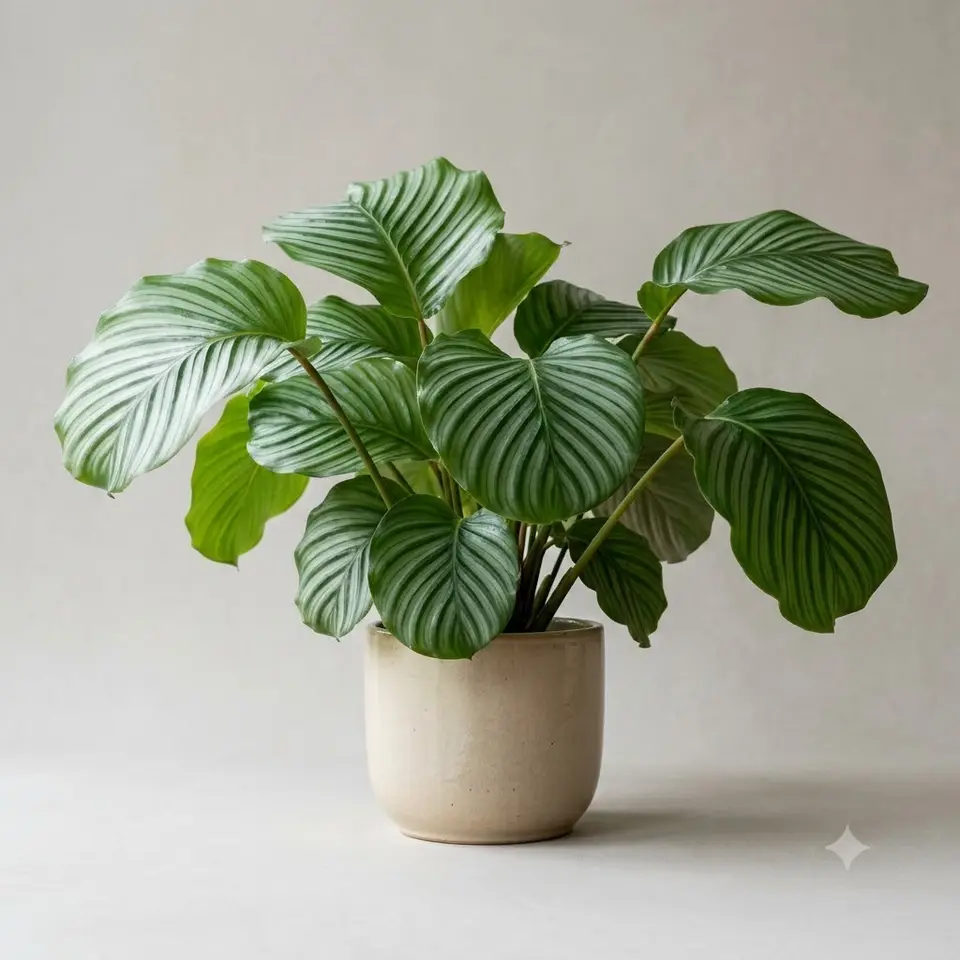 AI illustration
 Overview
Calathea orbifolia is a showpiece foliage plant prized for its large, round, silver-striped leaves that look almost hand-painted. Botanically it is Calathea orbifolia, now often reclassified as Goeppertia orbifolia, and it belongs to the prayer plant family, Marantaceae. It is one of the most striking Calatheas you can grow, but it is also one of the fussiest, rewarding steady humidity and clean water while punishing neglect with crispy edges.
Origin & Natural Habitat
This species is native to eastern Brazil, where it grows on the shaded floor of humid tropical forest. In that environment it sits beneath a dense canopy, receiving bright but heavily filtered light, warm stable temperatures, and consistently high humidity. Understanding those origins explains almost every care demand it makes indoors - it never evolved to cope with dry air, cold draughts, or harsh sun.
Appearance
The leaves are the whole point. Each one is broad, rounded and can reach 20 to 30 cm across on a mature plant, held on slender upright stalks. The surface is a soft pale green crossed by fine, evenly spaced silvery-blue-green stripes that radiate from the midrib, while the underside carries a paler, cooler tone. Growth is clumping and upright rather than trailing, and a well-grown specimen reaches roughly 60 to 90 cm tall and nearly as wide. Like other prayer plants it shows subtle daily leaf movement, lifting and lowering slightly between day and night.
Why People Grow It - Qualities & Benefits
- Dramatic, large silver-striped foliage that reads as a living centrepiece
- Genuinely pet-safe, making it a rare statement plant for homes with cats and dogs
- Clumping upright habit that fills a corner or shelf without trailing mess
- Gentle daily leaf movement that adds a quiet, living quality to a room
Care
Light: Bright, indirect light only. It thrives a metre or two back from an east or north window, or behind a sheer curtain. Direct sun scorches and bleaches the leaves, while deep shade flattens the silver patterning. Water: Keep the mix lightly and evenly moist, never soggy and never bone dry. This species is sensitive to fluoride and mineral salts in tap water, which cause brown crispy edges, so use rainwater, distilled, or filtered water where you can. Let the top centimetre dry slightly between waterings and empty any drainage tray promptly. Soil: A light, airy, moisture-retentive mix. A blend of peat-free coir or peat with perlite and a little fine bark works well, giving fast drainage while holding gentle moisture around the roots. Temperature & Humidity: Warm and stable, ideally 18 to 27°C, and never below about 15°C. Humidity is the make-or-break factor - aim for 60% or higher. A pebble tray, grouping with other plants, or a humidifier all help far more than misting alone. Feeding: Feed lightly during spring and summer with a balanced houseplant fertiliser at roughly half strength, about once a month. This plant is salt-sensitive, so under-feeding is safer than over-feeding, and flushing the pot occasionally clears mineral build-up. Extra: The key quirk is that everything hinges on water quality and humidity - crispy edges are almost always a response to dry air, tap-water minerals, or inconsistent moisture rather than a serious disease. Good news for animal lovers: Calathea orbifolia is non-toxic to cats and dogs, a genuinely pet-safe prayer plant.
Propagation
Propagate by division, ideally at repotting time in spring. Gently unpot the plant, tease the root ball apart into clumps that each keep several leaves and a healthy section of roots, and pot each division into fresh airy mix. Keep the new plants warm, humid, and evenly moist while they settle, and expect a pause in growth before they establish. Leaf cuttings do not work for this species.
Common Problems & Pests
- Brown, crispy leaf edges from low humidity, dry soil, or fluoride and salts in tap water
- Spider mites, which love the dry indoor air this plant hates - check leaf undersides regularly
- Yellowing leaves or root rot from overwatering and poor drainage, or curling leaves from underwatering
Toxicity & Safety
Calathea orbifolia is non-toxic to cats and dogs. As a Marantaceae prayer plant it is not known to contain compounds harmful to cats or dogs, which makes it one of the safest statement foliage plants for pet households. The plant itself is safe, though the potting mix and any fertiliser are not food and should be kept out of reach of curious pets and children.
Pros & Cons
Pros
- Spectacular, unusually large silver-striped leaves
- Pet-safe and non-toxic to cats and dogs
Cons
- Humidity-fussy and quick to develop crispy edges
- Sensitive to tap-water fluoride and mineral salts, so it needs filtered or rainwater
Best Suited For
- Experienced plant keepers who can provide steady humidity and clean water
- Pet owners wanting a bold statement plant without the toxicity worry
FAQ
Why are the leaf edges turning brown and crispy?
Almost always dry air, inconsistent watering, or minerals in tap water. Raise humidity above 60%, keep the mix evenly moist, and switch to filtered or rainwater to stop new damage.
Is Calathea orbifolia safe around cats and dogs?
Yes. It is non-toxic to cats and dogs as a member of the prayer plant family, so it is a genuinely pet-safe choice. Just keep pets from digging in the soil or nibbling fertiliser.
Sources
Pet toxicity: checked against the ASPCA Animal Poison Control Center lists of toxic and non-toxic plants for cats and dogs, genus-wide entry "Calathea" (Calathea spp.): non-toxic to cats and dogs. Lists read on 10 October 2026.
Gear for growing calathea orbifolia
Links go to Amazon or a partner store (such as Adagio Teas) and may earn us a commission at no extra cost to you. As an Amazon Associate we earn from qualifying purchases. We link gear types, not sponsors' picks: you choose the exact product.