Calathea Zebrina
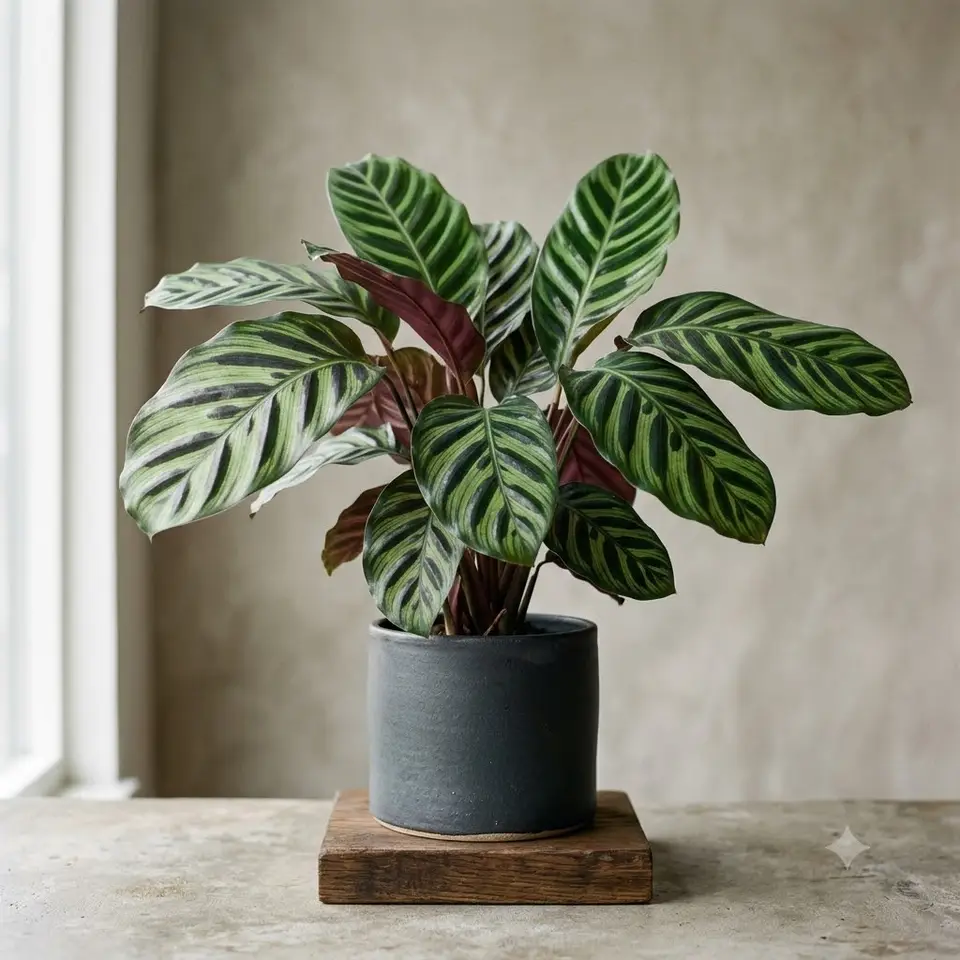
The Zebra Plant is one of the most striking members of the prayer-plant family, prized for broad, velvety leaves painted with alternating stripes of light and deep green (Goeppertia zebrina, still widely sold under its older name Calathea zebrina).
Last reviewed: September 2026
 AI illustration
 Overview
The Zebra Plant is one of the most striking members of the prayer-plant family, prized for broad, velvety leaves painted with alternating stripes of light and deep green (Goeppertia zebrina, still widely sold under its older name Calathea zebrina). It is a foliage-first collector plant grown purely for those dramatic leaves and their gentle nightly folding movement. Beautiful but genuinely demanding, it rewards steady humidity and clean water with lush, near-iridescent foliage.
Origin & Natural Habitat
Calathea Zebrina is native to southeastern Brazil, where it grows across the humid Atlantic coastal forest of the Rio de Janeiro and Sao Paulo regions. In the wild it lives on the shaded forest floor beneath a dense canopy, in warm, consistently moist, high-humidity conditions with soft dappled light and rich, leaf-littered soils. Understanding this origin explains almost every care rule: it never evolved for dry air, harsh sun, or hard tap water.
Appearance
The leaves are the whole point. Each blade is large, broadly oval to lance-shaped, and can reach 30 to 45 cm long, carried on upright stalks that emerge in a clumping rosette. The upper surface is soft and velvety, marked with bold zebra-like bars that alternate between pale yellow-green and dark emerald, radiating from the central vein. The undersides are flushed a purplish-red. Indoors the plant typically forms a full, bushy clump around 60 to 90 cm tall and wide at maturity, with new leaves unfurling from tight tubular scrolls.
Why People Grow It - Qualities & Benefits
- Some of the most dramatic striped, velvety foliage available in a houseplant
- Nyctinasty: leaves rise and fold at night and relax by day, a living daily rhythm
- Fully pet-safe, so it suits homes with cats and dogs
- Stays a manageable, clumping size that fits a shelf, plant stand, or grouped display
Care
Light: Bright, indirect light only. It thrives in a spot with plenty of ambient brightness but no direct sun, which scorches and bleaches the stripes. Too little light dulls the contrast and slows growth; an east-facing window or a metre or so back from a brighter one is ideal. Water: Keep the mix evenly moist but never soggy, letting only the top centimetre dry between waterings. This is the plant's biggest sensitivity: it reacts to fluoride, chlorine, and mineral salts in tap water with crispy brown edges, so use rainwater, distilled, or filtered water at room temperature. Soil: A light, airy, moisture-retentive mix. A peat or coco-coir base cut with perlite and a little fine bark holds humidity at the roots while still draining freely. Always use a pot with drainage holes. Temperature & Humidity: Warm and stable, ideally 18 to 27°C, and never below about 15°C. Humidity is non-negotiable: aim for 60% or higher. Dry indoor air is the usual cause of brown, curling edges, so a humidifier or a well-grouped humid corner helps far more than occasional misting. Feeding: Feed with a balanced liquid fertiliser diluted to half strength every four to six weeks during spring and summer. Pause in autumn and winter. It is a light feeder, and excess fertiliser salts contribute to the same edge-burn as hard water. Extra: The key quirk is that this plant is a communicator of its environment: crispy edges mean water quality or humidity, curling means it is too dry, and faded stripes mean too much light. Get water and humidity right and the rest follows. Good news for pet owners: Calathea Zebrina is non-toxic to cats and dogs.
Propagation
Propagate by division in spring, ideally when repotting. Gently remove the plant, tease the root ball apart into clumps that each keep several leaves and a healthy section of roots, and pot each division into fresh airy mix. Keep the new divisions warm, humid, and evenly moist while they recover, and expect a short sulk before new growth resumes. It does not propagate from leaf or stem cuttings.
Common Problems & Pests
- Crispy brown leaf edges and tips from hard or fluoridated tap water, low humidity, or fertiliser salt build-up
- Curling or limp leaves signalling underwatering or air that is too dry, and yellowing lower leaves from overwatering
- Spider mites, which thrive in the dry air the plant hates, plus occasional fungus gnats in constantly damp soil
Toxicity & Safety
Calathea Zebrina is pet-safe. It is non-toxic to cats and dogs, like the prayer plants (Marantaceae) commonly grown as houseplants, so it is a reassuring choice for households with curious animals or children. The plant itself poses no poisoning risk; as with any potted plant, the potting soil and fertiliser are simply not meant to be eaten and can cause mild stomach upset if ingested in quantity.
Pros & Cons
Pros
- Show-stopping striped, velvety foliage with a living day-night leaf movement
- Genuinely non-toxic and safe around pets and children
Cons
- Fussy about water quality and humidity, prone to crispy edges
- Not forgiving of neglect, making it a poor pick for hands-off owners
Best Suited For
- Experienced houseplant enthusiasts and collectors who enjoy attentive, responsive care
- Homes that can offer steady warmth and high humidity, such as a bright bathroom or a humidified plant corner
FAQ
Why does my Calathea Zebrina keep getting brown, crispy edges?
The most common causes are hard or fluoridated tap water and low humidity. Switch to rainwater, distilled, or filtered water, raise humidity toward 60% or more, and avoid letting the soil dry out fully. Existing brown edges will not turn green again, but new leaves should emerge clean.
Is Calathea Zebrina safe if my cat chews on it?
Yes. It is non-toxic to cats and dogs, so a nibble will not poison your pet. It is one of the safer choices for animal households, though you should still discourage chewing since the soil and fertiliser are not meant to be eaten.
Gear for growing calathea zebrina
Links go to Amazon or a partner store (such as Adagio Teas) and may earn us a commission at no extra cost to you. As an Amazon Associate we earn from qualifying purchases. We link gear types, not sponsors' picks: you choose the exact product.