Calathea Warscewiczii
Calathea warscewiczii is a striking collector prayer plant prized for its long, lance-shaped leaves patterned with a velvety, fishtail-like design and deep burgundy undersides (Calathea warscewiczii).
Last reviewed: September 2026
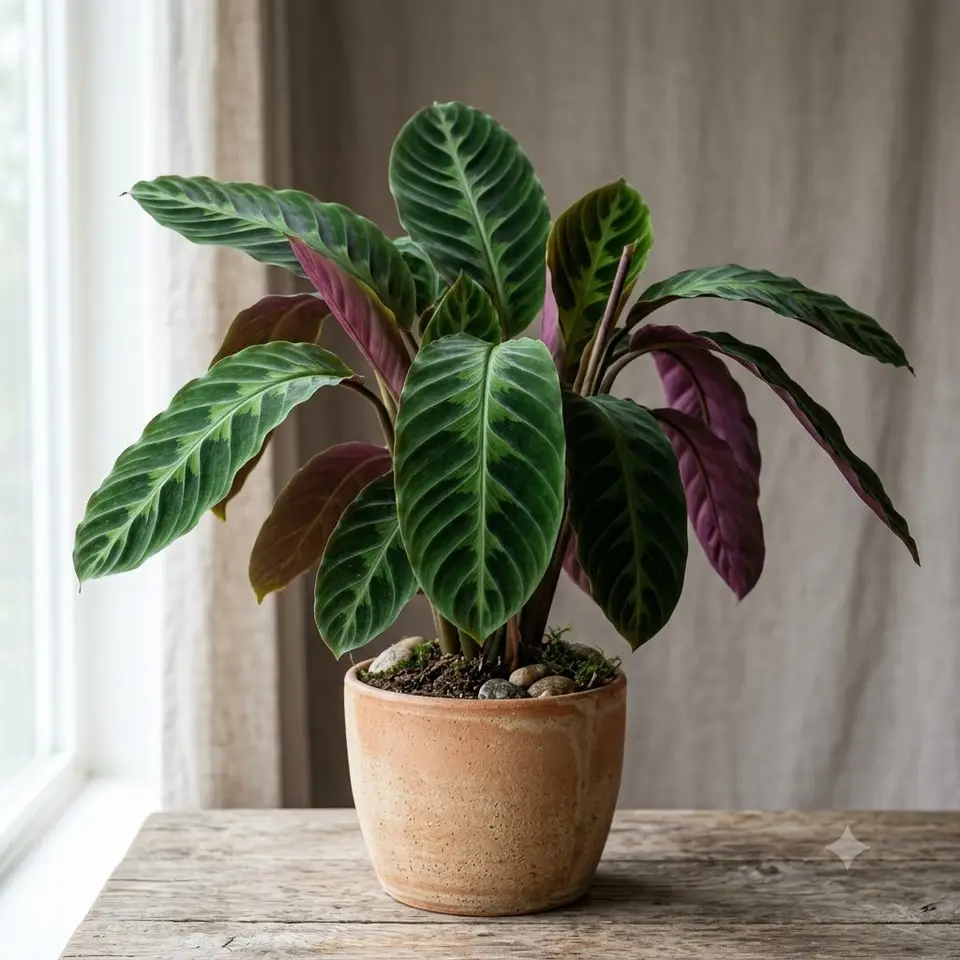 AI illustration
 Overview
Calathea warscewiczii is a striking collector prayer plant prized for its long, lance-shaped leaves patterned with a velvety, fishtail-like design and deep burgundy undersides (Calathea warscewiczii). Now botanically reclassified as Goeppertia warscewiczii, it is still sold almost everywhere under its classic Calathea name. It rewards attentive growers with dramatic foliage and, in good conditions, cone-like cream flushes, but it is honestly one of the fussier members of the family.
Origin & Natural Habitat
The species is native to the tropical rainforests of Central America, chiefly Costa Rica and Nicaragua. In the wild it grows on the shaded forest floor beneath a dense canopy, in warm, consistently humid air with dappled light and rich, moist, leaf-litter soil. Understanding that low-light, high-humidity origin explains almost every care requirement it has.
Appearance
The leaves are long and elliptical to lance-shaped, often reaching 20 to 30 cm, carried on upright stems. The upper surface has a soft, velvety sheen with a two-tone feathered pattern of dark and light green that fans out from the midrib, while the undersides are a rich maroon-purple. Like other prayer plants it moves on a daily rhythm, lifting its leaves upward at night and lowering them by day. Indoors it forms a clumping, upright rosette and can reach roughly 60 to 100 cm tall with age and good care.
Why People Grow It - Qualities & Benefits
- Velvety, feather-patterned foliage with dramatic burgundy undersides that few other houseplants match
- Genuinely pet-safe, so it suits homes with cats and dogs
- Living nyctinastic movement, folding and unfurling with the day-night cycle
- A rewarding challenge plant that signals a maturing collector when kept happy
Care
Light: Bright, indirect light only. Direct sun scorches and fades the pattern, while deep shade weakens growth. An east window or a spot set back from a brighter window is ideal. Water: Keep the soil lightly and evenly moist, never soggy and never bone dry. This species is notably sensitive to tap-water fluoride, chlorine and salts, which cause crispy brown edges, so use filtered, distilled or rainwater at room temperature. Soil: A light, airy, moisture-retentive mix. A blend of peat-free coir or peat, plus perlite and a little fine bark or worm castings, holds moisture while still draining freely. Temperature & Humidity: Warmth-loving; keep it between roughly 18 and 27°C and away from cold draughts and heating vents. Humidity is the make-or-break factor: aim for 60% or higher. A pebble tray, grouping with other plants, or a humidifier works far better than misting. Feeding: Feed with a balanced, diluted liquid fertiliser at roughly half strength every 4 to 6 weeks during spring and summer. Do not feed in winter, and flush the soil occasionally to prevent salt build-up. Extra: The key quirk is its intolerance of hard tap water; fluoride and mineral salts are the usual cause of the crispy edges people struggle with, so water quality matters as much as watering frequency. Good news for pet owners: Calathea warscewiczii is non-toxic to cats and dogs.
Propagation
The realistic and reliable method is division. During spring repotting, gently tease the root ball apart into clumps, making sure each section keeps healthy roots and at least a few leaves, then pot each division into fresh airy mix. Keep the new divisions warm, humid and lightly moist while they settle. Recovery can be slow, so patience helps.
Common Problems & Pests
- Crispy brown leaf edges and tips, usually from low humidity, underwatering or fluoride and salts in tap water
- Spider mites, which thrive in dry air; check leaf undersides regularly and raise humidity
- Curling, yellowing or faded pattern, pointing to inconsistent watering, cold, or too much direct sun
Toxicity & Safety
Calathea warscewiczii is non-toxic to cats and dogs. As a Marantaceae prayer plant it contains no known toxic compounds and is a genuinely pet-safe choice for households with curious animals. The only sensible caution is general: potting soil and fertiliser are not food and may cause mild digestive upset if a pet eats them, so keep the mix out of reach.
Pros & Cons
Pros
- Show-stopping velvety foliage with striking maroon undersides
- Safe around cats and dogs
Cons
- Humidity-fussy and quick to develop crispy edges
- Sensitive to tap-water fluoride and salts, so needs filtered or rainwater
Best Suited For
- Experienced or committed hobbyists who enjoy a demanding, rewarding plant
- Pet-owning households wanting dramatic foliage without toxicity worries
FAQ
Why does my Calathea warscewiczii keep getting crispy brown edges?
The usual causes are air that is too dry, inconsistent watering, or minerals and fluoride in tap water. Raise humidity to 60% or more, keep the soil evenly moist, and switch to filtered, distilled or rainwater.
Is Calathea warscewiczii safe for my cat or dog?
Yes. It is non-toxic to cats and dogs and is a genuinely pet-safe prayer plant. Just keep pets from eating the soil or fertiliser, which can upset any stomach.
Sources
Pet toxicity: checked against the ASPCA Animal Poison Control Center lists of toxic and non-toxic plants for cats and dogs, genus-wide entry "Calathea" (Calathea spp.): non-toxic to cats and dogs. Lists read on 10 October 2026.
Gear for growing calathea warscewiczii
Links go to Amazon or a partner store (such as Adagio Teas) and may earn us a commission at no extra cost to you. As an Amazon Associate we earn from qualifying purchases. We link gear types, not sponsors' picks: you choose the exact product.