Calathea White Star
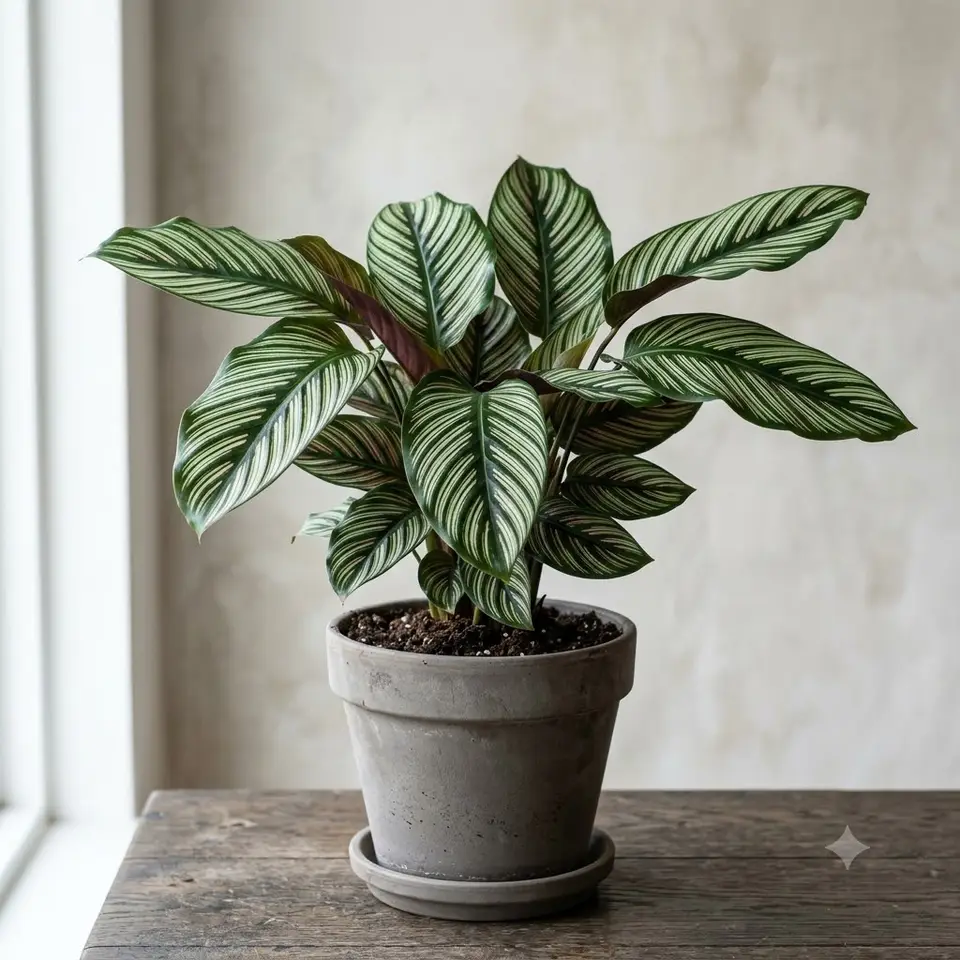
Calathea White Star is one of the most striking of the prayer plants, prized for tall lance-shaped leaves ruled with fine white and pink pinstripes (Calathea majestica 'White Star').
Last reviewed: September 2026
 AI illustration
 Overview
Calathea White Star is one of the most striking of the prayer plants, prized for tall lance-shaped leaves ruled with fine white and pink pinstripes (Calathea majestica 'White Star'). It is a foliage-first collector plant that rewards attentive growers and frustrates casual ones. Like all calatheas it folds its leaves upward at night, a nightly movement called nyctinasty.
Origin & Natural Habitat
The species behind this cultivar comes from the tropical rainforests of South America. In the wild it grows on the shaded forest floor, sheltered under the canopy in warm, consistently humid air and dappled light. This understory origin explains almost everything about its care: it wants steady warmth, high humidity, soft indirect light, and moisture that never swings to extremes.
Appearance
The leaves are large, elongated and elliptical to lance-shaped, often reaching 20 to 30 cm long on upright petioles. Each glossy green leaf is patterned with closely spaced pinstripes that run from the central midrib to the leaf edge, emerging pale pink and maturing to creamy white, with new leaves showing a distinct pink blush. The undersides are a soft purple-green. Indoors it forms an upright clumping rosette and can reach roughly 60 to 90 cm tall over time.
Why People Grow It - Qualities & Benefits
- Dramatic pinstriped foliage that looks hand-painted, with a pink flush on fresh leaves
- Genuinely pet-safe, so it suits homes with cats and dogs
- Nightly leaf movement (prayer plant behaviour) that makes it feel alive and interactive
- Stays a manageable size for shelves, plant corners and bright bathrooms
Care
Light: Bright, indirect light only. Direct sun scorches the leaves and fades the pattern, while deep shade dulls the contrast. An east window or a spot set back from a brighter window is ideal. Water: Keep the mix lightly and evenly moist, watering when the top 2 to 3 cm feels dry. It is very sensitive to minerals in tap water; fluoride, chlorine and salts cause the classic crispy brown edges. Use rainwater, distilled or filtered water, and never let it sit in a saucer of water. Soil: A light, airy, moisture-retentive mix. Peat or coco coir with perlite and a little orchid bark or fine composted matter works well, giving moisture retention with good drainage. Temperature & Humidity: Warmth of about 18 to 27°C, and never below roughly 15°C or in cold draughts. Humidity is the make-or-break factor: aim for 60% or higher. A humidifier is the most reliable fix; pebble trays help a little. Feeding: Feed lightly with a balanced houseplant fertiliser at half strength every 4 to 6 weeks in spring and summer, and stop in autumn and winter. Over-feeding builds up salts that worsen leaf-edge burn. Extra: The key quirk is its thirst for humidity and clean water together; get either wrong and you get crispy edges. Reassuringly, it is non-toxic to cats and dogs, a genuinely pet-safe prayer plant.
Propagation
Propagate by division at repotting time, ideally in spring. Ease the plant from its pot, gently tease apart the root clump into sections that each keep healthy roots and a few leaves, and pot them up separately. Keep the divisions warm, humid and evenly moist while they settle, since they resent disturbance and may sulk for a few weeks. Leaf and stem cuttings do not work for calatheas.
Common Problems & Pests
- Crispy brown leaf edges and tips from low humidity, tap-water minerals or underwatering
- Spider mites, which thrive in dry air; look for fine webbing and stippled leaves
- Yellowing leaves or root rot from overwatering and soggy, poorly draining soil
Toxicity & Safety
Calathea White Star is non-toxic to cats and dogs. As a member of the Marantaceae family it is a genuinely pet-safe prayer plant, so a curious nibble will not poison a pet. The plant itself is safe; as with any houseplant, keep pets and small children from eating the potting soil or fertiliser, which can cause mild digestive upset.
Pros & Cons
Pros
- Show-stopping pinstriped, pink-blushed foliage
- Non-toxic and safe around cats and dogs
Cons
- Humidity-fussy and quick to develop crispy edges
- Sensitive to fluoride and salts in tap water, so it needs filtered or rainwater
Best Suited For
- Attentive collectors who enjoy dialling in humidity and water quality
- Pet households wanting bold foliage without the toxicity worry
FAQ
Why does my Calathea White Star get crispy brown edges?
Almost always low humidity, inconsistent watering, or minerals in tap water. Raise humidity toward 60% or higher, keep the soil evenly moist, and switch to filtered, distilled or rainwater to prevent fluoride and salt burn.
Is Calathea White Star safe for cats and dogs?
Yes. It is non-toxic to cats and dogs, making it one of the safer statement foliage plants for pet owners. Just discourage pets from digging in or eating the soil.
Sources
Pet toxicity: checked against the ASPCA Animal Poison Control Center lists of toxic and non-toxic plants for cats and dogs, genus-wide entry "Calathea" (Calathea spp.): non-toxic to cats and dogs. Lists read on 10 October 2026.
Gear for growing calathea white star
Links go to Amazon or a partner store (such as Adagio Teas) and may earn us a commission at no extra cost to you. As an Amazon Associate we earn from qualifying purchases. We link gear types, not sponsors' picks: you choose the exact product.