Calathea Musaica
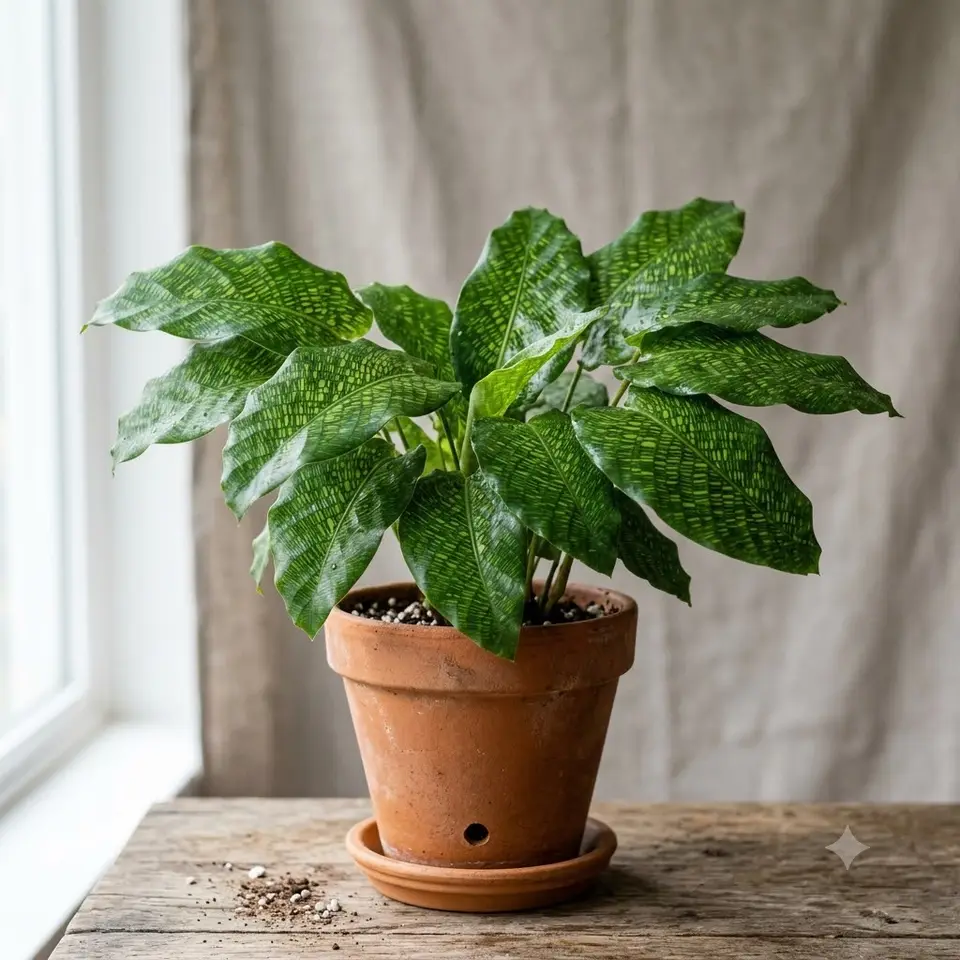
Calathea Musaica is a collector-favourite foliage plant grown entirely for its extraordinary leaves, which are covered in a dense mosaic of tiny green squares that look like fine stained-glass or a circuit board (Goeppertia kegeljanii, long sold under the synonym Calathea musaica).
Last reviewed: September 2026
 AI illustration
 Overview
Calathea Musaica is a collector-favourite foliage plant grown entirely for its extraordinary leaves, which are covered in a dense mosaic of tiny green squares that look like fine stained-glass or a circuit board (Goeppertia kegeljanii, long sold under the synonym Calathea musaica). It is often called the "Network" plant because of that intricate grid pattern. Compared with its cousins it is one of the more forgiving prayer plants, though it still rewards attention to humidity and water quality.
Origin & Natural Habitat
The species is native to eastern Brazil, where it grows on the shaded floor of warm, humid tropical rainforest. In that setting it sits below the canopy in bright but filtered light, in consistently moist, well-draining leaf litter, surrounded by high ambient humidity and stable warmth year round. Those conditions are the blueprint for how it behaves as a houseplant.
Appearance
The leaves are oval to lance-shaped, glossy, and mid-green, each one etched with a repeating network of small pale-green rectangles and squares so fine it looks almost pixelated. Unlike many Calatheas, it lacks a bold colour contrast; the drama comes purely from that mosaic texture. Leaves typically reach 10 to 20 cm long on upright, clustering stems, and a mature plant forms a full, bushy clump around 30 to 60 cm tall and roughly as wide. Like other prayer plants it shows gentle day-to-night leaf movement, lifting and lowering with the light.
Why People Grow It - Qualities & Benefits
- The mosaic leaf pattern is genuinely unusual and reads as a living piece of botanical art.
- It is one of the more resilient Calatheas, making it a good "next step" for growers moving beyond beginner plants.
- It stays compact and bushy, so it suits shelves, desks, and grouped plant displays.
- It is safely non-toxic, so it fits into homes with curious cats and dogs.
Care
Light: Bright, indirect light. An east-facing window or a spot a little back from a brighter window is ideal. Keep it out of direct midday sun, which scorches and fades the pattern; too little light flattens the leaf colour and slows growth. Water: Keep the soil lightly and evenly moist, never waterlogged and never bone dry. Water when the top 2 to 3 cm feels dry, and let excess drain fully. This species is sensitive to minerals in tap water, so use rainwater, distilled, or filtered water where possible to avoid crispy tips. Soil: A light, airy, moisture-retentive mix that still drains freely - for example a peat-free or coco-based potting mix loosened with perlite and a little bark or fine orchid mix. It should hold moisture without staying soggy. Temperature & Humidity: Warm and stable, roughly 18 to 27°C. Avoid cold draughts, heat vents, and anything below about 15°C. Humidity above 50 to 60% keeps the foliage happy; a pebble tray, grouping with other plants, or a humidifier all help. Feeding: Feed with a balanced, diluted liquid fertiliser about once a month during spring and summer, and pause in autumn and winter. Over-feeding builds up salts that this water-sensitive plant dislikes. Extra: The single biggest quirk is water and humidity sensitivity - fluoride and salts in ordinary tap water are a common cause of the browning edges people struggle with, so gentle water plus steady moisture solves most complaints. Good news for pet households: Calathea Musaica is non-toxic to cats and dogs.
Propagation
Propagate by division. In spring, when repotting a healthy, established clump, gently tease the root ball apart into sections, making sure each section keeps a good share of roots and several leaves. Pot each division into fresh moist mix, keep it warm and humid, and go easy on watering until new growth appears. This plant does not root reliably from leaf or stem cuttings, so division is the dependable method.
Common Problems & Pests
- Crispy brown leaf edges and tips, usually from low humidity, inconsistent watering, or mineral build-up from tap water.
- Spider mites, which thrive when the air is too dry - check the undersides of leaves for fine webbing and stippling.
- Yellowing or limp leaves and root rot from overwatering or a mix that stays soggy.
Toxicity & Safety
Calathea Musaica is pet-safe. As a member of the Marantaceae family it is non-toxic to both cats and dogs and contains no known harmful compounds, so it is a reassuring choice for animal-loving households. The only sensible caution is general: the potting soil and any fertiliser are not meant to be eaten by pets or children, so keep the growing medium undisturbed. The plant itself, however, is genuinely safe.
Pros & Cons
Pros
- Striking, one-of-a-kind mosaic foliage that stands out in any collection.
- Non-toxic and pet-friendly, and more forgiving than most Calatheas.
Cons
- Fussy about water quality and prone to crispy edges from tap water or dry air.
- Needs consistent moisture and humidity, so it is not a set-and-forget plant.
Best Suited For
- Growers ready to move up from easy beginner plants to something with more character.
- Pet owners who want a safe, sculptural foliage plant for a bright, humid spot.
FAQ
Why are the leaf edges turning brown and crispy?
Most often it is dry air, uneven watering, or minerals in tap water. Raise the humidity, keep the soil evenly moist rather than swinging between soaked and dry, and switch to rainwater, distilled, or filtered water to prevent new browning.
Is Calathea Musaica safe around cats and dogs?
Yes. It is non-toxic to both cats and dogs, so it is a genuinely pet-safe prayer plant. Just keep pets from digging in the soil, since the growing medium and fertiliser are not meant to be eaten.
Gear for growing calathea musaica
Links go to Amazon or a partner store (such as Adagio Teas) and may earn us a commission at no extra cost to you. As an Amazon Associate we earn from qualifying purchases. We link gear types, not sponsors' picks: you choose the exact product.