Calathea Medallion
The Calathea Medallion is a compact, showy prayer plant grown almost entirely for its striking foliage.
Last reviewed: September 2026
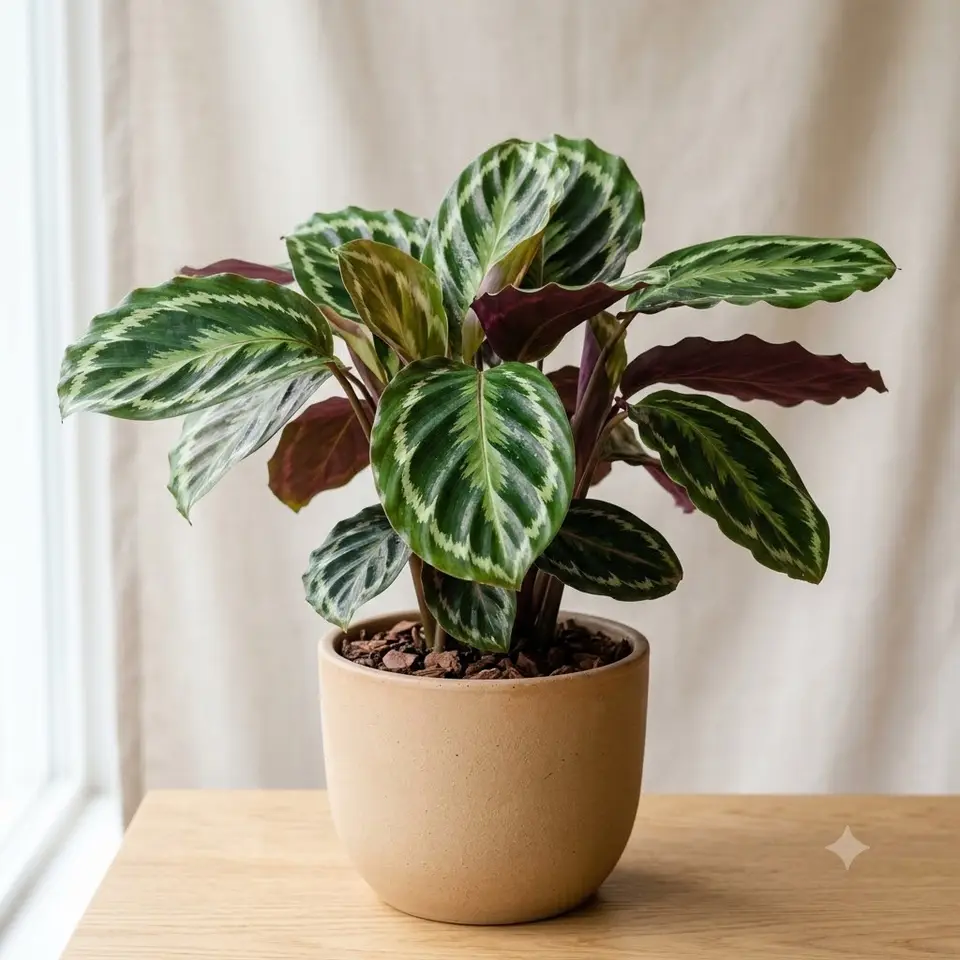 AI illustration
 Overview
The Calathea Medallion is a compact, showy prayer plant grown almost entirely for its striking foliage. Each rounded leaf carries a feathered pattern of light and dark green on top and a rich burgundy-purple underside, and the whole plant lifts and folds its leaves at night in a slow daily rhythm called nyctinasty (Goeppertia 'Medallion', sold under Calathea veitchiana or Calathea roseopicta). It is a genuinely beautiful plant, but an honest one to grow: it rewards steady humidity and clean water and punishes neglect with crispy edges.
Origin & Natural Habitat
Medallion is a cultivated selection whose wild Calathea relatives come from the tropical rainforests of South America. In the wild it lives on the shaded forest floor as an understory plant, sheltered by the canopy in warm, consistently humid, low-light conditions with rich, moist, leaf-littered soil. Those origins explain almost every quirk of its care indoors: it never evolved for dry air, bright direct sun, or mineral-heavy water.
Appearance
The Medallion forms a low, clumping rosette of large, near-round to broadly oval leaves, each held on its own upright stalk. Individual leaves reach roughly 15 to 20 cm across on a mature plant. The upper surface is patterned in alternating bands of pale silvery-green and deep green that radiate from the midrib like brushstrokes, while the underside is a deep wine-purple that shows clearly when the leaves fold upward in the evening. Overall the plant stays compact, typically around 40 to 60 cm tall and wide indoors, making it a tidy tabletop specimen rather than a sprawling one. It rarely flowers as a houseplant, and the foliage is the entire point.
Why People Grow It - Qualities & Benefits
- Dramatic, patterned foliage with a jewel-toned purple underside that few other houseplants match
- The nightly leaf-folding movement makes it feel like a living, responsive plant
- Stays compact and well-behaved, so it suits shelves, desks, and smaller rooms
- Genuinely pet-safe, which makes it a rare statement plant for homes with cats or dogs
Care
Light: Bright, indirect light. It tolerates medium light but not direct sun, which scorches and bleaches the pattern. An east-facing window or a metre or so back from a brighter one is ideal. Water: Keep the soil lightly and evenly moist, never soggy and never bone-dry. This is the fussy part: it is sensitive to fluoride, chlorine, and salts in tap water, which show up as browning tips and edges. Use rainwater, distilled, or filtered water at room temperature where you can. Soil: A light, airy, moisture-retentive mix that still drains freely. A peat- or coir-based houseplant mix loosened with perlite and a little orchid bark works well. Always use a pot with drainage holes. Temperature & Humidity: Warm and stable, roughly 18 to 27°C. Avoid cold draughts, heating vents, and anything below about 15°C. High humidity is not optional here: aim for 60% or more. A humidifier is the most reliable fix; pebble trays and grouping plants help a little. Feeding: Feed lightly during the growing season, spring through summer, with a balanced houseplant fertiliser at roughly half the recommended strength every 4 to 6 weeks. It is a light feeder and salt-sensitive, so err on the side of too little. Ease off in autumn and winter. Extra: The key quirk is that crispy brown edges are usually a water-quality or humidity signal, not underwatering, so switching to filtered water often does more than watering more. Good news for pet households: Calathea is non-toxic to cats and dogs.
Propagation
Propagate by division, ideally at repotting time in spring. Gently unpot the plant, tease or cut the root ball into clumps making sure each section keeps healthy roots and several leaves, then pot each division into fresh moist mix. Keep the new divisions warm, humid, and out of direct sun while they settle. It does not root from a single leaf or stem cutting the way pothos or philodendrons do, so division is really the only reliable home method.
Common Problems & Pests
- Crispy brown leaf edges and tips, usually from low humidity, dry soil, or minerals in tap water
- Spider mites, which thrive in dry air and hide on the leaf undersides; curling or faintly stippled leaves are an early warning
- Yellowing leaves or root rot from overwatering and poor drainage, versus limp, curling leaves from underwatering or cold
Toxicity & Safety
The Calathea Medallion is pet-safe. It is non-toxic to cats and dogs, as are prayer plants in the family Marantaceae generally, which makes it one of the better statement foliage plants for homes with curious animals. As with any houseplant, the potting soil and fertiliser are not meant to be eaten, and nibbling large amounts of foliage can still cause mild stomach upset simply from the plant matter, but the plant itself carries no known toxic compounds.
Pros & Cons
Pros
- Stunning patterned leaves with a purple underside and living, night-folding movement
- Non-toxic and compact, so it fits pet homes and smaller spaces
Cons
- Fussy about humidity and water quality; brown edges are common for beginners
- Needs consistent warmth and never fully forgives neglect or cold draughts
Best Suited For
- Pet owners who want a dramatic foliage plant without a toxicity worry
- Attentive growers who can offer high humidity, filtered water, and stable warmth
FAQ
Why does my Calathea Medallion get brown, crispy edges?
Most often it is water quality and dry air. This plant is sensitive to fluoride, chlorine, and salts in tap water, and to humidity below about 60%. Switch to filtered, distilled, or rainwater, add a humidifier, and keep the soil evenly moist rather than letting it dry out.
Is the Calathea Medallion safe around cats and dogs?
Yes. It is non-toxic to both cats and dogs, so it is a good choice for pet households. Still keep the soil and any fertiliser out of reach, since those are not meant to be eaten.
Sources
Pet toxicity: checked against the ASPCA Animal Poison Control Center lists of toxic and non-toxic plants for cats and dogs, genus-wide entry "Calathea" (Calathea spp.): non-toxic to cats and dogs. Lists read on 10 October 2026.
Gear for growing calathea medallion
Links go to Amazon or a partner store (such as Adagio Teas) and may earn us a commission at no extra cost to you. As an Amazon Associate we earn from qualifying purchases. We link gear types, not sponsors' picks: you choose the exact product.