Anthurium Hookeri
Anthurium Hookeri is a large bird's nest anthurium grown for its bold rosette of broad, upright, leathery leaves that arch out like a living funnel.
Last reviewed: October 2026
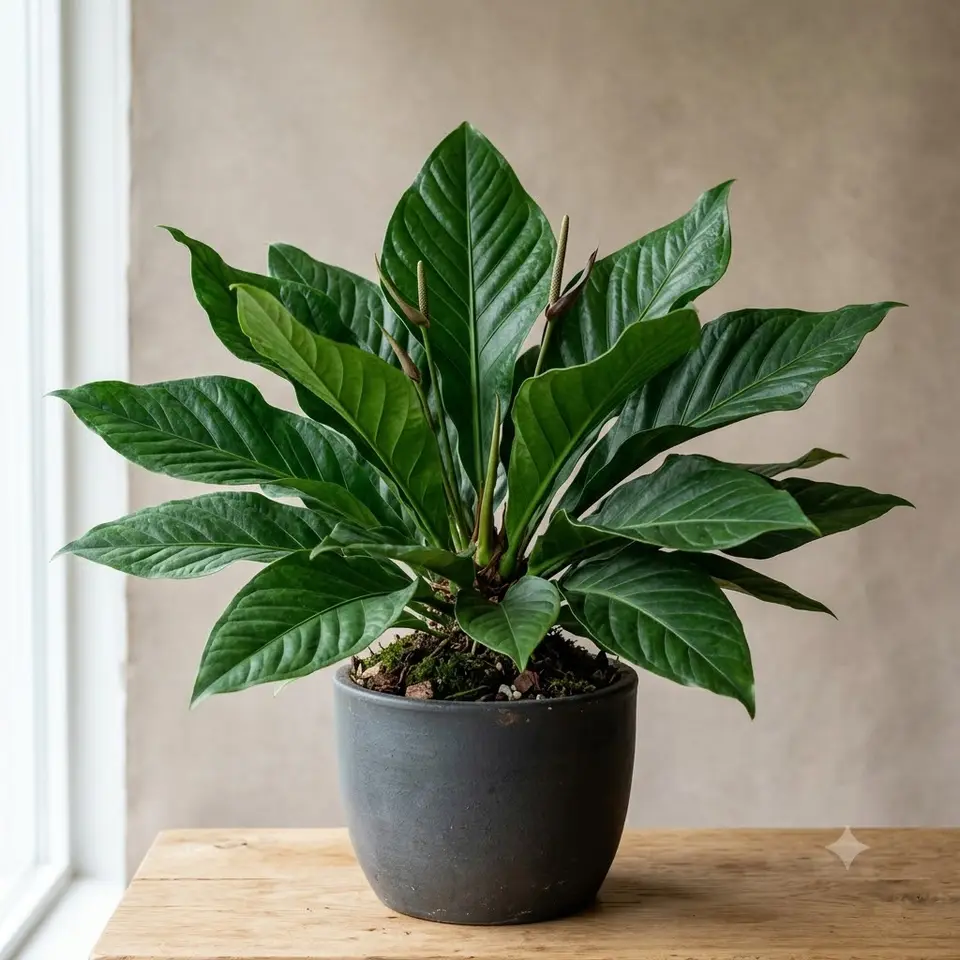 AI illustration
 Overview
Anthurium Hookeri is a large bird's nest anthurium grown for its bold rosette of broad, upright, leathery leaves that arch out like a living funnel. Collectors prize it as a statement epiphyte - architectural, sturdy, and quietly distinctive thanks to the tiny dark glandular dots freckling both leaf surfaces. It is botanically known as Anthurium hookeri.
Origin & Natural Habitat
This species is native to the Lesser Antilles and the Caribbean coast of northern South America, where it grows as an epiphyte or lithophyte in warm, humid lowland and montane rainforest. In the wild its rosette form catches falling leaf litter and moisture, feeding the plant much like a natural compost basket.
Appearance
The leaves are broadly strap-shaped to obovate, leathery, and bright to deep green, radiating upward from a central point to form a classic bird's nest rosette. Mature leaves can reach roughly 60 to 90 cm long in good conditions, and the whole plant can spread a metre or more across. A reliable identifying trait is the scattering of minute dark dots on both the upper and lower leaf surfaces, and it produces a slim spadix followed by small white to purplish berries.
Why People Grow It - Qualities & Benefits
- Dramatic architectural rosette that makes a bold floor or plinth specimen
- Thick, glossy, leathery foliage that reads as lush and tropical year round
- Tougher and more forgiving than thin-leaved velvet anthuriums
- A genuine collector's aroid that stays evergreen with no die-back
Care
Light: Bright, indirect light. It tolerates a little morning sun but harsh midday rays scorch the leaves; too little light leaves it thin and floppy.
Water: Keep the mix evenly moist but never soggy. Water when the top 2-5 cm feel dry, and always let excess drain freely to avoid rot in the crown and roots.
Soil: A chunky, fast-draining aroid mix - orchid bark, perlite, coco coir or peat, and a little charcoal. It needs air around the roots, not dense potting soil.
Temperature & Humidity: Warmth-loving: roughly 18 to 29°C. It resents anything below about 13°C. Humidity of 60% or higher keeps it happiest; in dry rooms leaf tips can brown and pests move in, so honestly, a pebble tray or humidifier helps.
Feeding: Feed with a balanced, diluted fertilizer every 3 to 4 weeks in spring and summer, tapering off in the cooler, darker months.
Extra: This anthurium has no dormancy: it grows slowly and steadily all year, so avoid the temptation to overwater in winter when growth stalls. Water crushed into the crown can rot it, so water the mix, not the center. Toxic to cats and dogs (insoluble calcium oxalate crystals in the sap) - keep out of reach of pets and children.
Propagation
The most reliable method is division: mature plants form offsets or can be split at the root mass, giving each division several leaves and a healthy share of roots. It can also be grown from fresh seed harvested from ripe berries, but that is slow and mainly for the patient.
Common Problems & Pests
- Spider mites and thrips, especially in dry air - check leaf undersides and along the freckled surfaces
- Root and crown rot from soggy mix or water sitting in the rosette
- Brown leaf tips and edges from low humidity, underwatering, or salt buildup from over-fertilizing
Toxicity & Safety
Anthurium Hookeri is toxic to cats and dogs. Like other anthuriums it contains insoluble calcium oxalate crystals; when the tissue is chewed these needle-like crystals cause intense oral irritation, drooling, pawing at the mouth, and vomiting. The sap can also irritate human skin and eyes, so wear gloves when dividing or cutting it and wash your hands afterward.
Pros & Cons
Pros
- Big, sculptural, evergreen presence with minimal fuss once settled
- Sturdier leaves than delicate velvet-leaf anthuriums
Cons
- Wants consistent warmth and higher humidity to truly thrive
- Gets large and space-hungry, and is toxic to curious pets
Best Suited For
- Collectors who want a bold statement aroid and can offer warmth and humidity
- Growers with room for a plant that spreads wide over time
FAQ
Why does my Anthurium Hookeri have brown leaf tips?
Usually low humidity or inconsistent watering, sometimes fertilizer salt buildup. Raise humidity, keep the mix evenly moist, and flush the pot occasionally with plain water.
Is Anthurium Hookeri a beginner plant?
It is more of an intermediate plant. It is forgiving about light and fairly tough-leaved, but its size, warmth, and humidity needs make it best for someone ready to meet those conditions.
Gear for growing anthurium hookeri
Links go to Amazon or a partner store (such as Adagio Teas) and may earn us a commission at no extra cost to you. As an Amazon Associate we earn from qualifying purchases. We link gear types, not sponsors' picks: you choose the exact product.