Anthurium Vittarifolium
Anthurium Vittarifolium is a pendant, strap-leaf aroid prized for its dramatically long, ribbon-like foliage that spills down from a hanging basket or shelf.
Last reviewed: October 2026
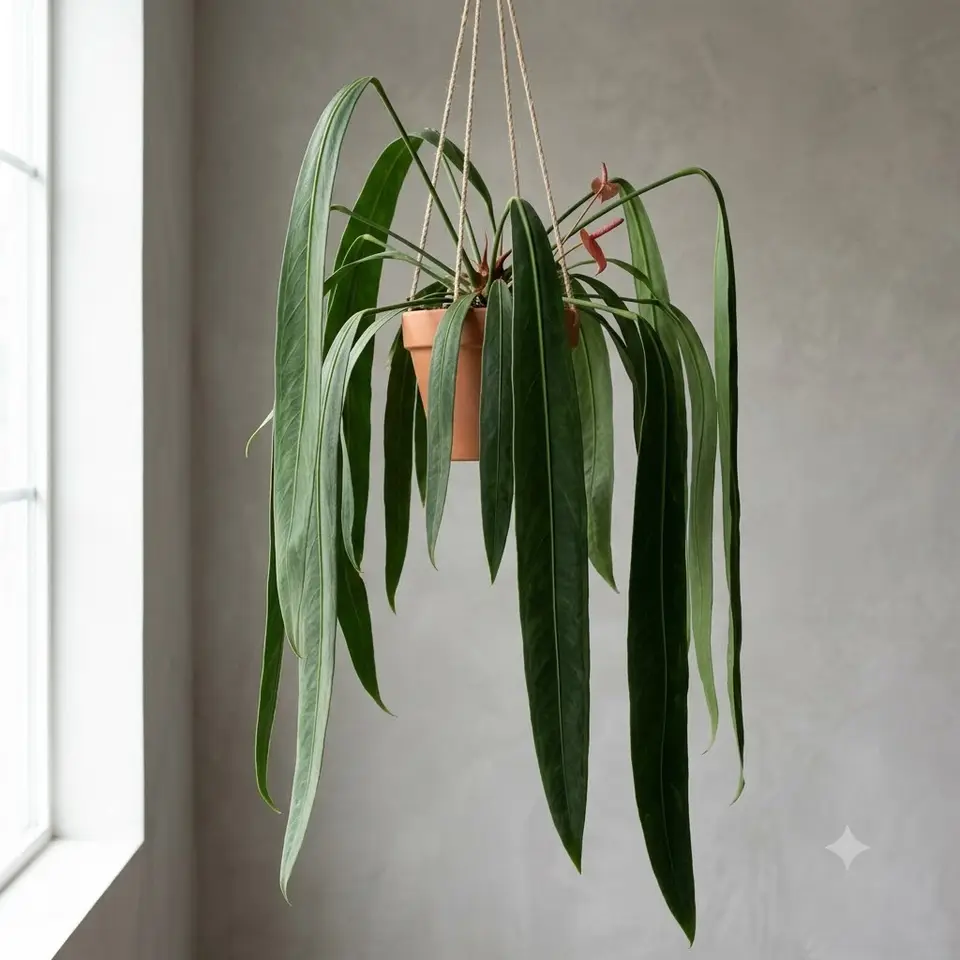 AI illustration
 Overview
Anthurium Vittarifolium is a pendant, strap-leaf aroid prized for its dramatically long, ribbon-like foliage that spills down from a hanging basket or shelf. Unlike the broad, heart-shaped anthuriums most people know, this species is all about texture and length, making it a standout collector's piece. Its botanical name is Anthurium vittariifolium - the trade usually spells it vittarifolium.
Origin & Natural Habitat
It is native to the humid tropical rainforests of northwestern South America and the western Amazon, from Colombia through Ecuador and Peru, along the Andean foothills and Amazon basin. There it grows as an epiphyte, clinging to tree trunks and branches where its narrow leaves hang freely in warm, moist, shaded air.
Appearance
The plant produces exceptionally long, thin, strap-shaped leaves that are deep green with a subtle sheen and a slightly rippled edge. Individual leaves can reach roughly 1 to 2 m long while staying only 2.5 to 5 cm wide, cascading straight down from a compact central crown. Mature specimens form a curtain of foliage, and older plants may bloom with a slim spadix followed by small pink to violet berries.
Why People Grow It - Qualities & Benefits
- Striking pendant habit that turns a hanging basket into a living waterfall of foliage
- Unusual strap-leaf form that stands apart from typical rounded anthuriums
- Compact root crown, so it needs less horizontal space than its leaf length suggests
- A genuine conversation piece and a rewarding challenge for aroid collectors
Care
Light: Bright, indirect light. Direct midday sun scorches the thin leaves, while deep shade slows growth and leaves the foliage sparse.
Water: Keep the mix lightly and evenly moist. Water when the top 2-3 cm begin to dry, and never let it sit in soggy medium, since the epiphytic roots rot quickly if waterlogged.
Soil: A chunky, fast-draining aroid mix - orchid bark, perlite, coco chips, and a little sphagnum. Airflow around the roots matters more than richness.
Temperature & Humidity: Warmth-loving, happiest at 18 to 29°C. It genuinely wants high humidity, ideally 60% or more; in dry indoor air the long leaves develop brown, crispy tips and edges. A humidifier or greenhouse cabinet helps a lot.
Feeding: Feed with a balanced, diluted liquid fertilizer roughly every 4 to 6 weeks during spring and summer. Ease off in the cooler, lower-light months.
Extra: Give it height so the leaves can hang free - a basket or tall shelf is essential, since cramped or crowded leaves crease and snap. It does not go dormant, but growth slows noticeably in winter. Toxic to cats and dogs (insoluble calcium oxalate crystals in the sap) - keep out of reach of pets and children.
Propagation
Propagate by division of the crown or by separating basal offshoots that carry their own roots. Mature plants can also be grown from seed, but division is far faster and more reliable for the home grower. Keep divisions warm and humid until new roots establish.
Common Problems & Pests
- Spider mites are the top pest, thriving in the dry air the plant hates and stippling or bronzing the thin leaves
- Brown, crispy leaf tips and edges from low humidity or inconsistent watering
- Root rot and yellowing from a heavy, water-retentive mix or overwatering
Toxicity & Safety
Like all anthuriums, this plant is toxic to cats and dogs. Every part contains insoluble calcium oxalate crystals, so chewing or biting the foliage causes intense oral irritation, drooling, pawing at the mouth, and vomiting. The sap can also irritate human skin and eyes, so wash your hands after pruning or repotting and keep the plant away from curious pets and small children.
Pros & Cons
Pros
- Unique, eye-catching pendant form unlike any common houseplant
- Compact rootball that fits small spaces despite long foliage
Cons
- Demands consistently high humidity that ordinary rooms rarely provide
- Prone to spider mites and unsightly leaf-tip burn when conditions slip
Best Suited For
- Collectors with a humid setup - a greenhouse cabinet, terrarium, or humidifier-rich room
- Growers who want a hanging specimen and can give it vertical space to cascade
FAQ
Why are my leaf tips turning brown?
Almost always low humidity or erratic watering. Raise ambient moisture toward 60% or more and keep the mix evenly damp, and new leaves will emerge cleaner.
How long do the leaves really get?
Under good conditions individual leaves commonly reach 1 to 2 m, though indoor plants often stay shorter until they are well established and consistently humid.
Gear for growing anthurium vittarifolium
Links go to Amazon or a partner store (such as Adagio Teas) and may earn us a commission at no extra cost to you. As an Amazon Associate we earn from qualifying purchases. We link gear types, not sponsors' picks: you choose the exact product.