Anubias
Anubias is a slow, tough, dark-green rosette that grows tied to wood or rock rather than planted in substrate, shrugging off low light and neglect.
Last reviewed: October 2026
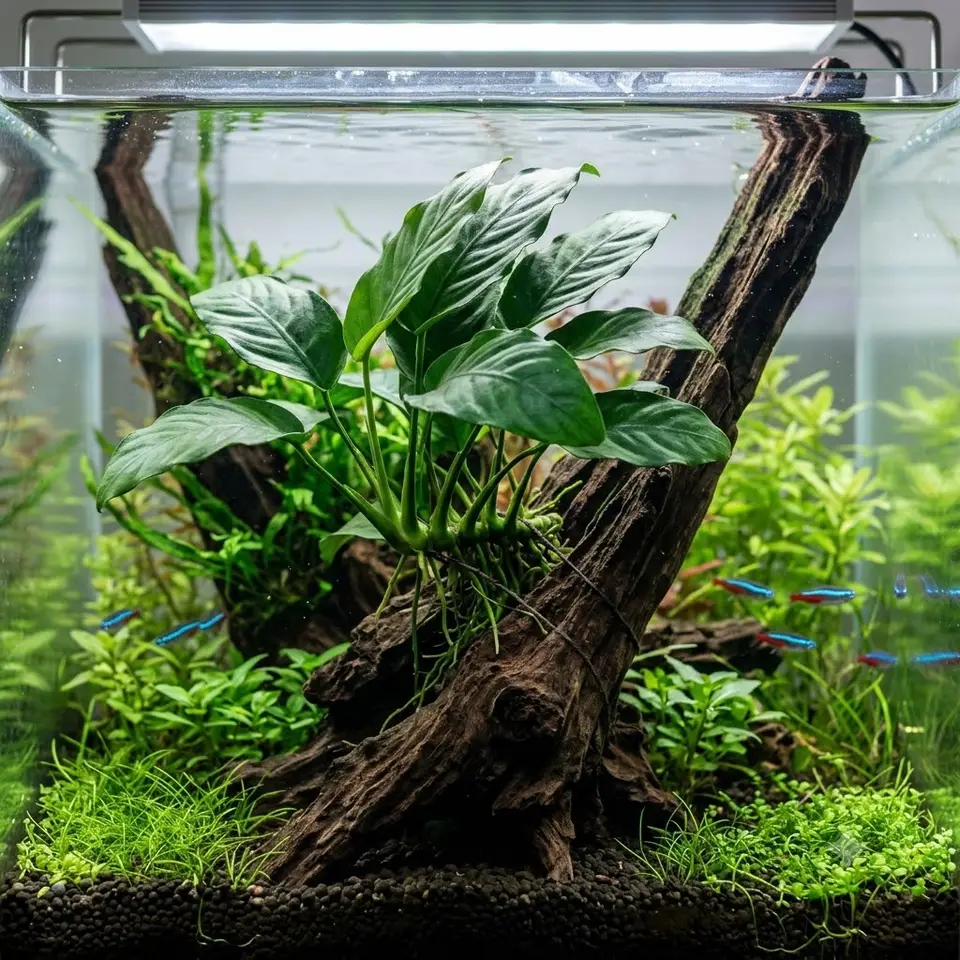 AI illustration
Overview
Anubias is a slow, tough, dark-green rosette that grows tied to wood or rock rather than planted in substrate, shrugging off low light and neglect. Its one hard rule: never bury the rhizome. (Anubias barteri.)
Origin & Natural Habitat
Tropical West and Central Africa, growing along shaded stream banks and over submerged rock and roots - which is why it is an epiphyte, not a substrate plant.
Appearance
Thick, leathery, deep-green leaves on a creeping horizontal rhizome; slow to add a leaf but nearly indestructible once settled. Dwarf forms like 'nana' and 'petite' stay palm-sized.
Why People Grow It - Qualities & Benefits
- Thrives in low light with no CO2
- Attaches to hardscape: no planting needed
- Tough leaves resist most fish and snails
- Extremely slow and forgiving
Care
Light: Low to moderate; too much light just grows algae on the slow leaves, not faster growth.
Water: 22-28°C, pH 6.0-7.8, soft to moderately hard - very adaptable aquarium water.
Substrate: None - tie or glue the rhizome to wood or rock; roots grip on their own.
CO₂ & feeding: Not needed; optional liquid fertiliser helps. Grows slowly either way.
Placement: Foreground to midground, on hardscape, ideally shaded by taller plants.
Extra: Never bury the rhizome (the thick horizontal stem) in substrate - it will rot and kill the plant. Only the roots go down; the rhizome stays exposed.
Propagation
Cut the rhizome into sections, each with a few leaves and roots; re-attach to new hardscape.
Common Problems & Pests
Black-beard algae on old leaves (from too much light/nutrients); rhizome rot (from being buried). Rare 'anubias melt' after big changes - it usually recovers.
Toxicity & Safety
Non-toxic to fish, shrimp and snails, and not known to be toxic to cats or dogs if nibbled. A safe, planted-tank staple.
Best Suited For
- Absolute beginners
- Low-tech, no-CO2 tanks
- Tanks with plant-nibbling fish
- Attaching to driftwood and rock
FAQ
Why are my anubias leaves covered in algae?
Too much light for such a slow grower. Shade it, reduce the photoperiod, and let shrimp or otos clean the leathery leaves - they take it.
Can I plant anubias in the gravel?
Only the roots, never the rhizome. Bury that thick horizontal stem and it rots. Tie the rhizome to wood or rock instead.
Gear for growing anubias
Links go to Amazon or a partner store (such as Adagio Teas) and may earn us a commission at no extra cost to you. As an Amazon Associate we earn from qualifying purchases. We link gear types, not sponsors' picks: you choose the exact product.