Anthurium Forgetii
Anthurium Forgetii is a compact velvet-leaved collector aroid prized for one striking quirk: its leaves are fully rounded and "closed" at the top, with the petiole meeting the blade at an entire, un-notched edge rather than the deep heart-shaped sinus most anthuriums show.
Last reviewed: September 2026
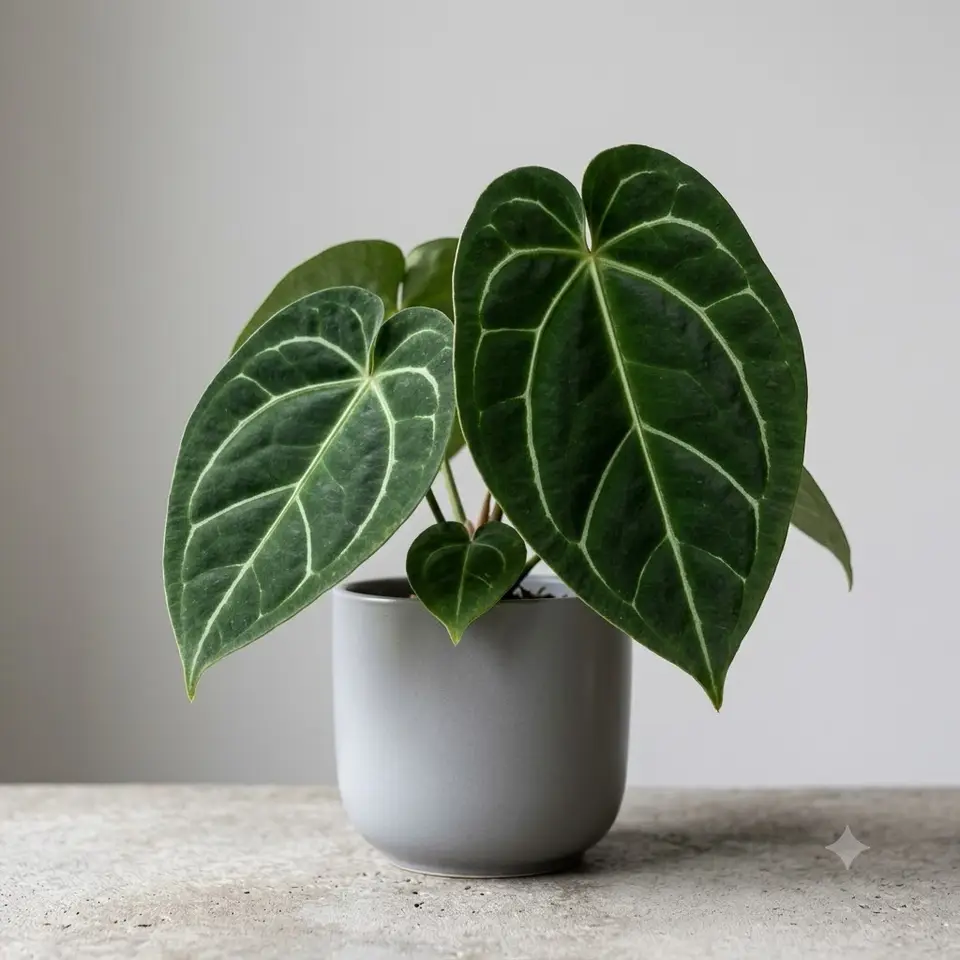 AI illustration
 Overview
Anthurium Forgetii is a compact velvet-leaved collector aroid prized for one striking quirk: its leaves are fully rounded and "closed" at the top, with the petiole meeting the blade at an entire, un-notched edge rather than the deep heart-shaped sinus most anthuriums show. Add dark, matte-velvet foliage laced with bright silvery-white veins and pale margins, and you have one of the most sought-after small anthuriums in cultivation. Botanically it is known as Anthurium forgetii.
Origin & Natural Habitat
The species is native to Colombia, where it grows in warm, humid montane and lowland rainforest, often in the shaded understory. It behaves as an epiphyte or terrestrial rooting in leaf litter and mossy bark, conditions that explain its appetite for constant humidity and airy footing.
Appearance
The leaves are ovate to nearly rounded, held on slender petioles, and finish in a velvety, deep blackish-green surface crossed by contrasting white to silver primary veins. Unlike most anthuriums, the blade has no basal lobes, so the outline reads as a smooth teardrop or shield, frequently edged with a fine pale margin. It stays small and slow, with mature leaves commonly reaching around 15 to 25 cm and the whole plant remaining a tidy, low rosette that suits a terrarium or cabinet.
Why People Grow It - Qualities & Benefits
- Rare, distinctive foliage with the unusual seamless, lobe-free leaf shape.
- Velvety texture and vivid silver-white venation that photograph beautifully.
- Stays compact, so it fits shelves, cabinets and terrariums rather than sprawling.
- A genuine conversation piece and a badge among aroid collectors.
Care
Light: Bright, indirect light. Filtered or dappled light mimics its understory home; direct sun scorches the velvet surface, while deep shade slows already slow growth.
Water: Keep the mix evenly moist but never soggy. Water when the top layer starts to dry, use room-temperature water, and never let roots sit in standing water, which invites rot.
Soil: A chunky, fast-draining aroid mix - bark, perlite, coco chips and sphagnum with some organic matter. It wants air around the roots and moisture-holding material in equal measure.
Temperature & Humidity: Warmth-loving: roughly 18 to 27°C, no cold drafts and nothing below about 15°C. Be honest - this plant is humidity-hungry, wanting 60 to 80%, and it sulks or crisps in normal dry room air. Most growers succeed only in a terrarium, cabinet or with a humidifier.
Feeding: Feed lightly with a balanced, diluted fertilizer every 3 to 4 weeks during active growth; ease off in the low-light winter months. It is sensitive to salt buildup, so flush the mix occasionally.
Extra: The single biggest challenge is stable high humidity paired with airflow - swings between wet and bone-dry air are what kill velvet anthuriums. It does not have a true dormancy but slows noticeably in winter. Toxic to cats and dogs (insoluble calcium oxalate crystals in the leaves and sap) - keep out of reach of pets and children.
Propagation
Propagate by division or by separating basal offsets once the plant produces them, making sure each division carries its own roots. It can also be grown from fresh seed harvested from ripe berries, though this is slow and mostly for dedicated hobbyists. Pot divisions into a moist, airy mix and keep humidity high until they establish.
Common Problems & Pests
- Spider mites are the top threat, especially in warm, dry air - inspect leaf undersides regularly for fine webbing and stippling.
- Root rot and yellowing from overwatering or a dense, waterlogged mix.
- Crispy edges, stalled growth and dull leaves when humidity drops too low; thrips and scale can also appear.
Toxicity & Safety
Like all anthuriums, this plant is toxic to cats and dogs. The leaves and sap contain insoluble calcium oxalate crystals that, when chewed, cause intense oral irritation, drooling, pawing at the mouth, and vomiting. The sap can also irritate human skin and eyes, so wash your hands after pruning or repotting and site the plant where pets and small children cannot reach it.
Pros & Cons
Pros
- Rare, unmistakable foliage that stands out in any collection.
- Compact and slow, so it never outgrows a shelf or terrarium.
Cons
- Fussy about humidity and unforgiving of dry indoor air.
- Prone to spider mites and slow to recover from stress.
Best Suited For
- Experienced aroid collectors who can offer a terrarium, cabinet or humid grow space.
- Anyone wanting a small, showpiece velvet anthurium rather than a large, easy houseplant.
FAQ
Why do the leaves look different from other anthuriums?
Its blade is fully rounded with no basal lobes, so the petiole joins an unbroken edge instead of the deep heart-shaped notch typical of the genus. That closed, shield-like outline is exactly what makes it collectible.
Can I grow it outside a terrarium?
It is possible in a naturally humid room with a humidifier and good airflow, but most people find it far easier and healthier inside an enclosed cabinet or terrarium where humidity stays consistently high.
Gear for growing anthurium forgetii
Links go to Amazon or a partner store (such as Adagio Teas) and may earn us a commission at no extra cost to you. As an Amazon Associate we earn from qualifying purchases. We link gear types, not sponsors' picks: you choose the exact product.