Philodendron Moonlight
Philodendron Moonlight is a compact, self-heading hybrid prized for its electric chartreuse new growth that glows against older, deeper green foliage.
Last reviewed: September 2026
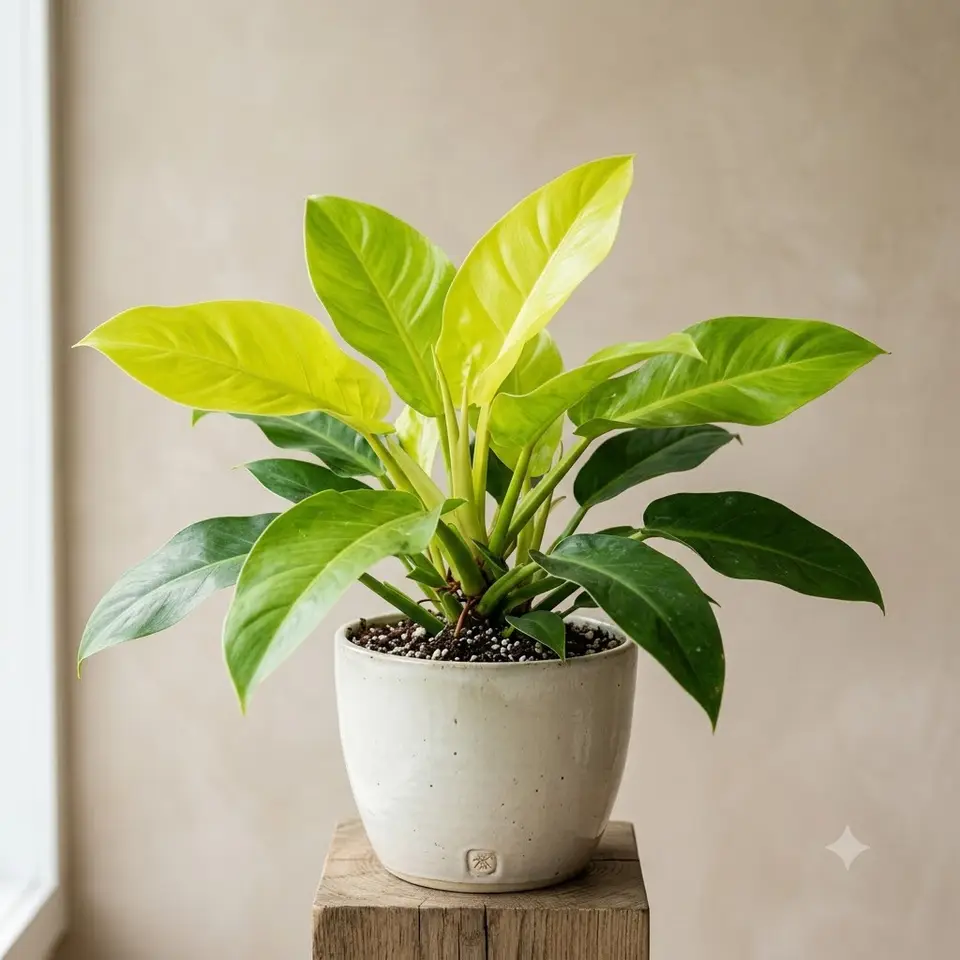 AI illustration
 Overview
Philodendron Moonlight is a compact, self-heading hybrid prized for its electric chartreuse new growth that glows against older, deeper green foliage. It is a man-made cultivar (Philodendron 'Moonlight') rather than a wild species, bred for a bushy, mounding habit that never needs a moss pole. Fast, forgiving and colourful, it is one of the easiest ways to bring neon-lime foliage into a home.
Origin & Natural Habitat
Moonlight is a cultivated hybrid with no natural range of its own - it does not grow wild anywhere. Its parent stock traces back to the genus Philodendron, a group native to the humid tropical rainforests of Central and South America, where relatives grow as understorey plants in warm, shaded, consistently moist conditions. The cultivar was selected in cultivation for its bright juvenile colour and self-heading (non-vining) form.
Appearance
Moonlight is a self-heading philodendron that grows in a rounded clump rather than climbing. New leaves emerge a vivid, almost fluorescent yellow-green (the "moonlight" glow), then gradually deepen to a rich medium green as they age, so the plant carries several shades at once. Leaves are lance-shaped to broadly elliptical, smooth and slightly glossy, typically 15 to 25 cm long. Reddish-tinged petioles support the foliage. Indoors it forms a tidy mound roughly 40 to 60 cm tall and wide, occasionally larger with age.
Why People Grow It - Qualities & Benefits
- Standout neon-lime new growth that adds colour without needing flowers
- Self-heading, bushy shape - no moss pole, trellis or staking required
- Fast growing and very forgiving, ideal for beginners
- Compact footprint that suits shelves, desks and smaller rooms
Care
Light: Bright, indirect light keeps the lime colour vivid. It tolerates medium light but growth slows and new leaves stay greener; avoid harsh direct sun, which scorches the tender foliage. Water: Water when the top 2 to 3 cm of mix feels dry, then water thoroughly and let it drain. Keep lightly moist in summer and drier in winter - soggy roots quickly cause rot. Soil: A chunky, well-draining aroid mix - peat or coco coir blended with perlite, orchid bark and a little compost. Good aeration and drainage are essential. Temperature & Humidity: Happiest at 18 to 27°C; protect from cold below 13°C and from drafts. Tolerates average household humidity but grows fuller at 50% or above. Feeding: Feed monthly through spring and summer with a balanced, diluted houseplant fertiliser. Ease off in autumn and winter when growth naturally slows. Extra: Because juvenile leaves are so bright, the colour contrast is strongest under good light - too little and the plant reads as plain green. It also produces occasional aerial roots at the base, which are normal and can be tucked back into the pot. Note that Philodendron Moonlight is toxic to cats and dogs - the insoluble calcium oxalate crystals cause oral irritation, drooling and vomiting if chewed.
Propagation
Propagate by stem cuttings that include at least one node (the point where a leaf and any roots emerge). Cut just below a node, let the cut callus for an hour, then root in water or directly in moist, airy potting mix. Kept warm and humid, cuttings usually root within a few weeks. Mature clumps can also be divided at repotting.
Common Problems & Pests
- Yellowing lower leaves and mushy stems from overwatering or poor drainage (root rot)
- Sap-sucking pests - spider mites, mealybugs, aphids and scale - especially in dry air
- Faded or all-green new growth and leggy stretching when light is too low
Toxicity & Safety
Philodendron Moonlight is toxic to cats and dogs. Like all philodendrons it contains insoluble calcium oxalate crystals throughout its leaves and stems. When an animal chews the plant, these needle-like crystals are released and embed in the mouth and throat, causing intense oral burning and irritation, pawing at the mouth, excessive drooling, difficulty swallowing and vomiting. It is also irritating to people, so keep it out of reach of pets and children and wash hands after handling cuttings or sap.
Pros & Cons
Pros
- Eye-catching neon new growth that stays interesting year-round
- Easy, fast and self-supporting - beginner friendly and low fuss
Cons
- Toxic to cats, dogs and people if chewed
- Bright colour fades to plain green in low light, and it is sensitive to overwatering
Best Suited For
- Beginners who want a colourful, low-maintenance foliage plant
- Pet-free or careful homes with bright, indirect light and limited space
FAQ
Why has my Moonlight lost its bright lime colour?
The vivid glow belongs mainly to new growth, and it develops best in bright, indirect light. In dim spots the plant still grows but new leaves emerge greener and older leaves darken faster, so the neon effect largely disappears. Move it somewhere brighter (out of direct sun) to restore the contrast.
Does Philodendron Moonlight need a moss pole?
No. Unlike climbing philodendrons, Moonlight is self-heading and grows in a compact mound, so it supports itself without a pole or trellis. Any aerial roots that appear at the base are normal and can simply be tucked back into the pot.
Gear for growing philodendron moonlight
Links go to Amazon or a partner store (such as Adagio Teas) and may earn us a commission at no extra cost to you. As an Amazon Associate we earn from qualifying purchases. We link gear types, not sponsors' picks: you choose the exact product.