Philodendron Mccolley Finale
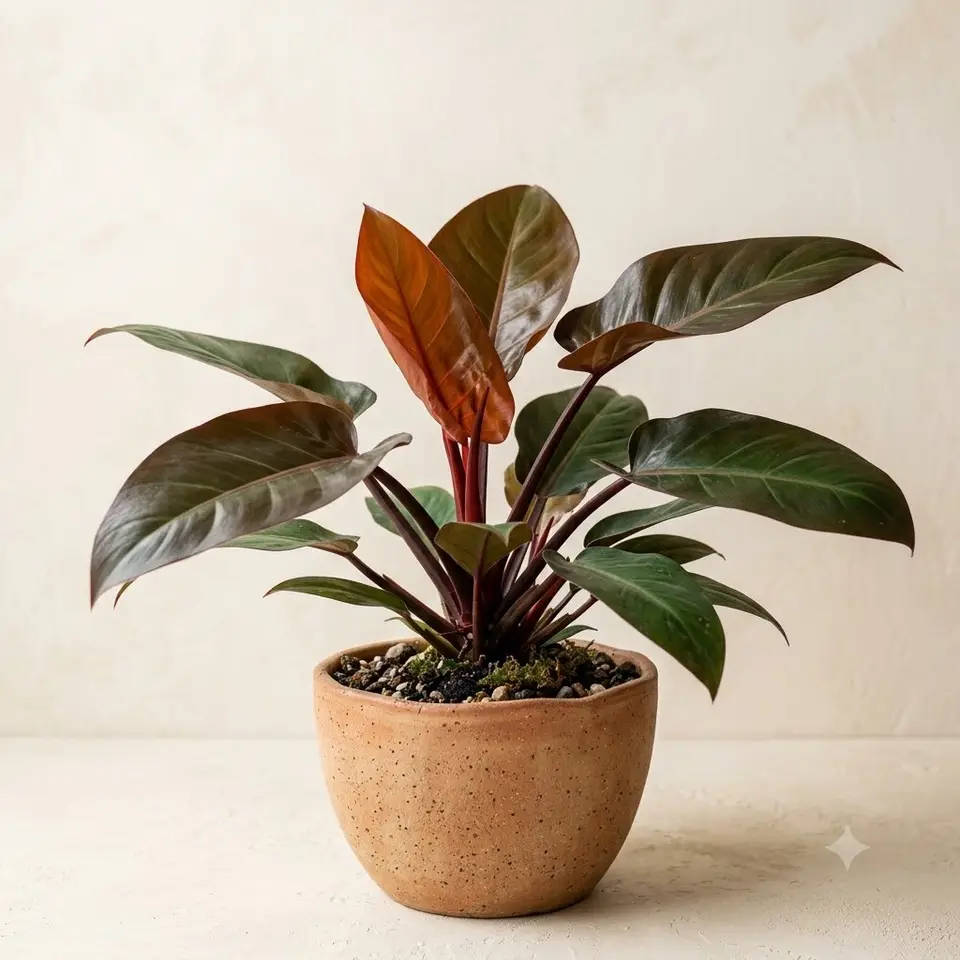
Philodendron 'McColley's Finale' is a compact, self-heading hybrid grown for its dramatic colour-shifting foliage, which emerges bright coppery-red and matures through orange and green (Philodendron 'McColley's Finale').
Last reviewed: September 2026
 AI illustration
 Overview
Philodendron 'McColley's Finale' is a compact, self-heading hybrid grown for its dramatic colour-shifting foliage, which emerges bright coppery-red and matures through orange and green (Philodendron 'McColley's Finale'). It is one of the easier "collector" philodendrons, staying tidy and upright rather than vining, which makes it a good fit for tabletops and shelves. The bold new-growth colour is its main draw and the reason it stays popular despite being a hybrid rather than a species.
Origin & Natural Habitat
This plant is a nursery-bred hybrid, not a wild species, so it has no true native range of its own. Its parent stock traces back to the Philodendron genus, which is native to the tropical rainforests of Central and South America and the Caribbean, where philodendrons grow as understorey and climbing plants in warm, humid, shaded conditions. 'McColley's Finale' was developed in cultivation for ornamental use and exists only as a grown hybrid, so it should be thought of as a warm-tropical houseplant rather than a plant collected from the wild.
Appearance
The leaves are broadly lance-shaped to arrow-shaped with a slightly wavy margin, typically reaching around 15 to 25 cm long on a well-grown plant. The standout feature is colour progression: new leaves push out a vivid reddish-copper to orange, then shift through amber and settle into a deep green as they age, so a healthy plant shows several colours at once. Growth is self-heading and clumping rather than trailing, forming a rosette-like mound that usually stays around 45 to 75 cm tall and wide indoors. Stems are short and stout, and older plants can develop stubby aerial roots at the base.
Why People Grow It - Qualities & Benefits
- Striking multi-colour foliage, with fiery new growth against mature green leaves for constant visual interest.
- Compact self-heading habit that stays tidy and does not need a moss pole or trellis to climb.
- Forgiving and fast-growing, tolerating a range of indoor light levels and occasional missed waterings.
- A "collector" look and feel without the fussiness of many rarer aroids, making it an approachable statement plant.
Care
Light: Bright, indirect light brings out the strongest new-growth colour; direct midday sun can scorch the leaves, while deep shade dulls the reds toward plain green. Water: Water when the top 3 to 5 cm of soil has dried, then water thoroughly and let excess drain; keep it evenly moist but never waterlogged, and ease off in winter. Soil: A chunky, well-draining aroid mix works best - for example potting soil loosened with orchid bark, perlite and a little coco coir to hold moisture while keeping roots airy. Temperature & Humidity: Prefers 18 to 27°C and dislikes cold; keep it above roughly 13°C and away from draughts. It does fine in average room humidity but grows lushest at 50 to 60% or higher. Feeding: Feed monthly during spring and summer with a balanced houseplant fertiliser at half strength; pause feeding in autumn and winter when growth slows. Extra: The vivid red is a feature of fresh growth only, so leaves naturally green up with age - this is normal, not a decline. Note that this plant is toxic to cats and dogs due to insoluble calcium oxalate crystals, and chewing causes oral irritation, drooling and vomiting.
Propagation
Propagate by stem cuttings that include at least one node, taken from the base or a side offset since this is a self-heading plant rather than a long vine. Let the cut end callus for an hour, then root it in water or directly in a moist, airy mix, keeping it warm and humid until new roots and growth appear. Clumps can also be divided at repotting by separating rooted offsets with a clean blade.
Common Problems & Pests
- Yellowing lower leaves, usually from overwatering or soggy soil - check drainage and let the mix dry more between waterings.
- Faded or all-green new growth from too little light; move it somewhere brighter but out of harsh direct sun.
- Sap-sucking pests such as spider mites, mealybugs, thrips and scale, especially in dry air - inspect leaf undersides and treat early with insecticidal soap.
Toxicity & Safety
This plant is toxic to cats and dogs. Like other philodendrons, every part contains insoluble calcium oxalate crystals; when a pet chews or bites the foliage, the crystals release sharp, needle-like raphides that embed in the mouth and throat. Signs include intense oral irritation and burning, excessive drooling, pawing at the mouth, difficulty swallowing and vomiting. It is also irritating to people if chewed, so keep it out of reach of pets and small children, and wash hands after handling cut stems as the sap can irritate skin.
Pros & Cons
Pros
- Eye-catching colour-shifting foliage that few compact houseplants can match.
- Easygoing, fast and compact, so it suits beginners and small spaces.
Cons
- Toxic to cats, dogs and people if chewed, so it needs careful placement.
- The prized red colour fades with leaf age, and low light can wash it out entirely.
Best Suited For
- Beginners who want a colourful "collector" plant without demanding care.
- People with bright, indirect light and no pets or children able to reach the foliage.
FAQ
Why are my new leaves red but the older ones green?
That colour shift is completely normal for 'McColley's Finale'. Leaves emerge coppery-red or orange and gradually turn green as they mature, so a healthy plant naturally displays both at the same time.
Does it need a moss pole to climb?
No. This is a self-heading, clumping philodendron rather than a climber, so it stays upright and mounded on its own and does not need a pole or trellis.
Gear for growing philodendron mccolley finale
Links go to Amazon or a partner store (such as Adagio Teas) and may earn us a commission at no extra cost to you. As an Amazon Associate we earn from qualifying purchases. We link gear types, not sponsors' picks: you choose the exact product.