Philodendron Florida Ghost
Philodendron Florida Ghost is a climbing aroid prized by collectors for the eerie, near-white new leaves that give it its name.
Last reviewed: September 2026
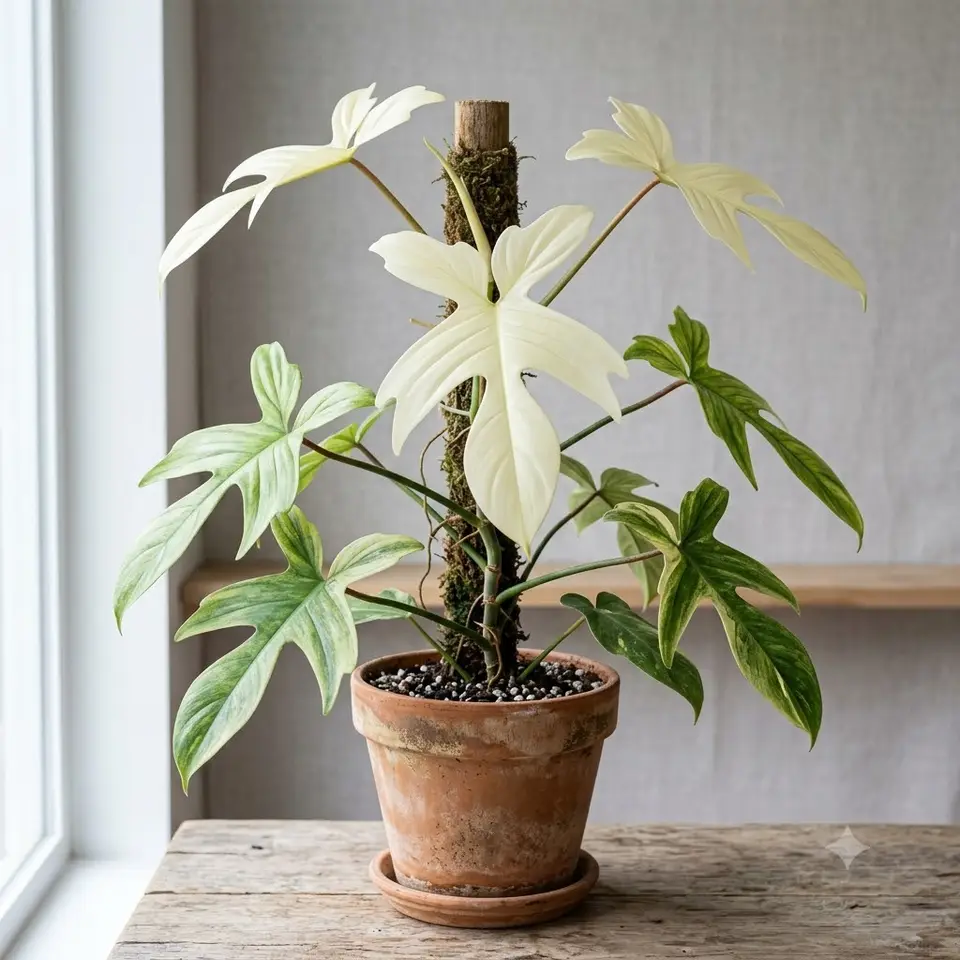 AI illustration
 Overview
Philodendron Florida Ghost is a climbing aroid prized by collectors for the eerie, near-white new leaves that give it its name. It is commonly described as a selection of the hybrid Philodendron 'Florida' (Philodendron 'Florida Ghost'), which is itself usually listed as a cross of Philodendron pedatum and Philodendron squamiferum. Fresh leaves unfurl a ghostly cream to pale mint, then slowly deepen to rich green as they harden off.
Origin & Natural Habitat
Florida Ghost is a horticultural hybrid and does not occur anywhere in the wild - it exists only in cultivation. Its parent species come from the humid tropical rainforests of northern South America, where they grow as hemi-epiphytes, rooting in the ground and then climbing tree trunks toward brighter light. Understanding that background explains its care: it wants warmth, steady moisture, high humidity and something to climb, much like its rainforest ancestors.
Appearance
The signature feature is the colour journey of the foliage. New leaves emerge almost pure white to pale cream (the "ghost" stage), pass through a chartreuse or minty green, and finally mature to a glossy deep green. Leaves are deeply lobed, developing three to five finger-like segments as the plant matures, and can reach roughly 20 to 30 cm long on an established specimen. Petioles are often reddish and slightly bumpy. It is a natural climber that produces aerial roots along the stem and, with a moss pole or support, can reach 1.5 m or more indoors; without support it stays smaller and sprawls.
Why People Grow It - Qualities & Benefits
- Dramatic colour-changing leaves, from ghostly white to deep green, all on one plant at once
- Sculptural, deeply lobed foliage that looks striking as it climbs a moss pole
- A genuine collector's talking-point that is still more forgiving than many rarer aroids
- Compact enough for a shelf or plant wall while young, yet rewarding to grow up over time
Care
Light: Bright, indirect light. Good light is what drives the strongest colour contrast on new growth; too little and leaves emerge greener and the plant grows leggy. Avoid harsh direct midday sun, which scorches the pale young foliage. Water: Water when the top 3 to 5 cm of mix feels dry, then water thoroughly and let the excess drain. Keep it lightly moist but never soggy - it dislikes sitting in water, and cold wet roots invite rot. Soil: A chunky, fast-draining aroid mix: roughly equal parts potting soil, orchid bark and perlite, with a handful of coco coir or charcoal. The goal is airflow around the roots plus moisture retention. Temperature & Humidity: Warm conditions of 18 to 27°C suit it best; protect it from anything below about 13°C and from cold draughts. It appreciates humidity of 60% or higher - higher humidity encourages larger leaves and cleaner ghost colouring, though it will tolerate average room humidity with slightly smaller growth. Feeding: Feed with a balanced, diluted liquid fertiliser roughly every 4 weeks during spring and summer. Ease off in autumn and winter when growth slows. Extra: Give it a moss pole or trellis - as a climber it produces aerial roots and rewards support with bigger, better-shaped leaves. Warning: this plant is toxic to cats and dogs due to insoluble calcium oxalate crystals; chewing it causes oral irritation, drooling and vomiting, so keep it out of reach of pets.
Propagation
Propagate from stem cuttings, and make sure each cutting includes at least one node - the small bump where a leaf and aerial roots emerge. A node is essential; a leaf without a node will not root. Cut just below a node, let the cut callus for an hour or two, then root the cutting in water, damp sphagnum moss or straight into a light, airy mix. Keep it warm and humid, and new roots typically appear within a few weeks.
Common Problems & Pests
- Reverting or all-green growth: too little light is the usual cause, so move it somewhere brighter to restore the ghost colouring
- Root rot and yellowing leaves from overwatering or a dense, water-holding mix
- Sap-sucking pests such as spider mites, mealybugs, aphids and thrips, especially in dry indoor air; wipe leaves and treat early with insecticidal soap
Toxicity & Safety
Philodendron Florida Ghost is toxic to cats and dogs. Like other philodendrons it contains insoluble calcium oxalate crystals throughout its leaves and stems. When a pet bites or chews the plant, these needle-like crystals are released and irritate the mouth and throat, causing intense oral pain, excessive drooling, pawing at the mouth, difficulty swallowing and vomiting. It is also irritating to people if ingested, and the sap can bother sensitive skin. Keep it well out of reach of pets and small children, and wash your hands after handling cuttings.
Pros & Cons
Pros
- Unique, ever-changing white-to-green foliage that few other plants match
- More manageable and available than many rare collector aroids
Cons
- Toxic to cats and dogs, so a poor fit for homes with curious pets
- New growth can turn out greener and lose its "ghost" drama in low light
Best Suited For
- Intermediate hobbyists and aroid collectors who can offer bright light, warmth and a moss pole
- Pet-free homes, or growers able to place it safely out of an animal's reach
FAQ
Why are my new leaves green instead of white?
Ghost colouring is strongest in bright, indirect light. If new leaves emerge green rather than pale, the plant is usually not getting enough light - move it closer to a bright window (but out of harsh direct sun) and new growth should show more of the ghostly contrast.
Does it need a moss pole?
It does not strictly need one, but it is a climber that grows best with support. A moss pole or trellis lets its aerial roots attach and encourages larger, better-formed leaves; left unsupported it stays smaller and tends to sprawl.
Sources
Pet toxicity: checked against the ASPCA Animal Poison Control Center lists of toxic and non-toxic plants for cats and dogs, genus-wide entry "Philodendron Pertusum" (Philodendron spp): toxic to cats and dogs. Lists read on 10 October 2026.
Gear for growing philodendron florida ghost
Links go to Amazon or a partner store (such as Adagio Teas) and may earn us a commission at no extra cost to you. As an Amazon Associate we earn from qualifying purchases. We link gear types, not sponsors' picks: you choose the exact product.