Shirley Temple Peony
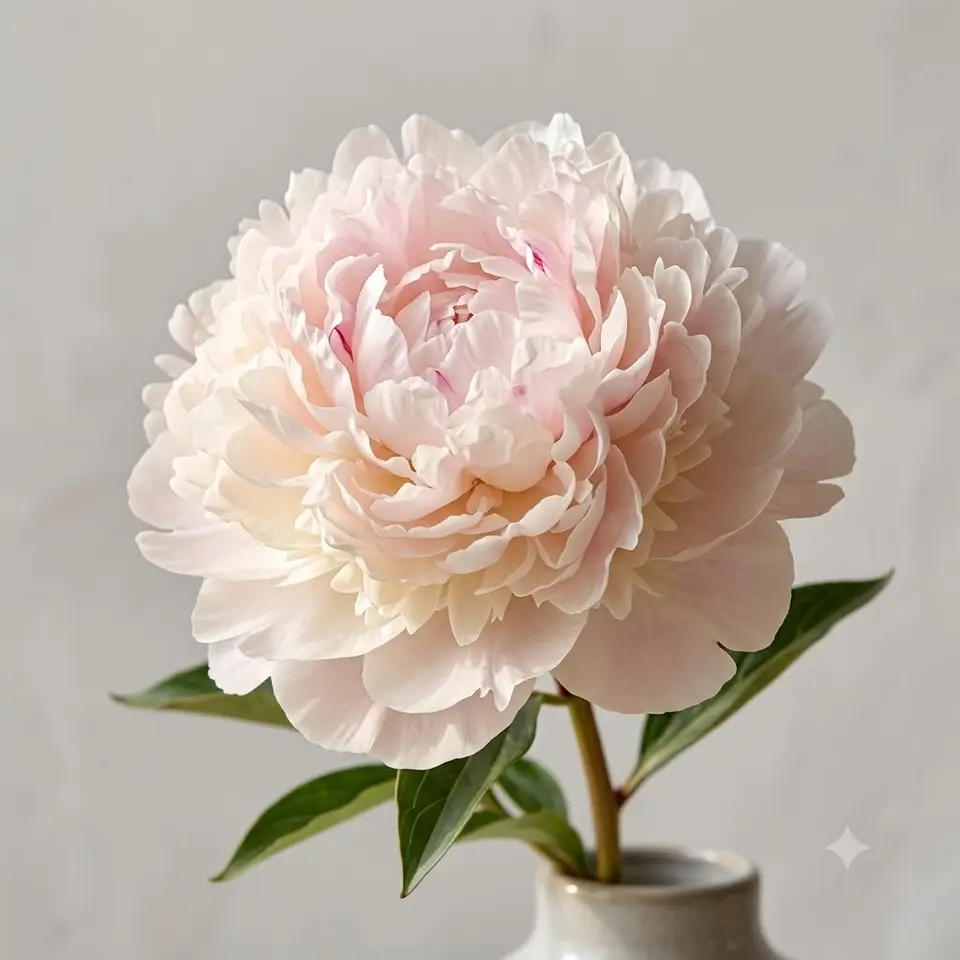
Shirley Temple is a herbaceous peony prized for enormous, fully double blooms that open the softest blush pink and age to a clean creamy white, giving one plant a two-toned look as the flowers mature (Paeonia lactiflora 'Shirley Temple').
Last reviewed: July 2026
 AI illustration
 Overview
Shirley Temple is a herbaceous peony prized for enormous, fully double blooms that open the softest blush pink and age to a clean creamy white, giving one plant a two-toned look as the flowers mature (Paeonia lactiflora 'Shirley Temple'). It pairs that soft colouring with a light, sweet fragrance and the long life for which garden peonies are known, easily lasting decades in one spot. Among lactiflora peonies it stands out for its pale, almost luminous petals and dependable mid-season flowering.
Origin & Background
The parent species, Paeonia lactiflora, is native to central and eastern Asia, ranging across Siberia, Mongolia, northern China and Korea, where it grows on grassy slopes and open woodland edges. The countless garden peonies grown today descend from centuries of selection from this species. 'Shirley Temple' is a twentieth-century garden cultivar, introduced in the United States and widely distributed from around the late 1940s; it was named for the child film star and has remained a nursery staple ever since.
Appearance
The flowers are large, often 15 to 18 cm across, and fully double in a rounded bomb-to-rose form packed with ruffled petals. They emerge pale pink from fat rounded buds and fade to soft ivory-white as they open, so a clump in bloom shows several shades at once. Flowering falls in mid-season, usually late spring into early summer. The plant forms an upright, bushy mound of glossy, deeply divided dark green leaves, reaching about 80 to 90 cm tall and roughly 90 cm wide at maturity. Foliage stays handsome through summer and can take on bronze-red tints in autumn before dying back to the ground for winter.
Why People Grow It - Qualities & Benefits
- Huge, romantic double blooms in a soft pink-to-white blend that suits cottage, wedding and formal borders alike
- Pleasant light fragrance, unlike many scentless modern doubles
- Extremely long-lived and low-maintenance once established, often outliving the gardener who planted it
- Excellent, long-lasting cut flower for the vase
Care
Light: Full sun is best, at least six hours a day; a little afternoon shade in hot regions is tolerated but too much shade reduces flowering. Water: Moderate and even; water deeply during dry spells in the first years and while budding, then it is fairly drought tolerant. Soil: Deep, fertile, well-drained loam rich in organic matter; slightly acidic to neutral, around pH 6.5 to 7.0. It dislikes soggy ground. Hardiness: USDA zones 3 to 8. Bloom or Season: Mid-season, late spring to early summer, with each clump flowering for roughly one to two weeks. Extra: Plant the growth eyes no more than about 3 to 5 cm below the surface, as burying them too deep is the usual reason peonies fail to bloom. The heavy double flowers often need support in rain, so add a grow-through ring in spring. Note for pet owners: peonies are toxic to cats and dogs.
Planting & Propagation
Plant bare-root divisions or potted plants in autumn in a permanent, sunny, well-drained spot, setting the eyes just below the soil surface. Propagate by division in early autumn: lift the whole clump, wash the soil off the tuberous roots, and cut into sections that each carry 3 to 5 healthy eyes with a good piece of root attached. Replant promptly at the correct shallow depth. Divisions may sulk for a year or two before flowering strongly. Growing from seed is possible but very slow and will not come true to the parent, so it is left to breeders rather than gardeners.
Common Problems & Pests
- Botrytis blight (grey mould) in cool, wet springs, causing blackened buds and stem collapse; improve airflow and remove affected growth
- Failure to bloom, almost always from planting too deeply, too much shade, or a division still establishing
- Flopping stems, as the very heavy double flowers bend to the ground after rain without support
Toxicity & Safety
Peonies are toxic to cats and dogs. They contain the compound paeonol, which is most concentrated in the bark and roots. If a pet chews the plant, or especially the freshly dug roots, the likely signs are vomiting and diarrhoea. Reactions are usually mild to moderate rather than life-threatening, but it is sensible to discourage pets from nibbling and to keep divided roots out of reach; contact a vet if a large amount is eaten or symptoms persist. The plant poses no hazard from simply growing in the garden.
Pros & Cons
Pros
- Spectacular, fragrant double blooms and decades of reliable performance from one planting
- Hardy, cold-loving and largely trouble-free once settled in the right spot
Cons
- Heavy flowers flop without staking and the main show lasts only a week or two
- Slow to establish, resents being moved, and is toxic to cats and dogs
Best Suited For
- Cottage gardens, mixed perennial borders and cutting gardens in cool-temperate climates
- Patient gardeners wanting a long-lived, low-input specimen they can plant once and enjoy for years
FAQ
Why won't my Shirley Temple peony flower?
The most common cause is planting the eyes too deep; they should sit only about 3 to 5 cm below the soil. Too much shade or a recently divided plant that is still establishing can also delay blooming for a season or two.
Do the flowers really change colour?
Yes. Buds and newly opened flowers are soft blush pink, then fade to creamy ivory-white as they mature, so an open clump shows a gentle range of pink and white at the same time.
Gear for growing shirley temple peony
Links go to Amazon or a partner store (such as Adagio Teas) and may earn us a commission at no extra cost to you. As an Amazon Associate we earn from qualifying purchases. We link gear types, not sponsors' picks: you choose the exact product.