Red Charm Peony
Red Charm is a herbaceous hybrid peony (Paeonia 'Red Charm') prized for its enormous, deep ruby-red bomb-type double flowers held on unusually sturdy stems.
Last reviewed: July 2026
 AI illustration
 Overview
Red Charm is a herbaceous hybrid peony (Paeonia 'Red Charm') prized for its enormous, deep ruby-red bomb-type double flowers held on unusually sturdy stems. Where many big-flowered peonies flop after rain, this cultivar stays upright, which is a large part of its enduring popularity. It is one of the classic red garden peonies and remains a benchmark for colour saturation and flower form.
Origin & Background
The genus Paeonia is native across the temperate Northern Hemisphere, with wild species spread through Europe, Asia, and a couple in western North America. 'Red Charm' itself is a garden hybrid raised by the American breeder Lyman Glasscock and introduced in 1944, produced by crossing the old European species peony Paeonia officinalis with the Chinese garden peony Paeonia lactiflora. That hybrid parentage gives it both the intense colour of the species type and the refined, full flower of a lactiflora, and it earned the American Peony Society Gold Medal in 1956.
Appearance
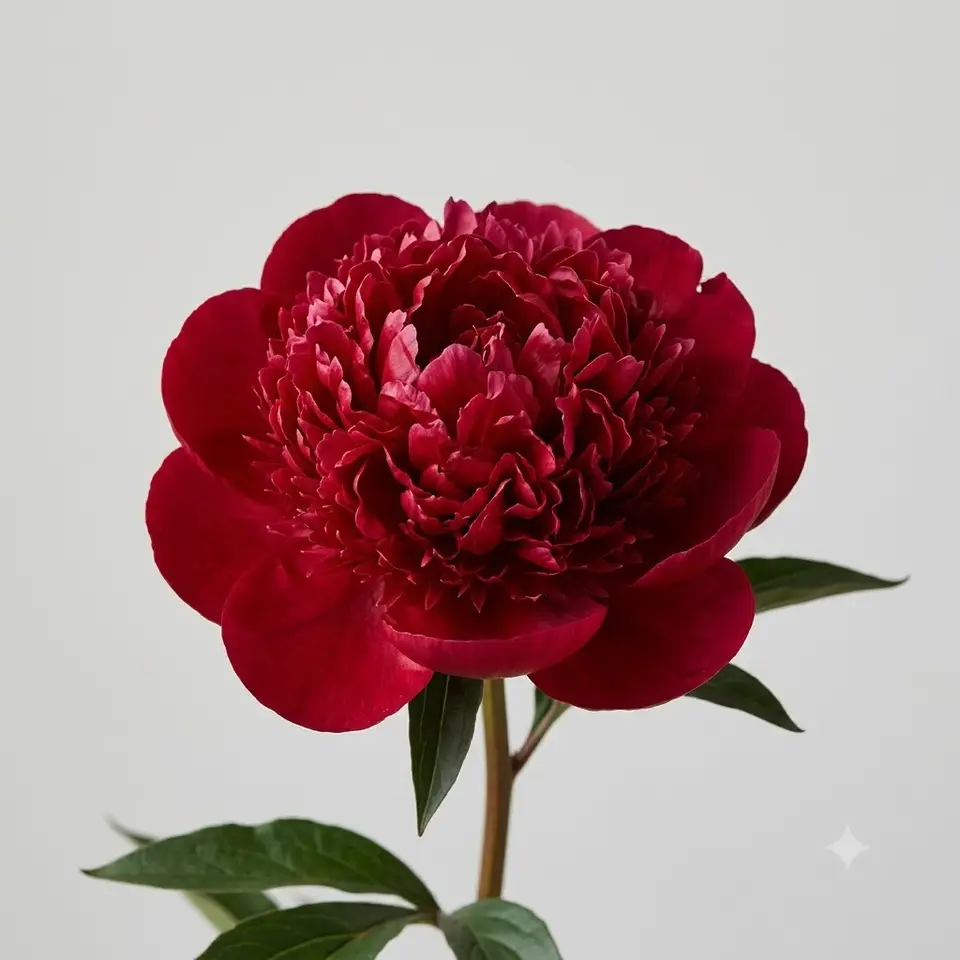
The flowers are a rich, velvety dark red that holds its tone without fading to pink or purple, arranged in a bomb double form: a broad collar of guard petals cradling a rounded, densely packed dome of narrower inner petals. Blooms are large, often 15 to 18 cm across, and lightly fragrant. Plants reach roughly 75 to 90 cm tall with a similar spread, forming a rounded, bushy clump of glossy dark green divided foliage. It flowers in late spring to early summer, and after the blooms fade the foliage stays clean and attractive through summer before taking on bronze and burgundy tints in autumn, then dying back for winter.
Why People Grow It - Qualities & Benefits
- Deep, saturated red that reads as a true statement colour in the border
- Strong, self-supporting stems that resist flopping better than most large-flowered peonies
- Extremely long-lived and low maintenance once established, often thriving for decades
- Excellent, long-lasting cut flower with attractive foliage that earns its space after bloom
Care
Light: Full sun for best flowering; tolerates light afternoon shade in hot climates. Water: Moderate and even during the growing season; established plants are fairly drought tolerant but dislike waterlogging. Soil: Deep, fertile, well-drained loam, ideally near neutral (pH about 6.5 to 7.0); enrich heavy soils with compost. Hardiness: USDA zones 3 to 8. Bloom or Season: Late spring to early summer, with a display of roughly one to two weeks per clump. Extra: Plant the crown so the buds (eyes) sit only 2 to 5 cm below the surface; planting too deep is the most common reason a peony refuses to bloom. Note that peonies are toxic to cats and dogs.
Planting & Propagation
Plant bare-root divisions in early autumn while the soil is still warm, setting each crown shallowly with the pink or red eyes just below the surface. Propagate the same way: lift a mature clump in early autumn, wash the soil off the tuberous roots, and cut it into pieces that each carry 3 to 5 healthy eyes plus a good section of root. Replant immediately at the correct shallow depth and water in. Peonies grow very slowly from seed, take years to reach flowering size, and hybrids like this will not come true, so division is the only reliable method.
Common Problems & Pests
- Botrytis blight, which blackens stems and buds in cool, wet springs; improve airflow and clear dead foliage in autumn
- Failure to bloom, almost always caused by planting too deeply, too much shade, or a clump disturbed too recently
- Ants on the buds, which are harmless and simply feeding on nectar, not a pest to be treated
Toxicity & Safety
Peonies are toxic to cats and dogs. The plants contain paeonol, a compound concentrated in the bark and roots, and ingestion can cause vomiting and diarrhoea. The risk is greatest if a pet digs at and chews the roots, so site plants where curious animals are less likely to excavate them, and contact a veterinarian if you suspect your pet has eaten part of the plant. Peonies are ornamental only and no part should be eaten.
Pros & Cons
Pros
- Reliable, sturdy stems and vivid, fade-resistant red flowers
- Decades-long lifespan with minimal ongoing care
Cons
- Short main flowering window and no repeat bloom
- Resents being moved and can sulk for a year or two after transplanting
Best Suited For
- Gardeners wanting a long-lived, structural perennial for a sunny mixed or cottage border
- Cut-flower growers who need a strong-stemmed red peony that stands up to weather
FAQ
Why won't my Red Charm peony flower?
The usual cause is planting depth. If the eyes sit more than about 5 cm below the soil, the plant produces leaves but few or no buds. Too much shade or a very recent transplant can also delay flowering, and a newly divided clump often needs two or three seasons to hit full stride.
Do the flowers need staking?
Less than most large peonies. Red Charm is bred for strong stems and usually stands on its own, but in an exposed spot or a very wet season a discreet grow-through support keeps the heavy blooms out of the mud.
Gear for growing red charm peony
Links go to Amazon or a partner store (such as Adagio Teas) and may earn us a commission at no extra cost to you. As an Amazon Associate we earn from qualifying purchases. We link gear types, not sponsors' picks: you choose the exact product.