Ruby Spider Daylily
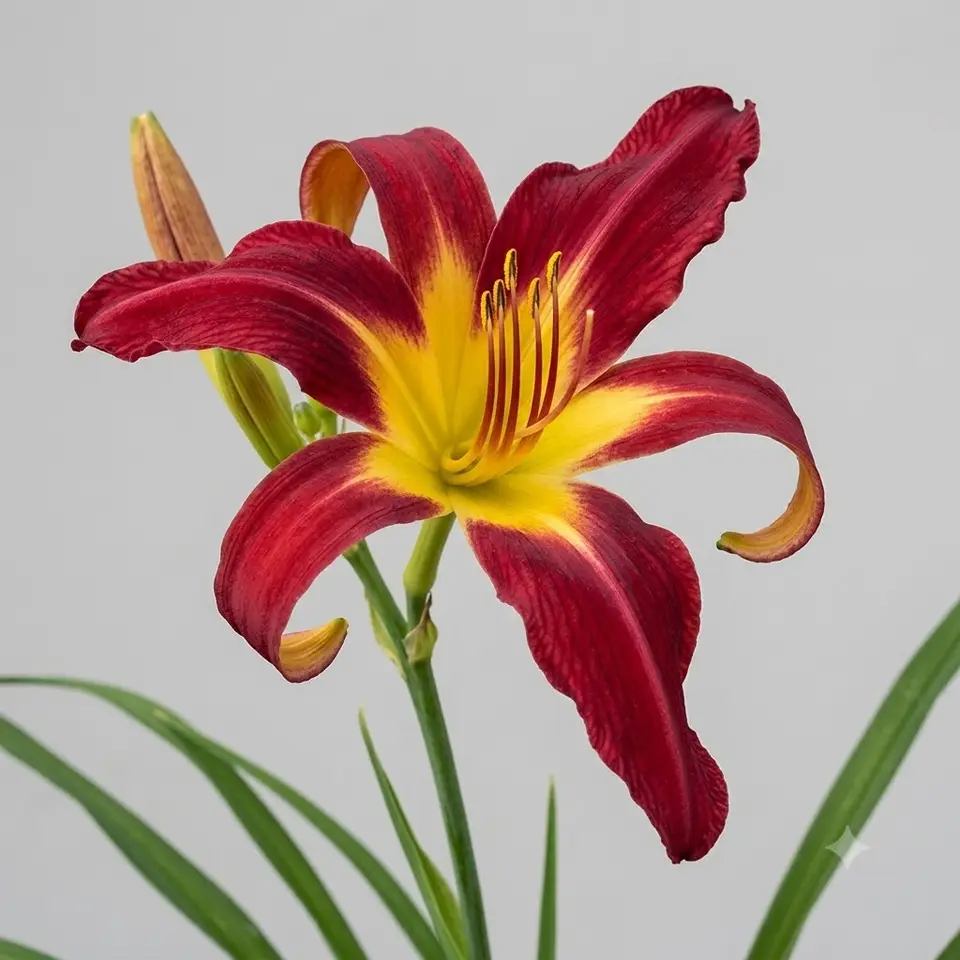
Ruby Spider is a large spider-form daylily prized for its enormous flowers, which open up to 20 to 23 cm across in a deep ruby red with a striking yellow-green throat (Hemerocallis 'Ruby Spider').
Last reviewed: October 2026
 AI illustration
 Overview
Ruby Spider is a large spider-form daylily prized for its enormous flowers, which open up to 20 to 23 cm across in a deep ruby red with a striking yellow-green throat (Hemerocallis 'Ruby Spider'). What sets it apart from rounder garden daylilies is the long, narrow, recurving petals that give each bloom a dramatic starburst silhouette on tall, sturdy scapes. It is tough, adaptable, and one of the most recognisable red spider daylilies grown today.
Origin & Background
The daylily genus Hemerocallis is native to eastern Asia, spanning China, Korea, and Japan, where the wild species grow in meadows, forest margins, and along streams. 'Ruby Spider' itself is a modern garden hybrid introduced by hybridizer Patrick Stamile in 1991. It is a tetraploid, dormant cultivar bred for large flower size and a high spider ratio, meaning the petal length far exceeds its width.
Appearance
The foliage forms an arching, grass-like clump of bright green, strap-shaped leaves. Flowers are the main event: deep ruby red, 20 to 23 cm wide, with long tapering petals that recurve backward around a large chartreuse to yellow-green throat. Scapes rise to about 85 cm tall, holding the blooms well above the foliage, and a mature clump spreads roughly 45 to 60 cm. As a dormant daylily, the foliage dies back to the ground in autumn and re-emerges in spring; peak bloom comes in early to midseason, often with a second flush later on.
Why People Grow It - Qualities & Benefits
- Very large, eye-catching spider blooms that read from across the garden
- Rich, saturated red colour that holds up well in strong sun
- Vigorous and clump-forming, filling out quickly with little fuss
- Often reblooms, extending colour beyond the main flush
Care
Light: Full sun for best flowering; tolerates light afternoon shade, though bloom count drops in deeper shade. Water: Average, even moisture; established clumps are quite drought-tolerant but bloom best with regular water. Soil: Widely adaptable; prefers fertile, well-drained soil with a slightly acidic to neutral pH around 6.0 to 7.0. Hardiness: USDA zones 3 to 9. Bloom or Season: Early to midseason (early to midsummer), with each scape flowering over several weeks and frequent reblooming. Extra: Individual flowers last a single day, so deadhead spent blooms to keep the clump tidy while new buds open daily. Important pet-safety note: daylilies are extremely dangerous to cats and can cause fatal kidney failure from even small amounts, so keep this plant away from cats and call a vet at once if a cat eats any part.
Planting & Propagation
Plant in spring or early autumn, setting the crown about 2.5 cm below the soil surface and spacing clumps 45 to 60 cm apart. Water well until established. The easiest way to propagate is division: lift a mature clump in early spring or after flowering in autumn, split it into fans each with roots and a bit of crown, and replant promptly. Dividing every three to four years keeps clumps vigorous and free-flowering.
Common Problems & Pests
- Daylily rust and leaf streak can spot or yellow the foliage in humid conditions
- Aphids and thrips may distort buds and reduce bloom quality
- Crown or root rot in soggy, poorly drained soil
Toxicity & Safety
Daylilies pose a serious, potentially fatal danger to cats. Ingesting even a small amount of any part of the plant, including leaves, flowers, pollen, or water from a vase, can trigger acute kidney failure in cats. This is an emergency: if you know or suspect a cat has eaten any part of a daylily, contact a veterinarian or an animal poison line immediately, as prompt treatment greatly improves the outcome. For dogs the risk is much milder, usually limited to mild stomach upset such as drooling or vomiting. The safest approach in a cat household is to avoid growing daylilies within a cat's reach and never bring cut stems indoors. The ASPCA lists daylilies (Hemerocallis) as toxic to cats. For dogs, the ASPCA lists them as non-toxic.
Pros & Cons
Pros
- Huge, dramatic spider flowers in a vivid ruby red
- Hardy, low-maintenance, and adaptable across a wide zone range
Cons
- Each bloom lasts only one day, needing frequent deadheading for a tidy look
- Genuinely dangerous to cats, ruling it out for many pet owners
Best Suited For
- Sunny perennial borders and mass plantings wanting bold summer colour
- Low-effort gardeners in cat-free settings who want reliable, showy blooms
FAQ
How big do the flowers really get?
Under good conditions the blooms reach 20 to 23 cm across, among the largest of the spider-form daylilies, though size can be a little smaller on young or crowded plants.
Will it flower more than once a season?
Yes. Ruby Spider blooms in early to midsummer and frequently reblooms later in the season, especially if you deadhead spent flowers and keep it watered and fed.
Gear for growing ruby spider daylily
Links go to Amazon or a partner store (such as Adagio Teas) and may earn us a commission at no extra cost to you. As an Amazon Associate we earn from qualifying purchases. We link gear types, not sponsors' picks: you choose the exact product.