Pinky Winky Hydrangea
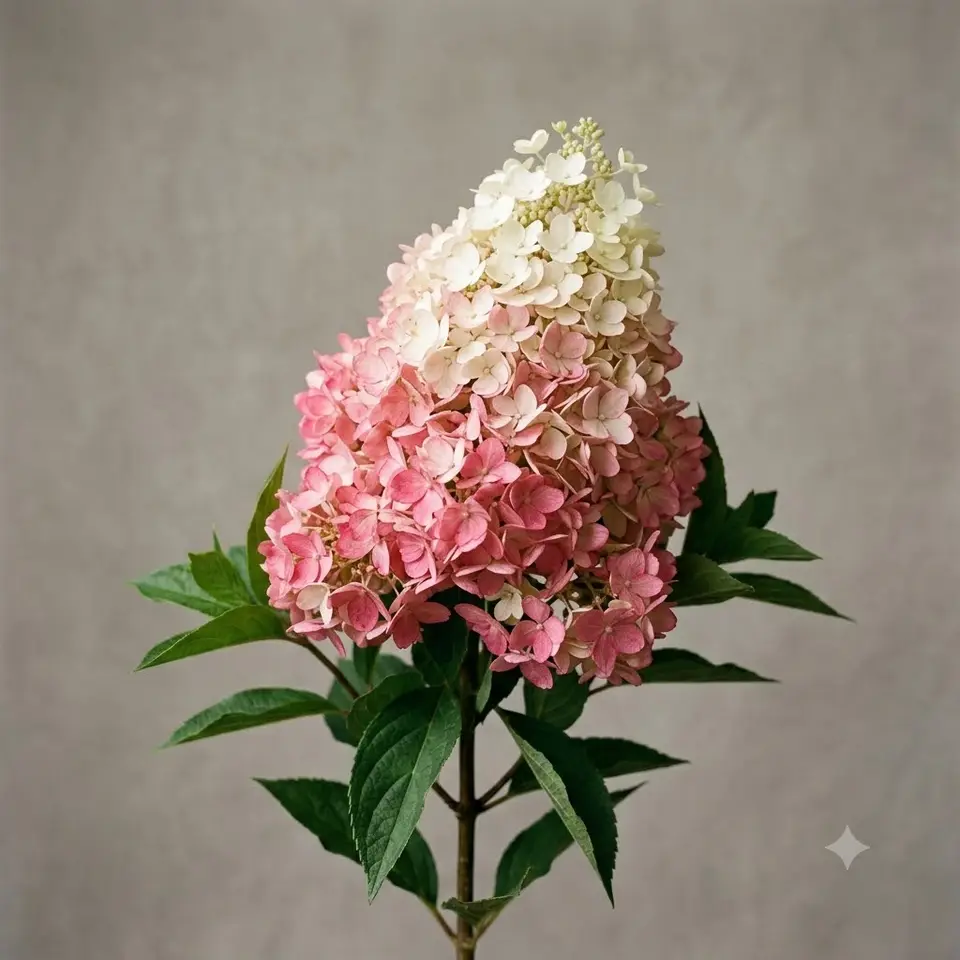
Pinky Winky is a panicle hydrangea (Hydrangea paniculata 'Pinky Winky') grown for its long, cone-shaped flower heads that open white and turn pink from the base upward, so a single panicle shows both colours at once.
Last reviewed: September 2026
 AI illustration
 Overview
Pinky Winky is a panicle hydrangea (Hydrangea paniculata 'Pinky Winky') grown for its long, cone-shaped flower heads that open white and turn pink from the base upward, so a single panicle shows both colours at once. Unlike bigleaf types, it blooms reliably on new wood, tolerates real sun, and is one of the toughest, most forgiving hydrangeas you can plant. That two-tone, bottom-up colour shift is its signature and the reason it stands out from plain white panicle types.
Origin & Background
The species Hydrangea paniculata is native to eastern Asia, mainly China, Korea, Japan and far-eastern Russia, where it grows as a large shrub or small tree in woodland edges and open slopes. Pinky Winky itself is a selected cultivar bred in Belgium in the early 2000s and introduced to North American gardens in the mid-2000s, chosen for its unusually large bicolour panicles and strong, upright stems.
Appearance
The flowers appear in dense conical panicles up to 30 to 40 cm long. Each head opens creamy white in mid to late summer, then the lower florets deepen to pink and finally rose while the tip keeps producing fresh white florets, giving the classic two-tone effect. Mature height is roughly 1.8 to 2.4 m with a similar 1.8 to 2.1 m spread, forming a broad upright shrub. Stiff stems hold the heavy blooms upright rather than flopping. In autumn the panicles age to deeper pink and dusky rose, and the foliage is a plain mid-green that offers little fall colour, so the flowers do the seasonal work.
Why People Grow It - Qualities & Benefits
- Distinctive two-tone panicles that shift from white to pink on the same flower head over the season
- Blooms on new growth, so a hard winter or a late frost rarely costs you the flowers
- Strong stems keep the large blooms upright without staking
- Cold-hardy and low-fuss, thriving where fussier hydrangeas struggle
Care
Light: Full sun to part shade. It flowers best with at least 6 hours of direct sun; in hot southern gardens a little afternoon shade helps. Water: Moderate and consistent. Keep the soil evenly moist while establishing, then water deeply in dry spells. It is not drought-proof but tolerates ordinary garden conditions once settled. Soil: Adaptable to most well-drained soils, from loam to clay, ideally slightly acidic to neutral. Note that soil pH changes flower colour only in bigleaf hydrangeas - this panicle type stays white-to-pink regardless of pH, so you cannot turn it blue. Hardiness: USDA zones 3 to 8. Bloom or Season: Flowers from mid to late summer through autumn, a long display of roughly two to three months as the colour deepens. Extra: Because it flowers on new wood, prune in late winter or early spring to shape and encourage bigger panicles. Note: this plant is toxic to cats, dogs and horses if eaten.
Planting & Propagation
Plant in spring or autumn in a hole as deep as the root ball and about twice as wide, setting the crown level with the soil surface and watering in well. Propagate from softwood cuttings taken in early summer or hardwood cuttings in late autumn, dipped in rooting hormone and kept in a moist, sheltered medium. Simple layering also works: pin a low, flexible stem to the ground, cover a section with soil, and let it root before separating. Named cultivars are not grown from seed because seedlings will not come true to type.
Common Problems & Pests
- Aphids and spider mites on soft new growth, usually cosmetic and easily rinsed off
- Powdery mildew or leaf spot in crowded, poorly ventilated plantings, reduced by good airflow
- Wilting and scorched leaf edges from underwatering or harsh reflected heat in very exposed sites
Toxicity & Safety
Hydrangeas, including Pinky Winky, are toxic to cats, dogs and horses. The leaves and flowers contain a cyanogenic glycoside that can release small amounts of cyanide when chewed. Ingestion most often causes vomiting, diarrhoea and lethargy. Serious poisoning is uncommon because animals rarely eat large quantities, but it is sensible to keep pets from grazing on the plant and to clear away prunings and fallen blooms. If you suspect your pet has eaten some, contact your vet.
Pros & Cons
Pros
- Reliable bloomer with eye-catching white-to-pink panicles
- Hardy, adaptable and beginner-friendly with strong self-supporting stems
Cons
- Toxic to cats, dogs and horses if eaten
- Large mature size needs space, and foliage offers little autumn interest
Best Suited For
- Gardeners in cold to temperate zones wanting a big, dependable summer-to-autumn shrub
- Mixed borders, informal hedges or a standalone specimen with room to reach full size
FAQ
When and how should I prune Pinky Winky?
Prune in late winter or early spring before new growth starts. Because it blooms on new wood, you can cut stems back by about a third to shape the shrub and encourage larger flower heads without losing that season's blooms.
Can I change the flower colour to blue like other hydrangeas?
No. Only bigleaf hydrangeas shift between blue and pink with soil pH. As a panicle hydrangea, Pinky Winky follows its natural white-to-pink progression no matter how you adjust the soil.
Gear for growing pinky winky hydrangea
Links go to Amazon or a partner store (such as Adagio Teas) and may earn us a commission at no extra cost to you. As an Amazon Associate we earn from qualifying purchases. We link gear types, not sponsors' picks: you choose the exact product.