Plum Pudding Heuchera
'Plum Pudding' is one of the classic dark-leaved coral bells, grown almost entirely for its rich, glossy foliage rather than its flowers (Heuchera 'Plum Pudding').
Last reviewed: September 2026
 AI illustration
 Overview
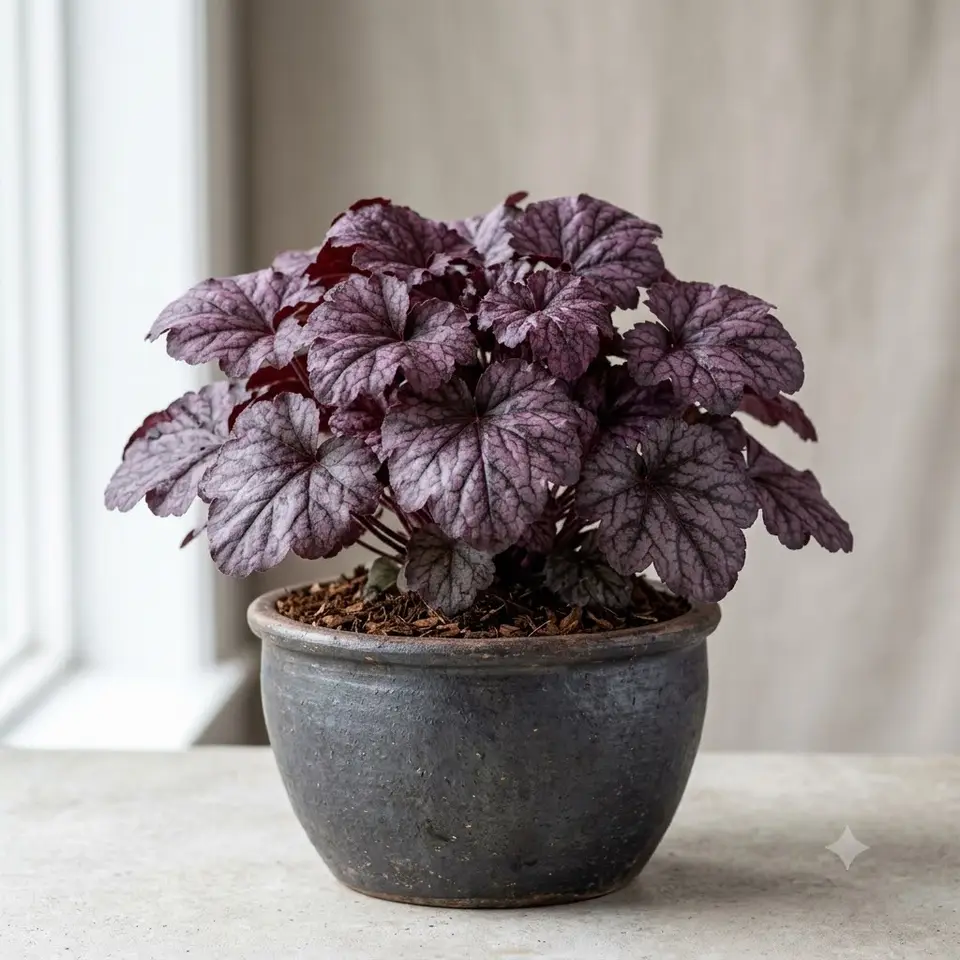
'Plum Pudding' is one of the classic dark-leaved coral bells, grown almost entirely for its rich, glossy foliage rather than its flowers (Heuchera 'Plum Pudding'). Its rounded, lobed leaves emerge a deep burgundy-plum with a subtle silvery sheen and darker veining, holding colour from spring through autumn and often into winter in milder zones. It is a compact, clump-forming perennial that reads as a low mound of colour in the border or container.
Origin & Background
The genus Heuchera is native to North America, where its species grow across woodland edges, rocky slopes and mountain habitats from Canada down into Mexico. 'Plum Pudding' is a garden hybrid from the modern wave of purple-foliage breeding that took off in the 1990s, developed by crossing purple-leaved forms in the Heuchera micrantha and villosa lines to fix a stable, deeply pigmented leaf. It became one of the widely distributed benchmark purples that later cultivars were measured against.
Appearance
The leaves are the whole point here: broadly rounded and shallowly lobed with a maple-like outline, coloured a saturated plum-purple to burgundy with a faint metallic-silver overlay and fine charcoal veins. The colour is deepest in cooler weather and can flush more richly in good light. Plants form a tidy basal mound roughly 20 to 25 cm tall and 30 to 45 cm wide. In late spring to early summer, wiry stems rise to about 45 to 60 cm carrying airy sprays of tiny cream to pale-pink bell flowers that are pleasant but secondary to the foliage. The mound is broadly evergreen to semi-evergreen, persisting through winter in milder zones and tattering in the harshest ones.
Why People Grow It - Qualities & Benefits
- Season-long foliage colour that fills the gap when nearby perennials are only green
- Compact, well-behaved mounds that suit the front of a border, edging or containers
- Shade tolerance, giving reliable colour in spots where flowering plants struggle
- Airy summer flower spikes that draw bees and other pollinators
Care
Light: Part shade is ideal, especially dappled light or morning sun with afternoon shade; it takes more sun in cooler climates but scorches in hot afternoon sun. Water: Moderate and even; keep the soil lightly moist but never waterlogged, and water during dry spells rather than on a fixed schedule. Soil: Rich, humusy, well-drained soil with a slightly acidic to neutral pH; add organic matter and avoid heavy, wet ground. Hardiness: USDA zones 4 to 9. Bloom or Season: Colourful foliage spring through autumn and often into winter, with cream-pink flower spikes in late spring to early summer. Extra: Crowns tend to heave and lift out of the soil over time, so mulch and reset or divide plants that push upward. Non-toxic to cats and dogs, making it a safe choice for pet households.
Planting & Propagation
Plant in spring or early autumn at the same depth as the crown, spacing plants about 30 to 45 cm apart in improved, well-drained soil. Set the crown at soil level, not buried, and mulch lightly to keep roots cool and moist. The reliable way to propagate a named cultivar like this is by division: lift the clump every 3 to 4 years, ideally in spring or autumn, and split it into sections that each keep a healthy piece of crown and roots, which also refreshes plants that have grown woody or lifted. Some Heuchera species can be grown from seed, but seedlings will not come true to 'Plum Pudding', so division is the way to keep the exact leaf colour.
Common Problems & Pests
- Crown rot and root rot in heavy or soggy soil, the most common cause of decline
- Vine weevil, whose larvae chew roots and can cause plants to collapse
- Frost heave that pushes the crown out of the ground over winter, exposing roots and needing re-firming or replanting
Toxicity & Safety
'Plum Pudding' Heuchera is non-toxic to cats and dogs. Coral bells are not listed among plants that are toxic to pets, so this is a reassuring, safe choice for households with cats, dogs or other curious animals.
Pros & Cons
Pros
- Long-lasting, striking dark foliage with minimal fuss
- Thrives in shade and mixes well in borders, edges and pots
Cons
- Dislikes wet, poorly drained soil and can rot in it
- Crowns lift over time and need dividing or resetting to stay vigorous
Best Suited For
- Shade and part-shade borders, woodland-edge plantings and container displays
- Gardeners, including beginners, who want reliable foliage colour and a pet-safe plant
FAQ
Does Plum Pudding Heuchera need full sun?
No. It performs best in part shade or dappled light. It can take more sun in cool climates, but hot afternoon sun tends to scorch and fade the leaves, so some shade keeps the colour and foliage in good condition.
How often should I divide it?
Every 3 to 4 years is a good rhythm. Lift and split the clump in spring or autumn to refresh a woody or lifting crown, keep the plant vigorous and give you extra plants that stay true to the original.
Gear for growing plum pudding heuchera
Links go to Amazon or a partner store (such as Adagio Teas) and may earn us a commission at no extra cost to you. As an Amazon Associate we earn from qualifying purchases. We link gear types, not sponsors' picks: you choose the exact product.