Niobe Clematis
Niobe is a large-flowered climbing clematis prized for some of the darkest, most saturated red blooms in the genus - deep ruby that opens almost blackish before settling into velvety crimson.
Last reviewed: September 2026
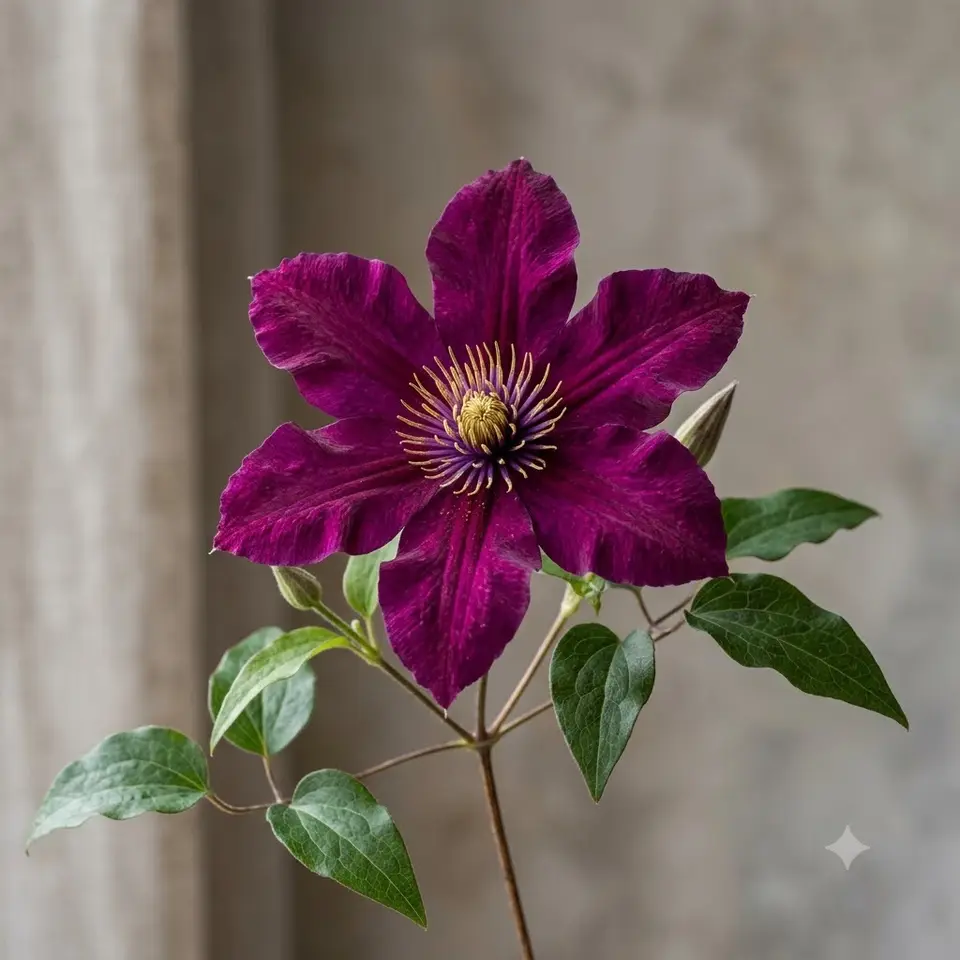 AI illustration
 Overview
Niobe is a large-flowered climbing clematis prized for some of the darkest, most saturated red blooms in the genus - deep ruby that opens almost blackish before settling into velvety crimson. Its rich colour is set off by a boss of bright golden-yellow stamens at the centre, giving each flower real depth (Clematis 'Niobe'). It is a compact, repeat-flowering climber that suits containers and smaller supports as readily as a full trellis.
Origin & Background
The genus Clematis is widespread across the temperate Northern Hemisphere, with many species native to China, Japan, Europe and North America, typically scrambling through hedgerows, woodland edges and rocky slopes. 'Niobe' is a garden hybrid raised in Poland by breeder Wladyslaw Noll and introduced in the mid-1970s. It has since become one of the most widely grown dark-red large-flowered clematis and holds the Royal Horticultural Society Award of Garden Merit.
Appearance
The flowers are large, usually 10 to 15 cm across, with six or seven broad, slightly overlapping tepals that are pointed at the tips and gently textured. They open a very deep, dusky red - almost maroon at first - and mature to a glowing ruby, always centred by a tuft of contrasting golden-yellow anthers. Blooming begins in early summer, eases, then returns for a lighter second flush in late summer into early autumn. Mature height is around 2 to 3 m with a spread of about 1 m, and the plant dies back somewhat over winter before pushing new growth in spring.
Why People Grow It - Qualities & Benefits
- One of the deepest, richest reds available in a large-flowered clematis, reading well against pale walls, roses and green foliage.
- Repeat-flowering, with a strong early flush and a useful second show later in the season.
- Compact and restrained in size, so it thrives in large pots and on smaller obelisks, arches and trellises.
- Holds the RHS Award of Garden Merit, a reliable marker of good garden performance.
Care
Light: Full sun to part shade; flowers colour best with sun on the top growth while the roots stay cool and shaded. Water: Keep consistently moist, especially in the first seasons and during dry spells; never let container plants dry out. Soil: Fertile, humus-rich, well-drained soil that stays cool; neutral to slightly alkaline is ideal but it tolerates a range. Hardiness: USDA zones 4 to 9. Bloom or Season: Early summer main flush, with a lighter repeat bloom from late summer into early autumn. Extra: 'Niobe' is a Pruning Group 2 clematis - in early spring cut back to the topmost strong buds and remove dead or weak stems, but avoid hard pruning or you lose the early flowers. Toxic to cats and dogs: the sap contains protoanemonin, and chewing can cause drooling, mouth irritation, vomiting and diarrhoea, usually mild because the bitter taste deters large intake.
Planting & Propagation
Plant in spring or autumn with the crown set about 5 to 8 cm below soil level, which encourages new shoots from the base and guards against clematis wilt; shade the root zone with low planting, a slab or mulch. Give it a support to climb from the start and tie in young growth until it grips. Named cultivars like 'Niobe' do not come true from seed, so propagate by semi-hardwood cuttings taken in summer, or by layering a low stem into the soil in summer and separating it once rooted.
Common Problems & Pests
- Clematis wilt, a fungal dieback that can collapse stems suddenly; deep planting and cutting out affected growth to healthy tissue help it recover.
- Powdery mildew in warm, still, humid conditions, especially on crowded plants with poor airflow.
- Aphids, earwigs and slugs or snails, which chew soft new shoots and flower buds.
Toxicity & Safety
'Niobe', like all clematis, contains protoanemonin in its sap and is toxic to cats and dogs. If a pet chews the leaves or stems it may drool, paw at an irritated mouth, and develop vomiting or diarrhoea. Reactions are generally mild because the bitter, acrid taste discourages animals from eating much, but keep an eye on curious pets and contact a vet if symptoms are persistent or severe.
Pros & Cons
Pros
- Exceptionally deep, velvety red flowers with a striking golden centre.
- Compact, repeat-flowering and container-friendly, with proven garden reliability.
Cons
- Susceptible to clematis wilt and needs correct deep planting and group-based pruning.
- All parts are toxic to cats and dogs and cause skin or mouth irritation.
Best Suited For
- Gardeners wanting a rich dark-red climber for an arch, obelisk, trellis or large pot.
- Small and mid-sized gardens where a restrained, repeat-flowering climber is more practical than a vigorous one.
FAQ
How and when should I prune Niobe clematis?
It belongs to Pruning Group 2. In early spring, cut each stem back to the highest pair of strong, healthy buds and remove any dead or spindly growth. Hard pruning sacrifices the early summer flowers, so keep it light.
Why are my Niobe flowers less deep red than expected?
Colour is richest with good light on the top growth and cooler, unstressed roots. Deep shade, drought or very hot spells can fade or thin the blooms, so ensure sun above, shaded moist roots below and steady watering.
Gear for growing niobe clematis
Links go to Amazon or a partner store (such as Adagio Teas) and may earn us a commission at no extra cost to you. As an Amazon Associate we earn from qualifying purchases. We link gear types, not sponsors' picks: you choose the exact product.