Osakazuki Japanese Maple
'Osakazuki' is an old and widely respected upright Japanese maple grown almost entirely for one thing: its autumn colour, which turns a blazing, uniform scarlet-crimson that many gardeners rate among the most intense of any tree (Acer palmatum 'Osakazuki').
Last reviewed: September 2026
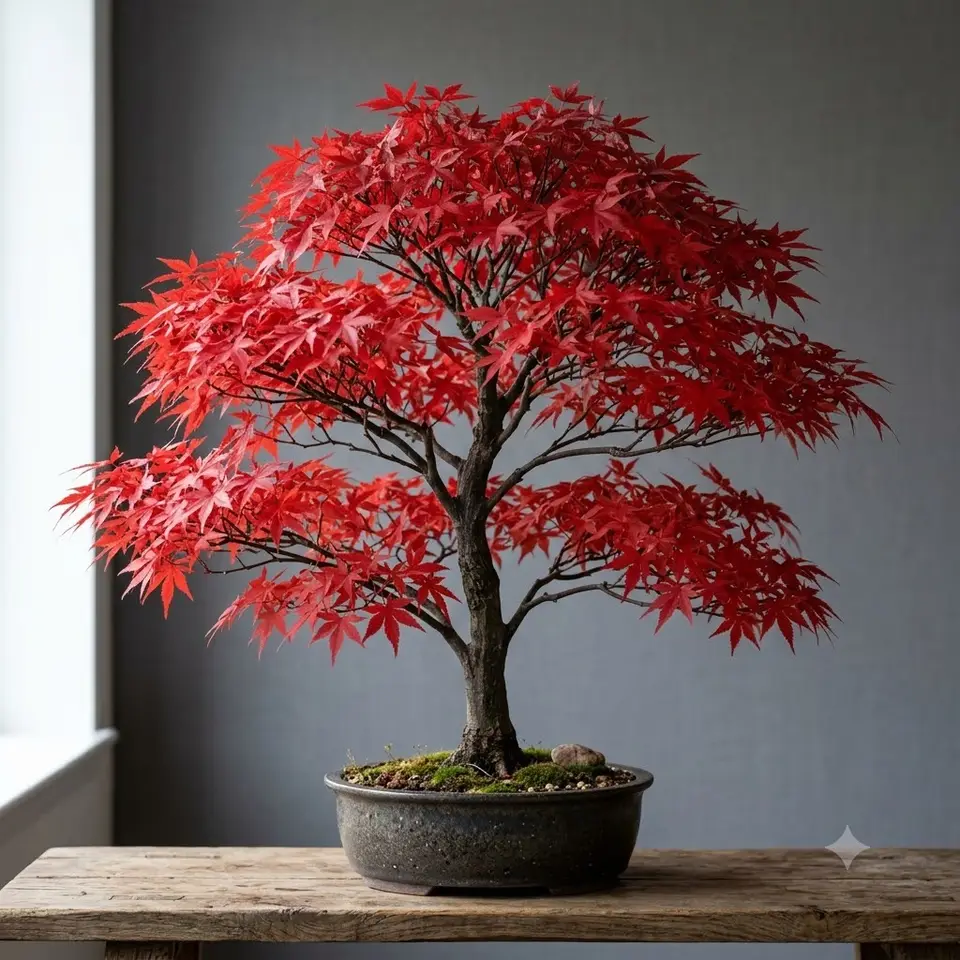 AI illustration
 Overview
'Osakazuki' is an old and widely respected upright Japanese maple grown almost entirely for one thing: its autumn colour, which turns a blazing, uniform scarlet-crimson that many gardeners rate among the most intense of any tree (Acer palmatum 'Osakazuki'). Through spring and summer it is a well-behaved, broad-leaved green tree with large seven-lobed leaves, so the fireworks come as a seasonal reward rather than a constant feature. It belongs to the Amoenum group of larger-leaved palmatums, which gives it bigger foliage and a sturdier habit than the delicate laceleaf types.
Origin & Background
The species Acer palmatum is native to Japan, Korea, and parts of eastern China, where it grows as an understorey and woodland-edge tree. 'Osakazuki' is a long-established Japanese selection whose name refers to a sake cup; it has been cultivated for well over a century and remains a benchmark cultivar against which other red-autumn maples are often compared.
Appearance
The leaves are broad and palmate with seven pointed lobes, larger than those of many palmatum cultivars, and are held on an upright, rounded, gradually spreading frame. Spring growth emerges soft green, sometimes with a faint reddish edge, and settles into a rich mid-green through summer. Small reddish-purple flowers appear in spring and are followed by winged seeds (samaras). The headline event is autumn, when the whole canopy shifts through orange to a deep, saturated crimson-scarlet, colouring evenly rather than patchily. Mature height is roughly 4.5 to 6 m with a similar spread, though it is slow to reach that size and can be kept smaller.
Why People Grow It - Qualities & Benefits
- Some of the most reliable and vivid scarlet autumn colour of any Japanese maple
- Larger, tougher leaves than laceleaf types, giving a fuller summer canopy
- Upright, well-proportioned form that reads as a proper small tree, not just a shrub
- Long-lived and adaptable, performing well as a specimen or in mixed borders
Care
Light: Full sun to part shade. Some sun is needed for the best red autumn colour, but afternoon shade in hot climates protects against leaf scorch. Water: Moderate and consistent; keep the root zone evenly moist, especially while young, and never let it bake dry in summer. Soil: Fertile, humus-rich, well-drained soil that is slightly acidic to neutral. It dislikes heavy waterlogging and strongly alkaline ground. Hardiness: USDA zones 5 to 8. Bloom or Season: Grown for foliage; green spring and summer leaves giving way to a strong scarlet-crimson autumn display, its main season of interest. Extra: The defining quirk is how uniformly and intensely it colours in autumn compared with other reds, but that colour is best where it gets some direct sun and is not baked or wind-dried. Non-toxic to cats and dogs.
Planting & Propagation
Plant in a sheltered spot out of harsh drying wind, in spring or autumn, setting it at the same depth it sat in the pot and mulching to keep roots cool and moist. Like most named maples, 'Osakazuki' does not come true from seed and is propagated by grafting selected scions onto seedling Acer palmatum rootstock; home gardeners occasionally increase it by layering, though grafting is the standard nursery method.
Common Problems & Pests
- Leaf scorch (brown, crisp leaf margins) from too much hot sun, drying wind, or drought stress
- Verticillium wilt and other root or vascular fungal problems in poorly drained soil
- Aphids, scale insects, and occasional caterpillars, usually cosmetic rather than serious
Toxicity & Safety
Non-toxic to cats and dogs. Japanese maple (Acer palmatum) is not listed as toxic to pets, so it is a safe choice for households and gardens shared with animals.
Pros & Cons
Pros
- Exceptional, dependable scarlet autumn colour
- Handsome upright form and robust, full-sized leaves
Cons
- Autumn is its only truly dramatic season; summer is quietly green
- Needs shelter and steady moisture, and can scorch in hot, exposed sites
Best Suited For
- Gardeners wanting a standout autumn specimen tree for a lawn, courtyard, or border
- Sheltered, moist, part-sun sites in cooler temperate climates within zones 5 to 8
FAQ
Why isn't my Osakazuki turning red in autumn?
Weak or muted colour usually means too little direct sun, an over-fed or over-shaded position, or a mild, cloudy autumn. Giving it a spot with some sun and a proper cool-night autumn brings out the fullest scarlet.
How big will Osakazuki eventually get?
Expect around 4.5 to 6 m tall and roughly as wide at maturity, but it grows slowly, so it stays a manageable small tree for many years and can be pruned to stay smaller.
Gear for growing osakazuki japanese maple
Links go to Amazon or a partner store (such as Adagio Teas) and may earn us a commission at no extra cost to you. As an Amazon Associate we earn from qualifying purchases. We link gear types, not sponsors' picks: you choose the exact product.