Palace Purple Heuchera
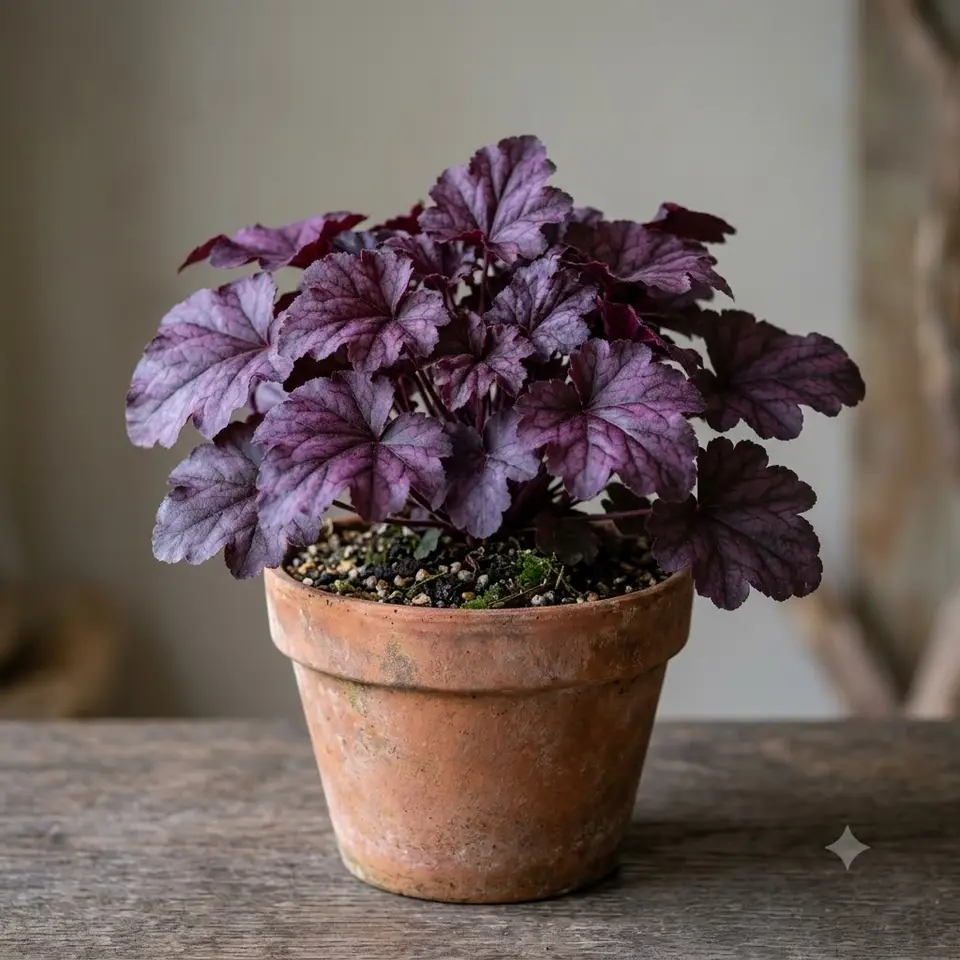
Palace Purple is a coral bells cultivar prized for broad, maple-shaped leaves in deep bronze-purple rather than for its flowers (Heuchera 'Palace Purple').
Last reviewed: October 2026
 AI illustration
 Overview
Palace Purple is a coral bells cultivar prized for broad, maple-shaped leaves in deep bronze-purple rather than for its flowers (Heuchera 'Palace Purple'). It forms a tidy, low mound that holds colour for most of the year, and it was famous enough to be named Perennial Plant of the Year in 1991. Where older heucheras were grown for their airy flower sprays, this one earns its place through leaf colour alone.
Origin & Background
The genus Heuchera is native to North America, where wild coral bells grow across woodlands, rocky slopes, and stream banks from Canada down into Mexico. Palace Purple was selected from seed of Heuchera micrantha (a western North American species) at the Royal Botanic Gardens, Kew, in England during the early 1980s, and was introduced to gardens later that decade. Because it originated as a seed selection, it is one of the few heucheras that can be raised from seed, though only the best-coloured seedlings match the named plant.
Appearance
The leaves are the whole point: large, ivy or maple-shaped, with pointed lobes and a slightly puckered, metallic sheen. Colour ranges from deep bronze and mahogany-purple in strong light to a more olive-bronze in shade, with beetroot-red undersides that show when the foliage lifts in a breeze. Plants build a rounded mound roughly 20 to 30 cm tall and 30 to 45 cm wide. In late spring to mid summer, wiry stems rise well above the foliage, to around 45 to 60 cm, carrying loose sprays of tiny creamy-white to pale-pink bell flowers. Colour is richest on new spring growth and deepens again as autumn cools.
Why People Grow It - Qualities & Benefits
- Long-season foliage colour that carries a bed even when little else is in bloom
- Semi-evergreen in mild climates, so the mound rarely disappears entirely in winter
- Compact, well-behaved habit that suits edging, containers, and small spaces
- Airy summer flower spikes that draw bees and other pollinators without dominating the plant
Care
Light: Full sun to part shade. Colour is deepest in good light, but in hot-summer regions give it afternoon shade to prevent leaf scorch. Water: Moderate and even; keep the soil consistently moist but never waterlogged. Established plants tolerate short dry spells. Soil: Humus-rich, well-drained soil is essential. Slightly acidic to neutral pH (about 6.0 to 7.0) suits it best. Hardiness: USDA zones 4 to 9. Bloom or Season: Grown mainly for year-round foliage; slender flower spikes appear late spring to mid summer. Extra: Crowns tend to lift out of the ground over time (frost heaving), so replant or mulch to keep the base covered. Non-toxic to cats and dogs, making it a safe choice for pet households.
Planting & Propagation
Plant in spring or early autumn, setting the crown at soil level and never buried, in well-drained ground enriched with compost. Space plants about 30 to 45 cm apart. The reliable way to propagate this named cultivar is by division: lift the clump every 3 to 4 years, ideally in spring or autumn, and split it into sections that each keep a piece of crown and healthy roots. This also refreshes plants that have grown woody or pushed themselves out of the soil. Seed is possible for Heuchera micrantha types, but seedlings vary in colour, so true-to-form plants come only from division.
Common Problems & Pests
- Vine weevil (root weevil), whose larvae chew the roots and can cause sudden collapse of container plants
- Frost heaving, which lifts the crown out of the soil over winter and exposes the roots
- Powdery mildew, rust, or crown rot in damp, crowded, or poorly drained conditions
Toxicity & Safety
Palace Purple Heuchera is non-toxic to cats and dogs. Coral bells are not listed among plants that are toxic to pets, so this is a reassuring, pet-safe choice for gardens and homes shared with animals. As with any plant, discourage pets from nibbling foliage to avoid mild digestive upset, but there is no known serious toxicity risk.
Pros & Cons
Pros
- Rich foliage colour over a very long season, with minimal upkeep
- Compact, versatile, and safe around pets
Cons
- Crowns heave and hollow out over a few years, needing periodic division
- Foliage can scorch or fade in intense, unshaded heat
Best Suited For
- Beginner gardeners wanting reliable colour in borders, edging, or containers
- Part-shade and woodland-edge plantings, and pet-friendly gardens
FAQ
Does Palace Purple keep its purple colour all year?
Largely, yes. It is semi-evergreen in mild zones and holds bronze-purple foliage across most of the year, with the deepest tones on fresh spring growth and in autumn. Colour is strongest in good light and can lean more olive-bronze in heavy shade.
How often should I divide it?
Every 3 to 4 years. Over time the crown becomes woody and lifts out of the soil, so lifting and splitting the clump in spring or autumn keeps plants vigorous, well-coloured, and firmly rooted.
Gear for growing palace purple heuchera
Links go to Amazon or a partner store (such as Adagio Teas) and may earn us a commission at no extra cost to you. As an Amazon Associate we earn from qualifying purchases. We link gear types, not sponsors' picks: you choose the exact product.