Orangeola Japanese Maple
Orangeola is a cascading laceleaf Japanese maple prized for foliage that shifts through orange-red, green-bronze, and fiery scarlet across the seasons, with a distinctive second flush of bright orange new growth in midsummer (Acer palmatum 'Orangeola').
Last reviewed: September 2026
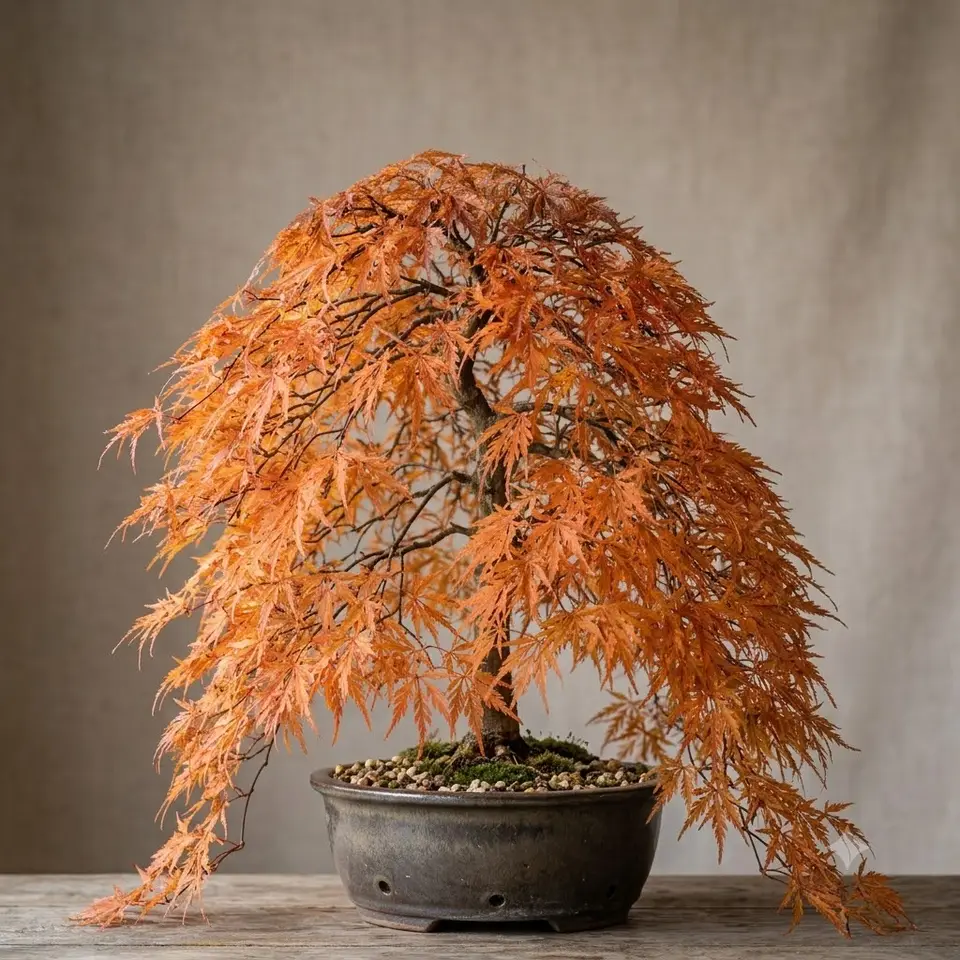 AI illustration
 Overview
Orangeola is a cascading laceleaf Japanese maple prized for foliage that shifts through orange-red, green-bronze, and fiery scarlet across the seasons, with a distinctive second flush of bright orange new growth in midsummer (Acer palmatum 'Orangeola'). It belongs to the dissectum group, meaning its leaves are so deeply cut they look feathery or lace-like. Its weeping, layered habit makes it read as a living waterfall of foliage rather than a typical upright tree.
Origin & Background
The species Acer palmatum is native to Japan, Korea, and parts of China, where it grows as an understory tree in cool, humid woodland. 'Orangeola' is a modern dissectum selection introduced through the North American nursery trade, chosen and propagated specifically for its warm orange spring and autumn color and its strong cascading form. Like nearly all named Japanese maple cultivars, it is a clonal selection maintained by grafting rather than a wild variety.
Appearance
The finely dissected leaves emerge orange-red in spring, mature to a green tinged with bronze-red through summer, and then blaze into brilliant orange-scarlet in autumn. A signature trait is the flush of fresh orange growth that appears in midsummer, layering bright new tips over the darker older foliage. The habit is weeping and cascading, with branches that arch and tumble outward and down, building a mounded, waterfall-like silhouette. Over 10 to 15 years it typically reaches about 1.8 to 2.5 m tall and 1.8 to 2.5 m wide, with the ultimate height strongly influenced by the graft height and any staking. The spring flowers are tiny reddish clusters, ornamentally minor, and are followed by small winged samaras.
Why People Grow It - Qualities & Benefits
- Multi-season color, moving from orange-red spring growth to a vivid scarlet-orange autumn finish
- Elegant cascading, layered form that adds movement and structure to a bed or container
- Compact mature size that suits small gardens, courtyards, and large pots
- Fine, lace-like texture that contrasts beautifully with broad-leaved companions
Care
Light: Part shade is ideal - morning sun with protection from hot afternoon sun. Too much intense sun scorches the delicate laceleaf foliage, while deep shade dulls the color. Water: Keep the soil consistently moist but never waterlogged, especially in the first few years and during heat; the fine leaves wilt and brown quickly under drought stress. Soil: Rich, well-drained soil high in organic matter, slightly acidic to neutral (roughly pH 5.5 to 6.5). Avoid heavy, soggy ground. Hardiness: USDA zones 5 to 9. Bloom or Season: Grown for foliage across three seasons, with the peak display in autumn; deciduous, dropping its leaves for winter to reveal the sculptural cascading branch structure. Extra: The midsummer orange re-flush is the cultivar's calling card - give it even moisture and dappled light to keep that color clean. Non-toxic to cats and dogs.
Planting & Propagation
Plant in spring or early autumn in a sheltered spot out of harsh wind and afternoon sun, setting the graft union at or just above soil level and mulching to keep roots cool and moist. 'Orangeola' does not come true from seed, so it is propagated by grafting onto Acer palmatum seedling rootstock, often at a raised standard height to enhance the cascading effect. Hobbyists sometimes attempt air layering, but grafting remains the reliable commercial method; cuttings root poorly and unevenly.
Common Problems & Pests
- Leaf scorch (brown, crispy leaf edges) from too much sun, wind, or dry soil
- Verticillium wilt and other fungal issues in poorly drained or overly wet soil
- Aphids, scale, and mites, which can distort new growth and produce sticky honeydew
Toxicity & Safety
Non-toxic to cats and dogs. Japanese maple (Acer palmatum) is not listed as toxic to pets, making Orangeola a safe choice for households and gardens with animals. As a sensible precaution, discourage pets from chewing on any plant material, since eating non-food foliage can still cause mild, temporary stomach upset.
Pros & Cons
Pros
- Outstanding, long-lasting color with a rare midsummer orange re-flush
- Graceful cascading form on a compact, container-friendly frame
Cons
- Fine foliage scorches easily without shelter and steady moisture
- Slow growing and, as a grafted specimen, usually more expensive than seed-grown maples
Best Suited For
- Small gardens, courtyards, and entryways needing a refined focal point
- Container planting, raised beds, and the edge of a water feature or low wall where the cascade can spill
FAQ
How big does Orangeola get?
Expect roughly 1.8 to 2.5 m tall and wide over 10 to 15 years, with mature height partly set by the graft height. It stays modest enough for small spaces and large containers.
Why do the leaf tips turn brown in summer?
That is usually leaf scorch from too much sun, drying wind, or inconsistent watering. Move or shade the plant from hot afternoon sun and keep the soil evenly moist to prevent it.
Gear for growing orangeola japanese maple
Links go to Amazon or a partner store (such as Adagio Teas) and may earn us a commission at no extra cost to you. As an Amazon Associate we earn from qualifying purchases. We link gear types, not sponsors' picks: you choose the exact product.