Obsidian Heuchera
Obsidian is prized for its solid, near-black foliage - one of the darkest and most consistent of all the coral bells (Heuchera 'Obsidian').
Last reviewed: September 2026
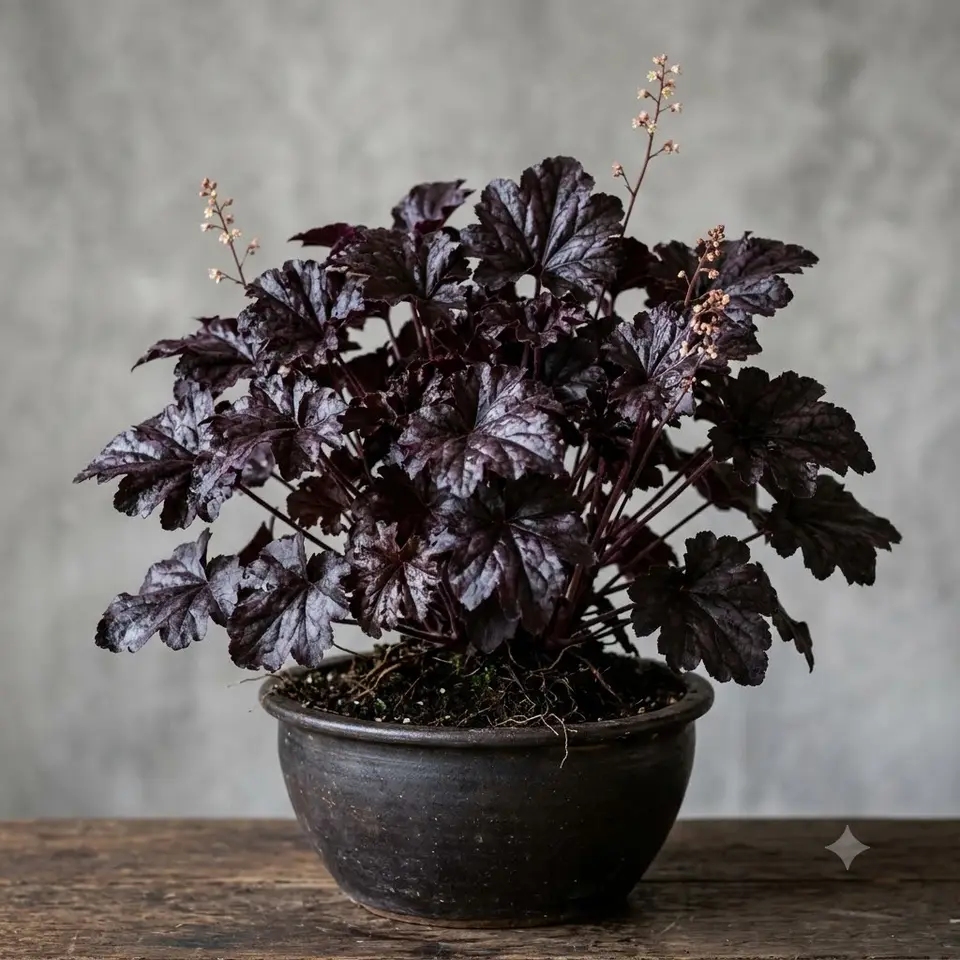 AI illustration
 Overview
Obsidian is prized for its solid, near-black foliage - one of the darkest and most consistent of all the coral bells (Heuchera 'Obsidian'). Where many dark heucheras fade to muddy purple or green as the season wears on, Obsidian holds a glossy, uniform charcoal-black tone that reads almost like polished stone. It is a foliage plant first and foremost, grown for that dramatic colour rather than its modest flowers.
Origin & Background
The genus Heuchera, commonly called coral bells or alumroot, is native to North America, where its many species grow in woodlands, rocky slopes, and mountain crevices from Canada down through Mexico. Obsidian is a modern interspecific hybrid, developed by specialist Heuchera breeders (widely attributed to a North American breeding programme) and introduced in the early 2000s as part of the wave of intensely dark-leaved selections that transformed coral bells from quiet groundcovers into bold colour accents.
Appearance
The leaves are broad, rounded, and shallowly lobed with a subtle ruffle at the margins, carried on short stems in a tidy dome. Colour is the headline feature: a deep, satiny purple-black that stays dark in both spring and late summer, with a slight sheen that catches light. The mound reaches roughly 20 to 25 cm tall and spreads about 30 to 40 cm. In late spring to early summer, wiry stems rise to around 45 to 60 cm bearing small, creamy-white to greenish flowers that contrast against the black foliage. In milder climates the plant is semi-evergreen, holding leaves through winter; in colder zones the foliage tatters and is refreshed by new growth in spring.
Why People Grow It - Qualities & Benefits
- Delivers rare, true near-black foliage that anchors a planting scheme and makes surrounding colours pop
- Colour stays consistent across the season instead of fading, unlike many older dark cultivars
- Compact, well-behaved mound that suits borders, edging, and containers alike
- Low-maintenance and long-lived, with airy summer flowers that attract bees and hummingbirds
Care
Light: Part shade is ideal. Obsidian tolerates full sun in cooler northern climates but wants afternoon shade where summers are hot, as intense sun can scorch the dark leaves; deep shade is tolerated but slightly dulls the colour and thins the mound. Water: Moderate and even - keep the soil consistently moist but never waterlogged, especially while establishing. Soil: Humus-rich, fertile, and above all well-drained, with a slightly acidic to neutral pH around 6.0 to 7.0. Hardiness: USDA zones 4 to 9. Bloom or Season: Grown chiefly for its year-round foliage; slender flower spikes of creamy-white bells appear in late spring to early summer. Extra: Like most heucheras, the woody crown tends to lift itself out of the ground over a few winters, so mulch and occasional re-setting keep it happy - and it is non-toxic to cats and dogs, making it a safe pick for pet-friendly gardens.
Planting & Propagation
Plant in spring or early autumn in enriched, free-draining soil, setting the crown at soil level so it does not sit wet and rot. Space plants about 30 to 45 cm apart and water in well. Refresh the clump by division every 3 to 4 years: lift in spring or early autumn, split the crown into sections each with roots and leaves, discard the old woody centre, and replant. Some species can be raised from seed, but named cultivars like Obsidian do not come true from seed and must be propagated by division to keep their colour.
Common Problems & Pests
- Crown and root rot in heavy, wet soils - sharp drainage is the main defence
- Frost heaving in cold winters, where the crown pushes up out of the soil and dries out; mulch and press or replant heaved crowns in spring
- Vine weevil (whose grubs chew the roots), plus occasional foliar nematodes and powdery mildew
Toxicity & Safety
Obsidian Heuchera is non-toxic to cats and dogs. Coral bells are not listed among plants known to harm pets, so this is a reassuring, safe choice for gardens shared with curious animals. As with any plant, discourage pets from nibbling foliage to avoid mild stomach upset.
Pros & Cons
Pros
- Striking, dependable near-black colour that few plants can match
- Easy, compact, and pet-safe, with good drought tolerance once established
Cons
- Prone to crown rot in poorly drained soil and to frost heaving in cold winters
- Dark leaves can scorch in strong afternoon sun without some shade
Best Suited For
- Shade and part-shade borders, woodland edges, and container plantings where dark foliage adds contrast
- Gardeners wanting a low-effort, pet-friendly accent plant with year-round structure
FAQ
Does Obsidian Heuchera stay black in the shade?
Yes. It keeps its deep, near-black colour better than most dark cultivars. In part shade and cooler-climate sun it stays richly dark; in very deep shade the tone may soften slightly and the mound thins a little, but it rarely reverts to green.
Is it evergreen?
It is semi-evergreen. In milder zones (roughly 7 to 9) it holds its leaves through winter, while in colder regions the foliage becomes tattered and is replaced by fresh growth in spring.
Gear for growing obsidian heuchera
Links go to Amazon or a partner store (such as Adagio Teas) and may earn us a commission at no extra cost to you. As an Amazon Associate we earn from qualifying purchases. We link gear types, not sponsors' picks: you choose the exact product.