Great Expectations Hosta
Great Expectations is a striking variegated hosta prized for its dramatic reverse-variegated leaves: a creamy chartreuse-to-butter-yellow centre framed by a wide blue-green margin (Hosta 'Great Expectations').
Last reviewed: September 2026
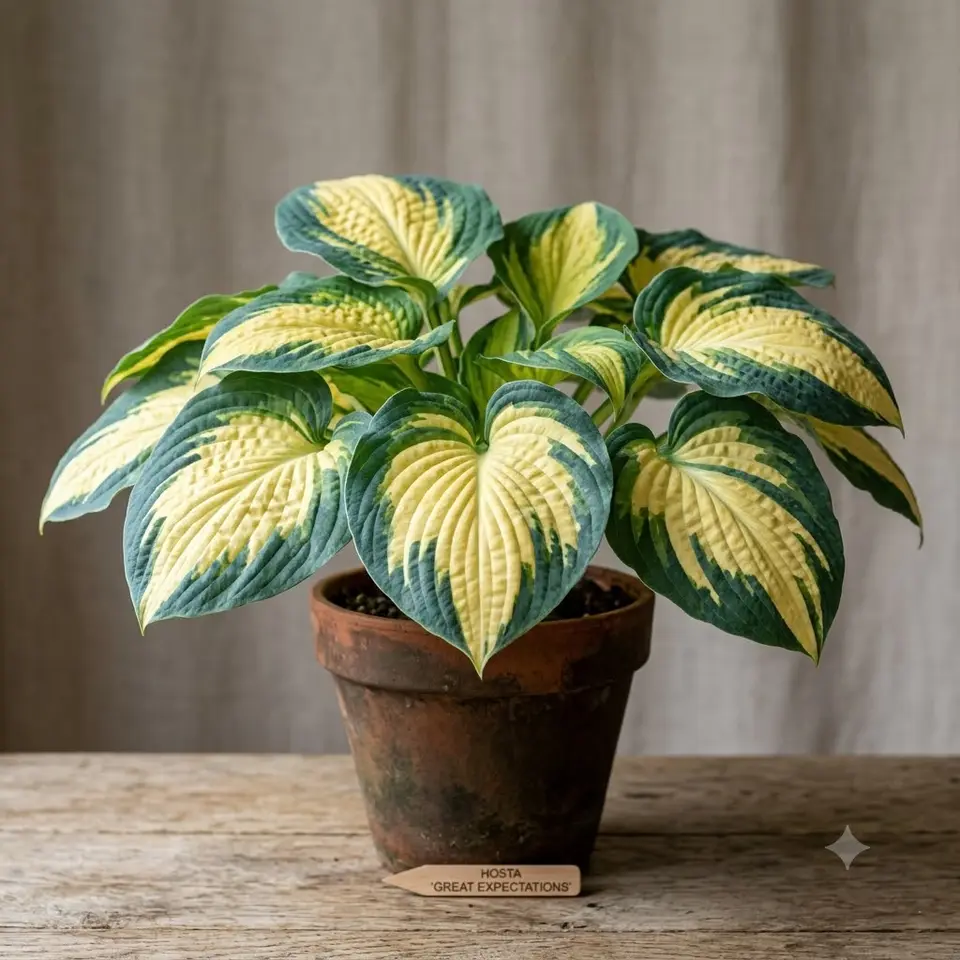 AI illustration
 Overview
Great Expectations is a striking variegated hosta prized for its dramatic reverse-variegated leaves: a creamy chartreuse-to-butter-yellow centre framed by a wide blue-green margin (Hosta 'Great Expectations'). It is a slow-growing, large-leaved sport that many gardeners consider one of the most beautiful - and most temperamental - hostas to grow well.
Origin & Background
The genus Hosta is native to north-east Asia, chiefly Japan, China and Korea, where the wild species grow in woodland margins, shaded slopes and streamsides. Great Expectations is a sport (spontaneous mutation) of the classic blue hosta Hosta sieboldiana 'Elegans', discovered in England at the Savill Garden in Windsor and registered in the late 1980s, and it inherits its parent's heavily corrugated, thick-substanced foliage while adding the bright central variegation.
Appearance
The large, heart-shaped leaves are deeply puckered and quilted, with a creamy-white to chartreuse-yellow centre that deepens toward soft gold in cool conditions, surrounded by an irregular blue-green to grey-green margin. It forms a bold, mounding clump roughly 55 to 75 cm tall and 90 cm to 1.2 m wide at maturity, though it is notably slow to reach full size. In early summer near-white, pale lavender-tinged bell flowers rise on scapes just above or among the foliage. As a foliage plant its main "season" is spring through autumn, with the leaves yellowing and dying back after frost rather than colouring brightly.
Why People Grow It - Qualities & Benefits
- Spectacular reverse variegation that lights up shaded borders and woodland corners
- Large, sculptural, heavily textured leaves that add substance and structure
- Thrives in shade where many ornamentals struggle, making it a problem-solver plant
- A collector's centrepiece specimen that anchors a shade planting on its own
Care
Light: Bright to moderate shade; morning sun with afternoon shade brings out the best colour, but the pale centre scorches easily in hot direct sun. Water: Consistent, even moisture; never let it dry out, yet avoid waterlogging. Soil: Rich, humus-heavy, moisture-retentive but well-drained soil, ideally slightly acidic to neutral (pH about 6.0 to 7.0). Hardiness: USDA zones 3 to 8. Bloom or Season: Grown for foliage from spring to autumn, with pale flowers in early to mid summer; leaves yellow and collapse after the first hard frost, with no lasting autumn colour. Extra: This cultivar is famously slow and fussy - the bright centre burns in too much sun yet the plant sulks in dense shade, so getting the light balance right is the whole game. Toxic to cats and dogs; hostas contain saponins and ingestion causes vomiting, diarrhoea and depression, so site it away from pets that nibble plants.
Planting & Propagation
Plant in spring or early autumn in a shaded, sheltered spot enriched with plenty of leaf mould or compost, setting the crown level with the soil surface and spacing to allow for its eventual 90 cm to 1.2 m spread. Propagate by division in early spring just as the pointed shoots (pips) emerge: lift the clump and cut it into sections, each with several eyes and healthy roots. Because it is slow-growing, divide only established clumps and expect divisions to take a few seasons to bulk up; it does not come true from seed.
Common Problems & Pests
- Slugs and snails, which chew ragged holes in the tender leaves, especially in wet, shady conditions
- Leaf scorch and bleaching of the pale centre when exposed to too much direct sun or drying wind
- Crown rot and virus (including Hosta Virus X) in poorly drained soil or from infected stock
Toxicity & Safety
Great Expectations Hosta is toxic to cats and dogs. Like all hostas it contains saponins; when a pet ingests the leaves, stems or roots these compounds irritate the digestive tract, causing vomiting, diarrhoea and lethargy or depression. It is a good idea to keep grazing pets away from the plant and to discourage chewing.
Pros & Cons
Pros
- Outstanding, high-impact variegated foliage that few plants can match in shade
- Tough, cold-hardy and long-lived once it settles in
Cons
- Slow to establish and genuinely tricky to site for perfect colour
- Highly prone to slug damage and toxic to cats and dogs
Best Suited For
- Patient gardeners and hosta collectors wanting a showpiece shade specimen
- Woodland gardens, shaded borders and north-facing beds with rich, moist soil
FAQ
Why does my Great Expectations look scorched or bleached?
The pale central variegation has little protective pigment, so too much direct sun or hot, dry wind burns it. Move it to bright dappled or morning-only sun and keep the soil evenly moist.
Is Great Expectations Hosta safe around pets?
No. It is toxic to cats and dogs because of the saponins in its tissues, which cause vomiting, diarrhoea and depression if eaten. Plant it where pets are unlikely to graze, and contact a vet if a pet consumes any.
Gear for growing great expectations hosta
Links go to Amazon or a partner store (such as Adagio Teas) and may earn us a commission at no extra cost to you. As an Amazon Associate we earn from qualifying purchases. We link gear types, not sponsors' picks: you choose the exact product.