Happy Returns Daylily
Happy Returns is a compact, reblooming daylily prized for its clean lemon-yellow flowers and an unusually long season, sending up fresh blooms from early summer into autumn (Hemerocallis 'Happy Returns').
Last reviewed: October 2026
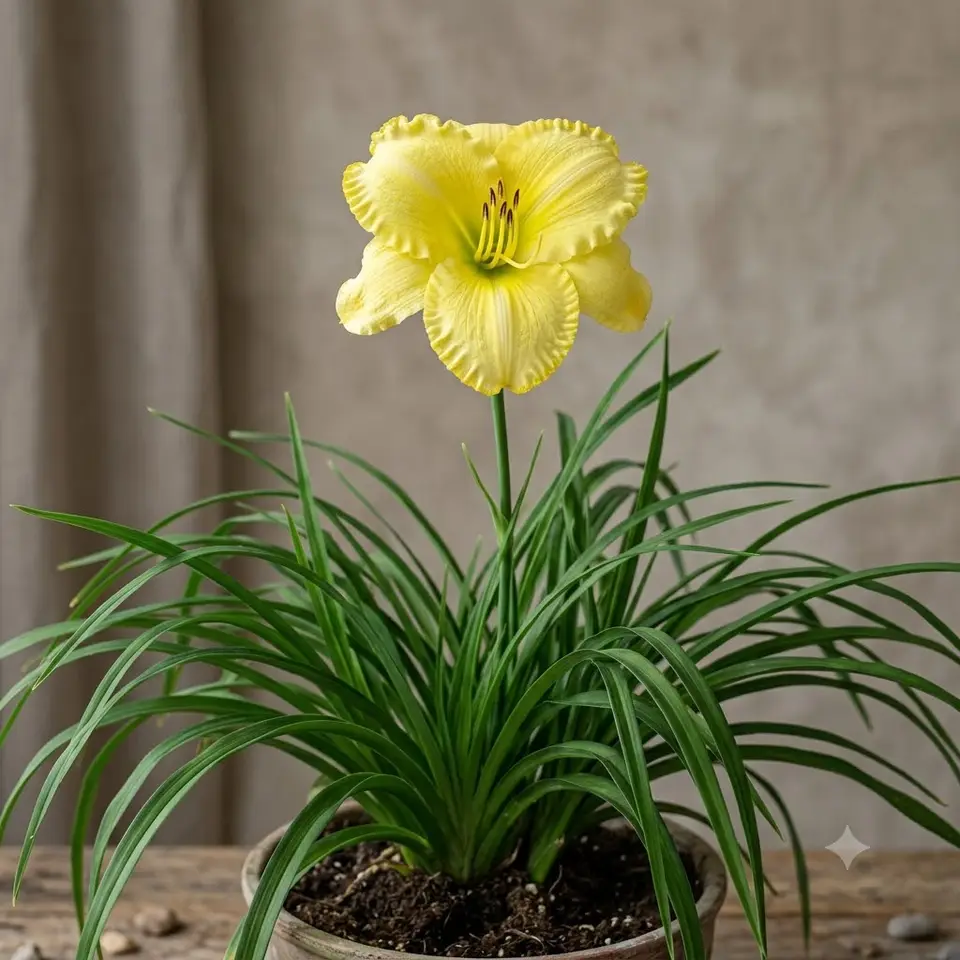 AI illustration
 Overview
Happy Returns is a compact, reblooming daylily prized for its clean lemon-yellow flowers and an unusually long season, sending up fresh blooms from early summer into autumn (Hemerocallis 'Happy Returns'). Unlike many single-flush daylilies, it repeats reliably, making it one of the most dependable small-scale performers for edging and mass planting. Its tidy, grassy mound stays neat all season, which is why it turns up so often in low-maintenance landscapes.
Origin & Background
The genus Hemerocallis is native to eastern Asia, from China and Korea through Japan and eastern Siberia, where wild species grow in meadows, forest edges, and along streams. Modern daylilies are almost entirely hybrids rather than species. 'Happy Returns' was bred by American hybridizer Darrel Apps and registered in the mid-1980s as a seedling in the same reblooming line that produced the famous compact yellow types, selected specifically for its softer, more refined color and strong repeat bloom.
Appearance
This is a small, mounding daylily with narrow, arching, bright green strap-like foliage. The flowers are a soft, clear lemon-yellow, roughly 8 cm across, with a rounded, slightly ruffled form and a light, pleasant fragrance. Mature clumps typically reach about 40 to 45 cm tall and spread 45 to 60 cm wide. Each bloom lasts a single day, true to the name Hemerocallis, but the plant produces them in steady succession. Foliage is dormant in winter, dying back to the ground and re-emerging in spring.
Why People Grow It - Qualities & Benefits
- Reblooms over a long season rather than a single early-summer flush
- Compact size fits edges, borders, and containers without flopping
- Very cold-hardy and tough, tolerating a wide range of conditions
- Light fragrance and a soft, non-garish yellow that blends with most schemes
Care
Light: Full sun for best rebloom; tolerates light afternoon shade but flowers less. Water: Average, even moisture during active growth and bloom; established plants are quite drought-tolerant. Soil: Adaptable; prefers fertile, well-drained soil, ideally slightly acidic to neutral (pH about 6.0 to 7.0). Hardiness: USDA zones 3 to 9. Bloom or Season: Early to midsummer with strong repeat flushes into early autumn, especially if spent scapes are removed. Extra: Deadheading old scapes and a light midseason feeding encourage the heaviest rebloom. Pet-safety note: daylilies are extremely dangerous to cats - even small amounts can cause fatal kidney failure - so keep this plant away from cats and call a vet immediately if one ingests any part.
Planting & Propagation
Plant in spring or early autumn, setting the crown about 2.5 cm below the soil surface with the fanned foliage upright, spaced 45 to 60 cm apart. Water in well and mulch lightly. The easiest and most reliable way to propagate is division: lift a mature clump every three to four years in early spring or after the main bloom, tease or cut it into sections each with several fans and roots, and replant promptly. Divisions establish quickly and often bloom the same season.
Common Problems & Pests
- Daylily rust and leaf streak can spot or brown the foliage in humid conditions
- Aphids and thrips may distort buds and reduce flower quality
- Crown or root rot in soggy, poorly drained soil
Toxicity & Safety
Daylilies are a serious, potentially fatal poison to cats. Ingesting even a small amount of any part - petals, leaves, pollen, or even water from a vase - can cause acute kidney failure in cats, and prompt treatment is critical. If you keep cats, do not grow this plant where they can reach it, and if a cat eats or chews any part, contact a veterinarian or an animal poison line immediately; do not wait for symptoms. For dogs the risk is much lower, usually limited to mild drooling or stomach upset, though it is still best to discourage chewing. The ASPCA lists daylilies (Hemerocallis) as toxic to cats. For dogs, the ASPCA lists them as non-toxic.
Pros & Cons
Pros
- Long, repeating bloom season from a compact, low-care plant
- Extremely cold-hardy and forgiving for beginners
Cons
- Genuinely dangerous to cats, so unsuitable for cat households
- Each flower lasts only one day, so it needs deadheading to look tidy
Best Suited For
- Beginner gardeners wanting reliable, long-season color at the front of a border
- Low-maintenance mass plantings, edging, and mixed perennial beds in cat-free settings
FAQ
Does Happy Returns really rebloom all summer?
Yes. After its main early-summer flush it sends up new scapes in waves into early autumn, especially in full sun and when old flower stalks are removed. It will not be covered in bloom every single day, but it flowers far longer than standard once-blooming daylilies.
How often should I divide it?
Every three to four years is plenty. When the clump gets crowded and bloom starts to thin, lift it in early spring or just after flowering, split it into sections with several fans each, and replant. This keeps it vigorous and gives you free plants.
Gear for growing happy returns daylily
Links go to Amazon or a partner store (such as Adagio Teas) and may earn us a commission at no extra cost to you. As an Amazon Associate we earn from qualifying purchases. We link gear types, not sponsors' picks: you choose the exact product.