Ernest Markham Clematis
Ernest Markham is a late-flowering, large-flowered clematis prized for its glowing magenta-red blooms that arrive when many early clematis have finished (Clematis 'Ernest Markham').
Last reviewed: October 2026
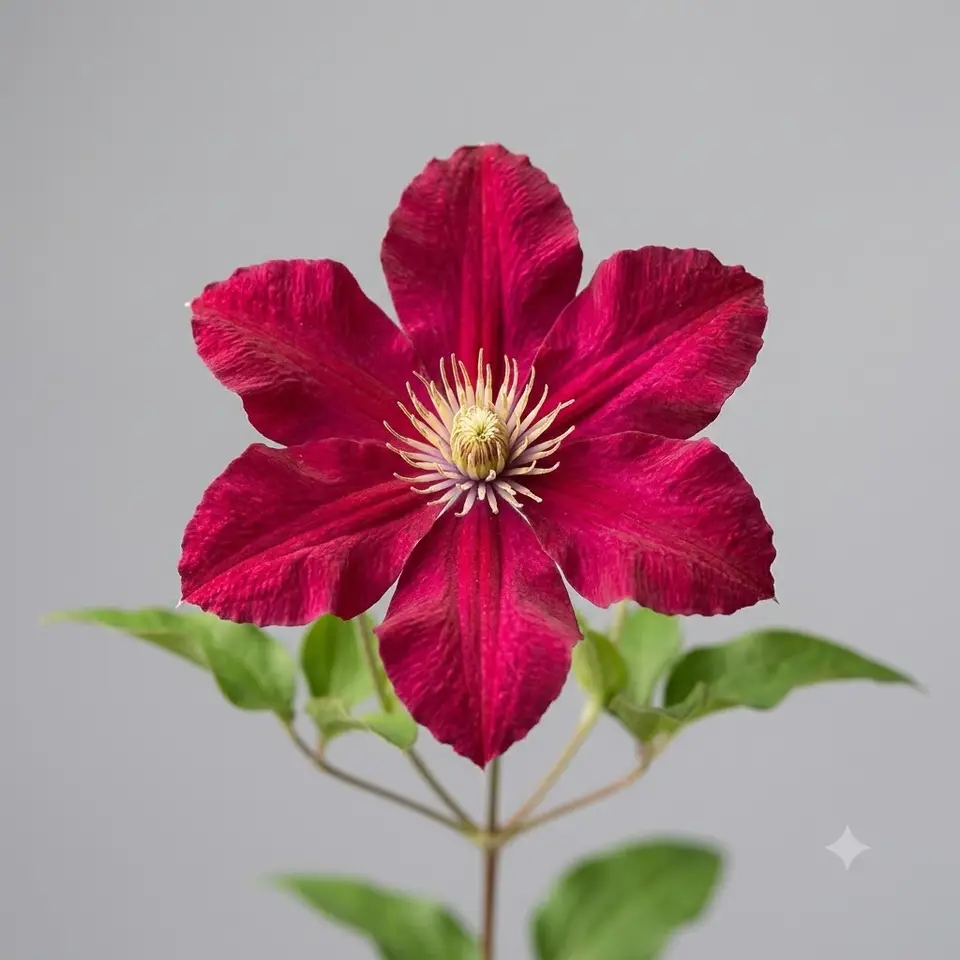 AI illustration
 Overview
Ernest Markham is a late-flowering, large-flowered clematis prized for its glowing magenta-red blooms that arrive when many early clematis have finished (Clematis 'Ernest Markham'). Unlike the softer pinks and blues common in the group, this cultivar delivers a warm, saturated colour that reads almost fluorescent in full sun. It is a vigorous, reliable climber that flowers on the current season's growth, which makes it forgiving to prune.
Origin & Background
The genus Clematis is widespread across the temperate Northern Hemisphere, with many species native to China, Japan, Europe and North America; the large-flowered garden clematis are hybrids bred from several of these Asian and European parents. 'Ernest Markham' was introduced by the Jackman nursery of Woking, England, in 1938 and named in honour of Ernest Markham, the head gardener at Gravetye Manor who worked alongside the influential garden writer William Robinson.
Appearance
The flowers are rounded and full, made up of six broad, overlapping sepals in a vivid petunia-red to magenta, each with a slightly velvety texture and a boss of creamy to pale-brown stamens at the centre. Individual blooms measure roughly 10-15 cm across. Flowering runs from mid summer into early autumn, typically July through September, on the current year's shoots. The plant climbs by twining leaf stalks to a mature height of about 3-4 m with a spread of around 1 m, and dies back or is cut back each year, so it reads as fresh growth topped with colour rather than a permanent woody framework.
Why People Grow It - Qualities & Benefits
- Long, generous flowering season that peaks in high summer when the garden needs colour most
- Intense magenta-red shade that stands out against green foliage, walls and fences
- Vigorous and easy to train up trellis, obelisks, arches or through shrubs
- Simple, low-risk pruning because it blooms on new growth
Care
Light: Full sun is best for strong flowering and the richest colour; it tolerates a little afternoon shade but flowers less freely in deep shade. Water: Keep consistently moist, especially in the first two seasons and during dry spells; it dislikes drying out at the root. Soil: Fertile, humus-rich, well-drained soil that stays cool at the root; neutral to slightly alkaline pH suits it, though it is adaptable. Hardiness: USDA zones 4-9. Bloom or Season: Mid to late summer into early autumn (roughly July to September), with a flush that can last several weeks. Extra: This is a Pruning Group 3 clematis, so cut all stems back hard to a pair of strong buds about 30 cm above the ground in late winter or very early spring; a classic tip is to keep the roots cool and shaded while the top grows in sun. Toxic to cats and dogs - the sap contains protoanemonin, and chewing can cause drooling, mouth irritation, vomiting and diarrhoea, usually mild.
Planting & Propagation
Plant in spring or autumn, setting the crown about 5-8 cm deeper than it sat in the pot to encourage new shoots from below ground and to guard against clematis wilt. Give the roots a cool, shaded position with a stone, tile or low planting over them, and provide support for the top growth from the start. As a named cultivar it does not come true from seed, so propagate to keep it identical by taking semi-hardwood cuttings in summer or by layering a low stem into the soil and separating it once rooted the following season.
Common Problems & Pests
- Clematis wilt, a fungal dieback that can collapse stems suddenly; cut affected growth back to healthy tissue or the base, and deep planting helps recovery
- Aphids and earwigs, which can distort young shoots and nibble buds
- Powdery mildew or slug and snail damage on soft new growth, especially in crowded, humid conditions
Toxicity & Safety
All clematis, including 'Ernest Markham', are toxic to cats and dogs. The sap contains protoanemonin, an irritant compound released when the plant is chewed or crushed. Signs include drooling, redness or irritation of the mouth, vomiting and diarrhoea. Reactions are usually mild because the bitter taste discourages animals from eating a large amount, but it is sensible to site the plant away from pets that like to chew and to rinse skin after handling cut stems.
Pros & Cons
Pros
- Bold, long-lasting summer colour on an easy-to-prune plant
- Vigorous and adaptable, quickly covering supports
Cons
- Colour can look slightly harsh next to pastel planting schemes
- Susceptible to clematis wilt and needs its roots kept cool and moist
Best Suited For
- Sunny walls, fences, trellises, arches and obelisks that need a strong summer highlight
- Gardeners who want a reliable, hard-prune clematis without fussy timing
FAQ
When and how do I prune Ernest Markham clematis?
It is a Pruning Group 3 clematis that flowers on new growth, so prune it hard in late winter or early spring, cutting every stem down to a pair of healthy buds about 30 cm above the ground. This keeps it tidy and encourages strong flowering shoots.
Why is my Ernest Markham not flowering well?
The most common cause is too much shade; this cultivar needs full sun to flower freely and to develop its deepest colour. Poor flowering can also follow drought stress at the root or over-feeding with high-nitrogen fertiliser, which favours leaves over blooms.
Gear for growing ernest markham clematis
Links go to Amazon or a partner store (such as Adagio Teas) and may earn us a commission at no extra cost to you. As an Amazon Associate we earn from qualifying purchases. We link gear types, not sponsors' picks: you choose the exact product.