Feather Reed Grass
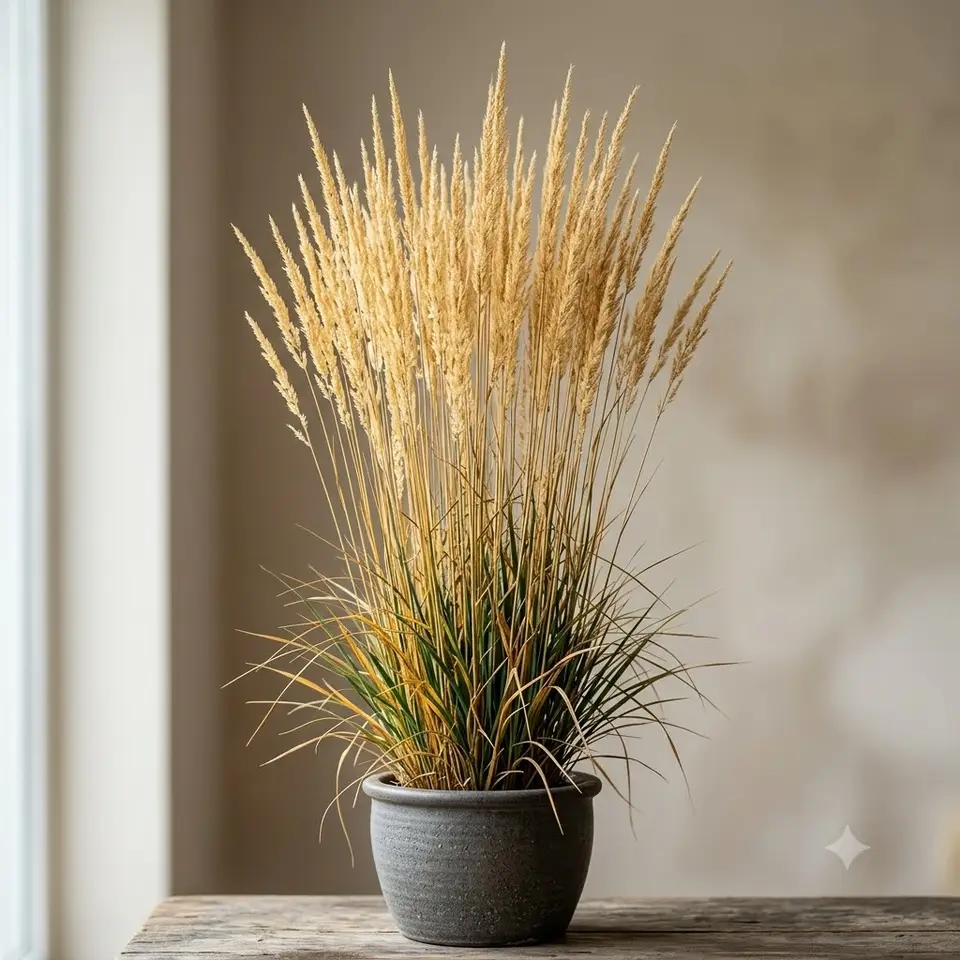
Feather Reed Grass 'Karl Foerster' is a strictly upright, early-blooming ornamental grass whose wheat-colored plumes stand like soldiers from June to February.
Last reviewed: October 2026
 AI illustration
 Overview
Feather Reed Grass 'Karl Foerster' is a strictly upright, early-blooming ornamental grass whose wheat-colored plumes stand like soldiers from June to February. It was the first grass ever named Perennial Plant of the Year, and no other grass gives vertical structure this reliably. (Calamagrostis × acutiflora 'Karl Foerster'.)
Origin & Natural Habitat
A sterile hybrid of European and Asian reed grasses, selected in Germany by Karl Foerster - the nurseryman who talked the gardening world into grasses in the first place. Hardy in zones 4-9.
Appearance
A tight, upright clump 90-150 cm tall in bloom, barely 60 cm wide. Feathery pink-bronze June plumes tighten into golden wheat-like spikes that hold through winter snow.
Why People Grow It - Qualities & Benefits
- Strictest vertical accent of any grass: living architecture
- Blooms months earlier than miscanthus or switchgrass
- Sterile: zero self-seeding, stays where planted
- Winter silhouette holds up under snow
Care
Light: Full sun for the stiffest, tallest stands; tolerates light part shade with a little lean.
Water: Adaptable - moderately drought-tolerant once established, and one of few grasses happy in heavier, damper clay.
Soil: Any reasonable soil including clay; pH-indifferent.
Temperature & Hardiness: Zones 4-9; fully cold-hardy, cool-season growth pattern (spurts in spring and fall).
Feeding: Little to none - a light spring compost topdress is plenty; rich feeding flops it.
Maintenance: Cut the whole clump to 10-15 cm in late winter before new growth - the entire annual maintenance list.
Planting & Propagation
Division in spring every 4-6 years (it's sterile, so division is the ONLY way - no seed). A sharp spade through the crown, replant the vigorous outer sections.
Common Problems & Pests
- Rust spotting in humid, stagnant corners: give it airflow
- Center die-out in old clumps: divide and replant
- Flopping = too much shade or nitrogen, not a disease
Toxicity & Safety
Non-toxic to dogs, cats and people; the leaf edges are only mildly rough, far gentler than pampas grass.
Pros & Cons
Pros
- Instant vertical structure
- Earliest-blooming major grass
- No self-seeding, no spreading
- Bone-hardy and clay-tolerant
Cons
- One rigid shape: no soft billow
- Needs the late-winter chop
- Cool-season: summer growth pauses
Best Suited For
- Modern and formal borders needing repetition
- Narrow spaces where width is scarce
- Rain gardens and heavier soils
- Winter-interest plantings
FAQ
When do I cut it back?
Late winter (Feb-Mar), down to 10-15 cm, before the new green shows. Cut later and you behead the new tips; earlier and you lose months of winter structure.
Why is mine flopping?
Karl Foerster flops for exactly two reasons: too little sun or too much nitrogen. Move it or starve it and it stands to attention again.
Will it spread into my lawn?
No - it is a sterile clumper. The footprint widens a few centimeters a year and that is all.
Gear for growing feather reed grass
Links go to Amazon or a partner store (such as Adagio Teas) and may earn us a commission at no extra cost to you. As an Amazon Associate we earn from qualifying purchases. We link gear types, not sponsors' picks: you choose the exact product.