Festiva Maxima Peony
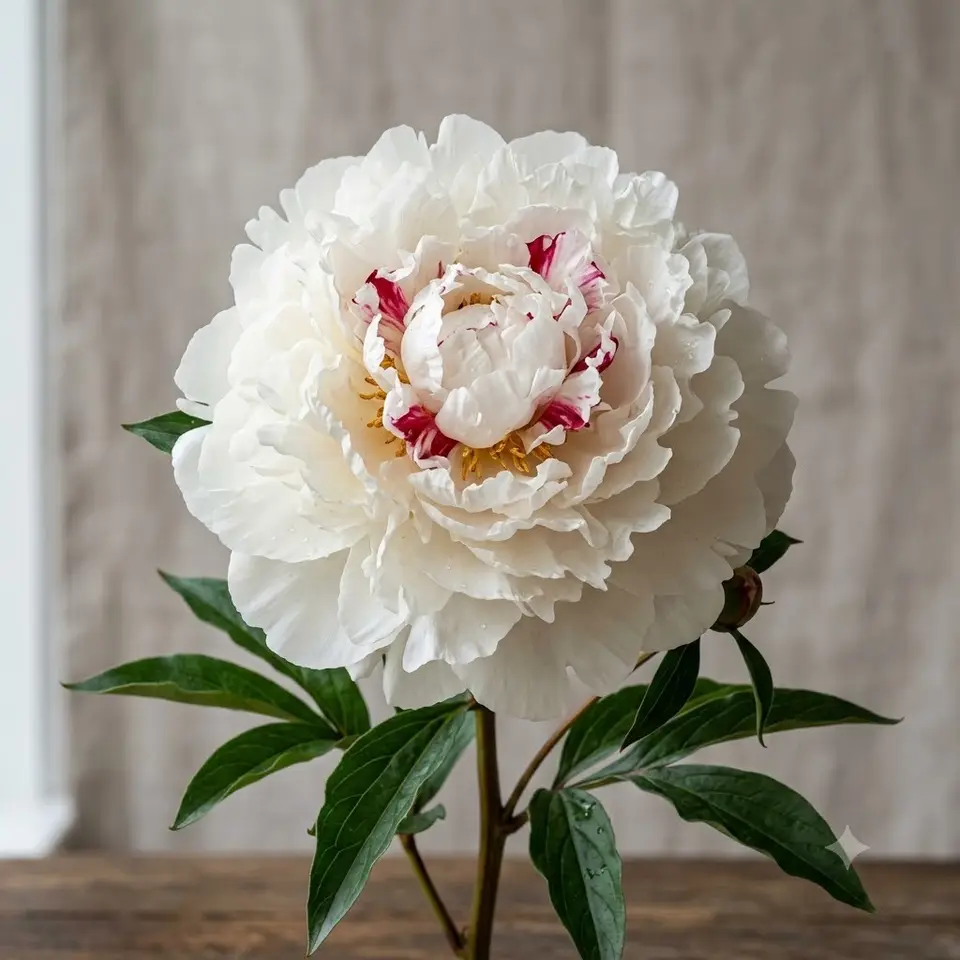
Festiva Maxima is one of the oldest and most enduring garden peonies still in wide cultivation, prized for enormous, fully double white blooms marked with a scattering of crimson flecks at the heart (Paeonia lactiflora 'Festiva Maxima').
Last reviewed: September 2026
 AI illustration
 Overview
Festiva Maxima is one of the oldest and most enduring garden peonies still in wide cultivation, prized for enormous, fully double white blooms marked with a scattering of crimson flecks at the heart (Paeonia lactiflora 'Festiva Maxima'). It pairs that antique flower form with a strong rose-like fragrance and remarkable longevity, often thriving in the same spot for decades. Its blend of heirloom pedigree, cold-hardiness, and low fuss keeps it a benchmark against which other white peonies are still judged.
Origin & Background
The genus Paeonia is native across the temperate Northern Hemisphere, spanning Europe, temperate Asia, and a couple of species in western North America, with the parent species Paeonia lactiflora originating in central and eastern Asia including China, Mongolia, and Siberia. Festiva Maxima itself is a herbaceous garden cultivar raised in France and introduced by the breeder Auguste Miellez in 1851, which makes it one of the longest-lived named peonies in continuous garden use.
Appearance
The flowers are large, often 15 to 20 cm across, opening pure white in a full double to bomb form, with a signature dusting of raspberry-crimson flecks near the centre that distinguishes it from plainer whites. Bloom time is early to mid season, typically late spring into early summer (May into June in most temperate gardens), with a display that lasts roughly a week to ten days per clump. Plants form a rounded, shrubby mound of glossy dark green divided foliage, reaching about 90 cm tall and 90 cm wide at maturity. The leaves stay handsome through summer and often take on bronzy tints in autumn before the whole plant dies back to the ground for winter.
Why People Grow It - Qualities & Benefits
- Large, fragrant, exhibition-quality white blooms with a distinctive crimson-flecked centre
- Exceptional longevity, frequently flowering well for 30 years or more once established
- Excellent, long-lasting cut flower with a genuine rose-like scent
- Very cold-hardy and low maintenance, needing little beyond staking and tidy-up
Care
Light: Full sun is best, at least 6 hours a day; it tolerates light afternoon shade but flowers more sparsely in deeper shade. Water: Moderate and even moisture, especially in spring while budding; established clumps are fairly drought tolerant but resent soggy soil. Soil: Deep, fertile, well-drained loam rich in organic matter, with a near-neutral pH around 6.5 to 7.0. Hardiness: USDA zones 3 to 8; it needs a period of winter chill to bloom well and dislikes hot, humid climates. Bloom or Season: Early to mid season, late spring to early summer, with each clump flowering for roughly one to two weeks. Extra: The heavy double blooms tend to flop, particularly after rain, so plan on a grow-through support ring set early in the season. Note that peonies are toxic to cats and dogs: they contain paeonol, concentrated in the bark and roots, and ingestion causes vomiting and diarrhoea.
Planting & Propagation
Plant in early autumn so roots settle before winter, setting the fleshy tuberous crown so the pink growth buds (eyes) sit only 3 to 5 cm below the soil surface; planting too deep is the single most common reason a peony fails to bloom. Propagate by lifting and dividing the tuberous root clump in early autumn, cutting it into pieces that each carry 3 to 5 healthy eyes and a portion of storage root. Give divisions a season or two to re-establish before expecting a full flush of flowers. Growing from seed is possible but very slow and will not come true to the named cultivar, so division is the reliable route.
Common Problems & Pests
- Botrytis blight (grey mould), which blackens stems and buds in cool, wet springs; improve airflow and remove affected growth
- Powdery mildew on foliage in humid conditions, usually cosmetic late in the season
- Failure to bloom, most often from planting too deep, too much shade, or an immature recently divided clump
Toxicity & Safety
Peonies are toxic to cats and dogs. The plant contains paeonol, a compound concentrated in the bark and roots, and if a pet chews and swallows plant material it can cause vomiting and diarrhoea. Signs are typically gastrointestinal rather than life-threatening, but the roots are the most concentrated part, so take care when dividing or planting and clear away any exposed root pieces. If you keep curious pets, site the plant where they are unlikely to dig or graze, and contact a vet if a significant amount is eaten.
Pros & Cons
Pros
- Reliable, long-lived, and cold-hardy with minimal ongoing care
- Fragrant, showy blooms that also excel as cut flowers
Cons
- Heavy flowers flop without support and the bloom season is short
- Toxic to cats and dogs, and it dislikes hot, humid southern climates
Best Suited For
- Cottage gardens, mixed borders, and dedicated cutting gardens in cold to temperate zones
- Gardeners wanting a plant-once, enjoy-for-decades perennial with heirloom character
FAQ
Why won't my Festiva Maxima peony flower?
The usual cause is planting too deep. The eyes should sit no more than 3 to 5 cm below the surface. Too much shade or a clump that was only recently divided can also delay blooming for a year or two.
Do I need to worry about the ants on the buds?
No. Ants are drawn to the sweet nectar on peony buds and are harmless to the plant; they are not needed for the flowers to open, so there is no need to spray them.
Gear for growing festiva maxima peony
Links go to Amazon or a partner store (such as Adagio Teas) and may earn us a commission at no extra cost to you. As an Amazon Associate we earn from qualifying purchases. We link gear types, not sponsors' picks: you choose the exact product.