Floribunda Roses
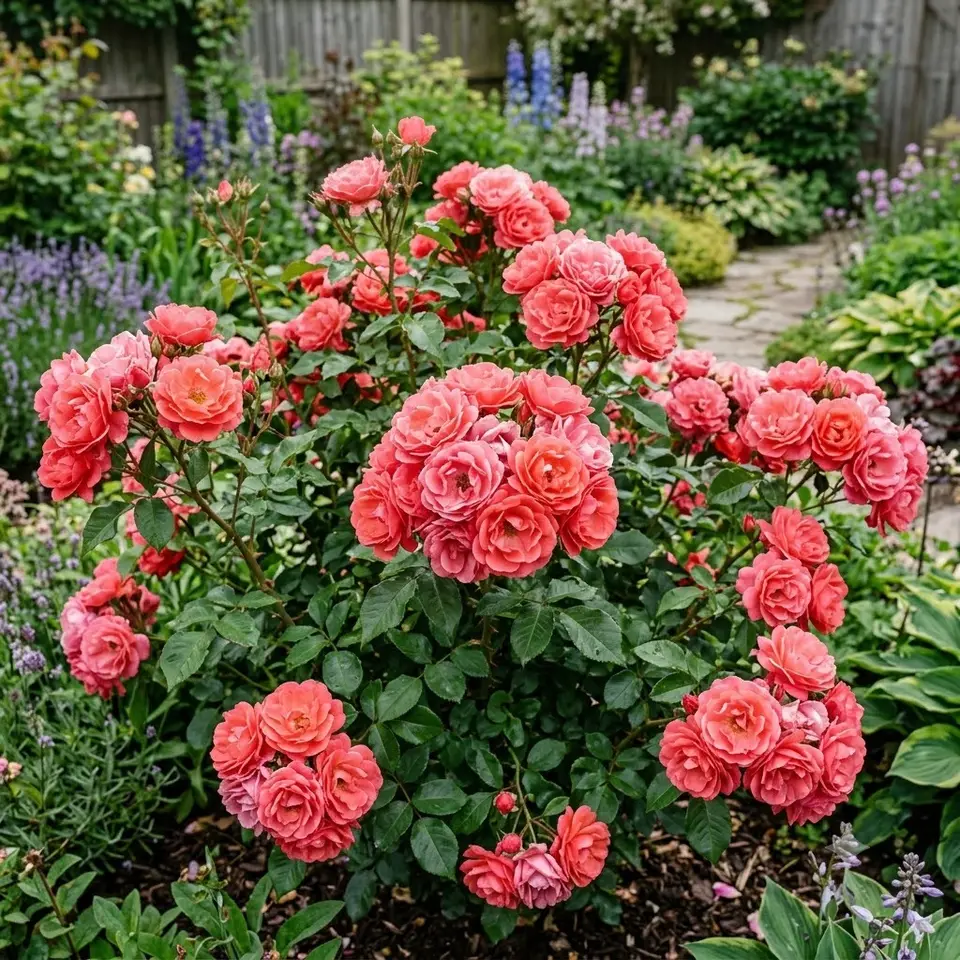
Floribunda roses carry their flowers in clusters, with several blooms open on one stem at the same time, and they keep flowering from summer into late autumn.
Last reviewed: October 2026
 AI illustration
 Overview
Floribunda roses carry their flowers in clusters, with several blooms open on one stem at the same time, and they keep flowering from summer into late autumn. The name is Latin for "many-flowering". The class was bred by crossing hybrid teas with polyanthas, low roses that bear large clusters of small blooms, and in Britain the RHS calls floribundas cluster-flowered bush roses. (Rosa: floribunda class.)
Origin & Natural Habitat
The class has no wild habitat: it is a modern cultivar group made by rose breeders. Danish breeders of the Poulsen family crossed polyanthas with hybrid teas early in the 20th century, and their 'Else Poulsen' followed in 1924; such roses were first sold as hybrid polyanthas or Poulsen roses. The word "floribunda" was coined in 1930 by Dr. Nicolas, a hybridizer at the American firm Jackson & Perkins. The American Rose Society, which has kept the international register of rose names since 1955, defines the class by its ability to have more than one bloom open at a time in large clusters or trusses.
Appearance
A typical floribunda is a stiff, bushy shrub, smaller than most hybrid teas and more compact than most polyanthas. Purdue Extension describes clusters of single to fully double flowers that resemble small hybrid teas, on plants that usually stay at or below 4 feet. The University of Georgia notes small to medium-size flowers on medium-length stems, and the RHS describes dark, glossy foliage. The class covers every hybrid tea color.
Why People Grow It - Qualities & Benefits
- More than one bloom open at a time in each cluster, which the American Rose Society credits with long-lasting garden displays
- The RHS notes that floribundas tend to repeat continuously from summer to late autumn, while hybrid teas come in three flushes
- The American Rose Society calls the class hardier and easier to care for than hybrid teas
- A height that Purdue puts at 4 feet or less suits beds and park plantings
Care
Light: Full sun; Purdue Extension says roses grow satisfactorily with 6 hours of sun a day. Purdue prefers early morning sun to afternoon sun, because it gives the foliage a chance to dry early in the day.
Water: Purdue gives bedding roses about 1 inch of water every 7 to 10 days. Water in the morning or early afternoon so the foliage dries quickly; soaker hoses and drip irrigation, which never wet the leaves, are the methods Purdue prefers.
Soil & Feeding: Good drainage matters most, according to Purdue Extension; on heavy clay it mixes 1 part organic matter such as compost with 2 parts garden soil. Our rose care guide has the feeding routine.
Temperature & Hardiness: Hardiness depends on the variety. The American Rose Society rates floribundas as a class hardier than hybrid teas. Among the floribundas profiled here, Weeks Roses lists Iceberg for USDA zones 4b-9b and Julia Child for 6b-9b.
Pruning & Maintenance: The RHS prunes in late winter as growth resumes, usually mid-February in the south of England and March in colder areas. Floribundas are its pruning group 16: cut the strongest shoots to within 25-30 cm (10 in-1 ft) of soil level, prune weaker shoots harder, and now and then take an old stem down to a few inches to force strong growth from the base. Stems stay longer than on a hybrid tea so they carry more buds for the next clusters.
Planting & Propagation
Most floribundas are sold grafted onto a rootstock, Purdue Extension notes, and some, 'Iceberg' and 'Julia Child' among them, are also offered on their own roots by Weeks Roses. Purdue spaces floribundas 18 to 24 inches apart, a little closer than the 24 to 30 inches it gives hybrid teas and grandifloras, and in Indiana sets the bud union 1 to 2 inches below ground level.
Common Problems & Pests
- Powdery mildew: Purdue Extension lists floribundas among the roses it attacks and advises against crowded, damp or shady spots
- Thrips, spider mites and aphids, which the University of Georgia names as the most common rose insects
- Leaves that stay wet: good air movement dries dew and rain quickly, which UGA says discourages disease
Toxicity & Safety
Roses are non-toxic to dogs and cats - the thorns are the only hazard.
Pros & Cons
Pros
- Many blooms per stem
- Repeat flowering from summer to late autumn
- Usually 4 feet or shorter, easy to fit into beds
Cons
- Flowers are often smaller than hybrid tea blooms
- Scent varies; the RHS describes the group as sometimes fragrant
- Medium-length stems, shorter than the long stems of hybrid teas
Best Suited For
- Bedding schemes in public parks and large gardens
- Landscape plantings that need masses of color
- Mixed borders that need color into late autumn
- Cut flowers, a use Purdue lists for the class
FAQ
How is a floribunda different from a hybrid tea?
The RHS tells them apart by flowering habit: a hybrid tea usually has one flower per stem and flowers in three flushes, while a floribunda has many flowers per stem and repeats more or less continuously from summer to late autumn. The American Rose Society puts the hybrid tea's bloom cycle at every six to seven weeks.
Which floribundas have their own profile here?
Two classics: Iceberg, a white floribunda bred by Reimer Kordes and introduced in 1958, and Julia Child, a golden-yellow floribunda bred by Tom Carruth and introduced by Weeks Roses in 2006. The University of Georgia's list of floribundas for Georgia gardens adds 'Angel Face', 'Apricot Nectar', 'Gene Boerner' and 'Sunsprite'.
Gear for growing floribunda roses
Links go to Amazon or a partner store (such as Adagio Teas) and may earn us a commission at no extra cost to you. As an Amazon Associate we earn from qualifying purchases. We link gear types, not sponsors' picks: you choose the exact product.